

41
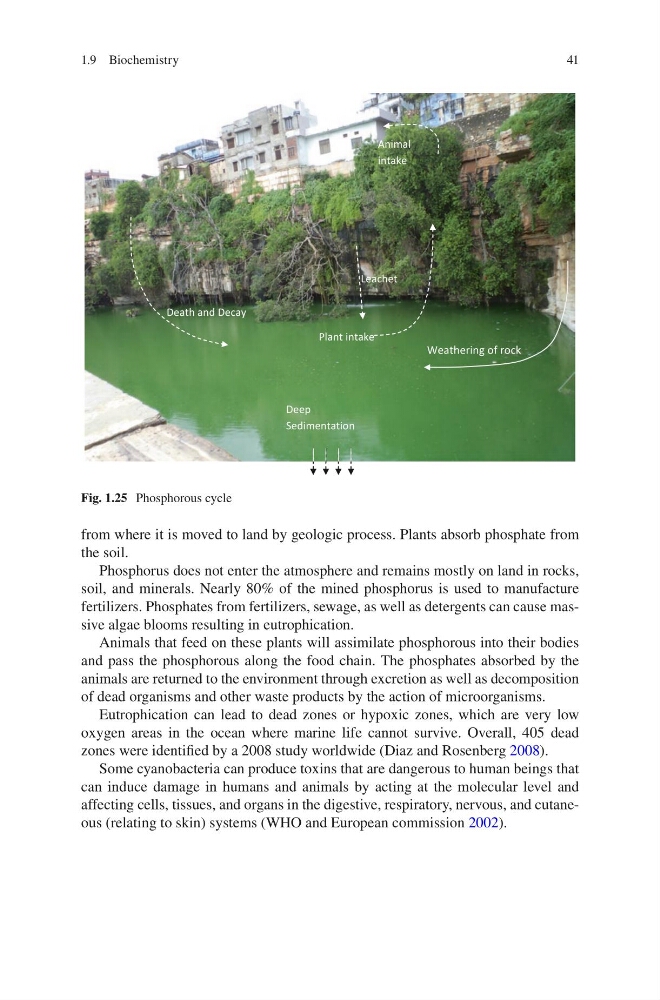
from where it is moved to land by geologic process. Plants absorb phosphate from
the soil.
Phosphorus does not enter the atmosphere and remains mostly on land in rocks,
soil, and minerals. Nearly 80% of the mined phosphorus is used to manufacture
fertilizers. Phosphates from fertilizers, sewage, as well as detergents can cause massive algae blooms resulting in eutrophication.
Animals that feed on these plants will assimilate phosphorous into their bodies
and pass the phosphorous along the food chain. The phosphates absorbed by the
animals are returned to the environment through excretion as well as decomposition
of dead organisms and other waste products by the action of microorganisms.
Eutrophication can lead to dead zones or hypoxic zones, which are very low
oxygen areas in the ocean where marine life cannot survive. Overall, 405 dead
zones were identified by a 2008 study worldwide (Diaz and Rosenberg 2008).
Some cyanobacteria can produce toxins that are dangerous to human beings that
can induce damage in humans and animals by acting at the molecular level and
affecting cells, tissues, and organs in the digestive, respiratory, nervous, and cutaneous (relating to skin) systems (WHO and European commission 2002).
Plant intake
Animal
intake
Death and Decay
Leachet
Deep
Sedimentation
Weathering of rock
Fig. 1.25 Phosphorous cycle
1.9 Biochemistry
from where it is moved to land by geologic process. Plants absorb phosphate from
the soil.
Phosphorus does not enter the atmosphere and remains mostly on land in rocks,
soil, and minerals. Nearly 80% of the mined phosphorus is used to manufacture
fertilizers. Phosphates from fertilizers, sewage, as well as detergents can cause massive algae blooms resulting in eutrophication.
Animals that feed on these plants will assimilate phosphorous into their bodies
and pass the phosphorous along the food chain. The phosphates absorbed by the
animals are returned to the environment through excretion as well as decomposition
of dead organisms and other waste products by the action of microorganisms.
Eutrophication can lead to dead zones or hypoxic zones, which are very low
oxygen areas in the ocean where marine life cannot survive. Overall, 405 dead
zones were identified by a 2008 study worldwide (Diaz and Rosenberg 2008).
Some cyanobacteria can produce toxins that are dangerous to human beings that
can induce damage in humans and animals by acting at the molecular level and
affecting cells, tissues, and organs in the digestive, respiratory, nervous, and cutaneous (relating to skin) systems (WHO and European commission 2002).
Plant intake
Animal
intake
Death and Decay
Leachet
Deep
Sedimentation
Weathering of rock
Fig. 1.25 Phosphorous cycle
1.9 Biochemistry