

6
The matter is made up of pure and impure substances. Pure substances are made
up of only one type of atom or molecule whereas the impure substances contain
more than a single type of atom or molecule.
As of 2019, there are 118 elements that have been identified, of which 98 occur
naturally and the remaining 20 being synthetic elements.
Actual mass of hydrogen is found to be 1.673 × 10
−24
g, which is extremely
small. It is found to be easy to compare the masses of different atoms with some
reference atom.
Moles are used in chemical/environmental engineering process by using concept
of molar flow rate, which is the number of moles of a solution that passes a fixed
point per unit time. Molar flow rates are useful because using moles instead of mass
allows writing material balances in terms of reaction conversion as well as
stoichiometry.
The molecular weight of a compound is the summation of the atomic weights of
the atoms that form a molecule of the compound; for example, atomic oxygen (O)
has an atomic weight of 16 and hence molecular oxygen (O 2 ) has a molecular weight
of 32. A gram-mole (g-mole or mol in SI units) of a species is the quantity of that
species whose mass in grams is numerically equal to its molecular weight. Hence,
one mole of oxygen is 32 g.
Figure 1.2 shows a typical reactor in an industry. Engineers are often interested
in reactions between large quantities of chemicals. Hence, kg-moles, lb-moles, and
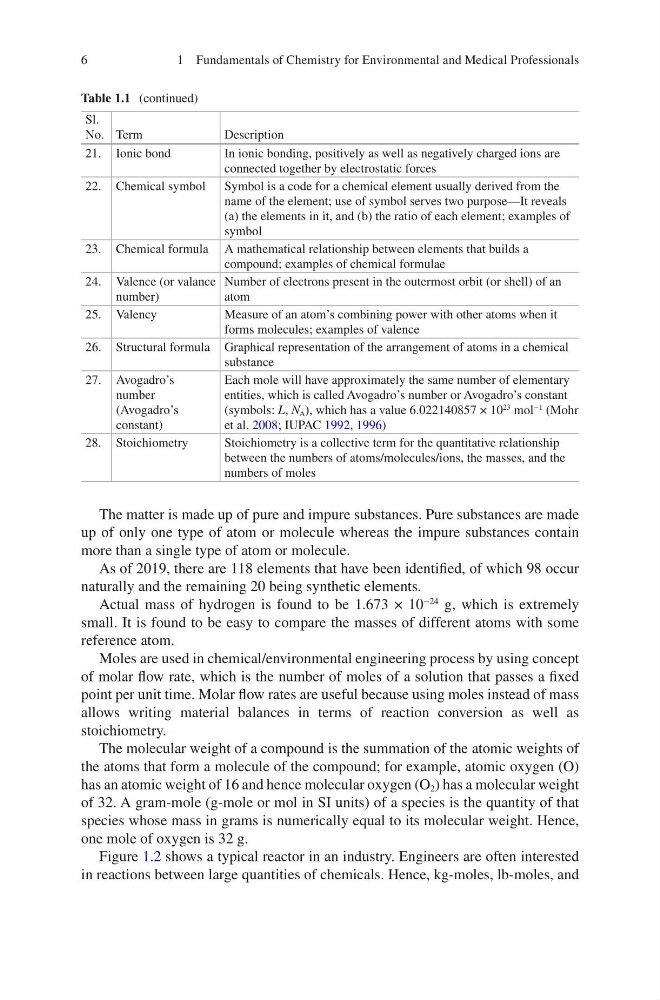
Table 1.1 (continued)
Sl.
No. Term
Description
21. Ionic bond
In ionic bonding, positively as well as negatively charged ions are
connected together by electrostatic forces
22. Chemical symbol Symbol is a code for a chemical element usually derived from the
name of the element; use of symbol serves two purpose—It reveals
(a) the elements in it, and (b) the ratio of each element; examples of
symbol
23. Chemical formula A mathematical relationship between elements that builds a
compound; examples of chemical formulae
24. Valence (or valance
number)
Number of electrons present in the outermost orbit (or shell) of an
atom
25. Valency
Measure of an atom’s combining power with other atoms when it
forms molecules; examples of valence
26. Structural formula Graphical representation of the arrangement of atoms in a chemical
substance
27. Avogadro’s
number
(Avogadro’s
constant)
Each mole will have approximately the same number of elementary
entities, which is called Avogadro’s number or Avogadro’s constant
(symbols: L, N A ), which has a value 6.022140857 × 10
23 mol
−1 (Mohr
et al. 2008; IUPAC 1992, 1996)
28. Stoichiometry
Stoichiometry is a collective term for the quantitative relationship
between the numbers of atoms/molecules/ions, the masses, and the
numbers of moles
1 Fundamentals of Chemistry for Environmental and Medical Professionals
The matter is made up of pure and impure substances. Pure substances are made
up of only one type of atom or molecule whereas the impure substances contain
more than a single type of atom or molecule.
As of 2019, there are 118 elements that have been identified, of which 98 occur
naturally and the remaining 20 being synthetic elements.
Actual mass of hydrogen is found to be 1.673 × 10
−24
g, which is extremely
small. It is found to be easy to compare the masses of different atoms with some
reference atom.
Moles are used in chemical/environmental engineering process by using concept
of molar flow rate, which is the number of moles of a solution that passes a fixed
point per unit time. Molar flow rates are useful because using moles instead of mass
allows writing material balances in terms of reaction conversion as well as
stoichiometry.
The molecular weight of a compound is the summation of the atomic weights of
the atoms that form a molecule of the compound; for example, atomic oxygen (O)
has an atomic weight of 16 and hence molecular oxygen (O 2 ) has a molecular weight
of 32. A gram-mole (g-mole or mol in SI units) of a species is the quantity of that
species whose mass in grams is numerically equal to its molecular weight. Hence,
one mole of oxygen is 32 g.
Figure 1.2 shows a typical reactor in an industry. Engineers are often interested
in reactions between large quantities of chemicals. Hence, kg-moles, lb-moles, and
Table 1.1 (continued)
Sl.
No. Term
Description
21. Ionic bond
In ionic bonding, positively as well as negatively charged ions are
connected together by electrostatic forces
22. Chemical symbol Symbol is a code for a chemical element usually derived from the
name of the element; use of symbol serves two purpose—It reveals
(a) the elements in it, and (b) the ratio of each element; examples of
symbol
23. Chemical formula A mathematical relationship between elements that builds a
compound; examples of chemical formulae
24. Valence (or valance
number)
Number of electrons present in the outermost orbit (or shell) of an
atom
25. Valency
Measure of an atom’s combining power with other atoms when it
forms molecules; examples of valence
26. Structural formula Graphical representation of the arrangement of atoms in a chemical
substance
27. Avogadro’s
number
(Avogadro’s
constant)
Each mole will have approximately the same number of elementary
entities, which is called Avogadro’s number or Avogadro’s constant
(symbols: L, N A ), which has a value 6.022140857 × 10
23 mol
−1 (Mohr
et al. 2008; IUPAC 1992, 1996)
28. Stoichiometry
Stoichiometry is a collective term for the quantitative relationship
between the numbers of atoms/molecules/ions, the masses, and the
numbers of moles
1 Fundamentals of Chemistry for Environmental and Medical Professionals