

5
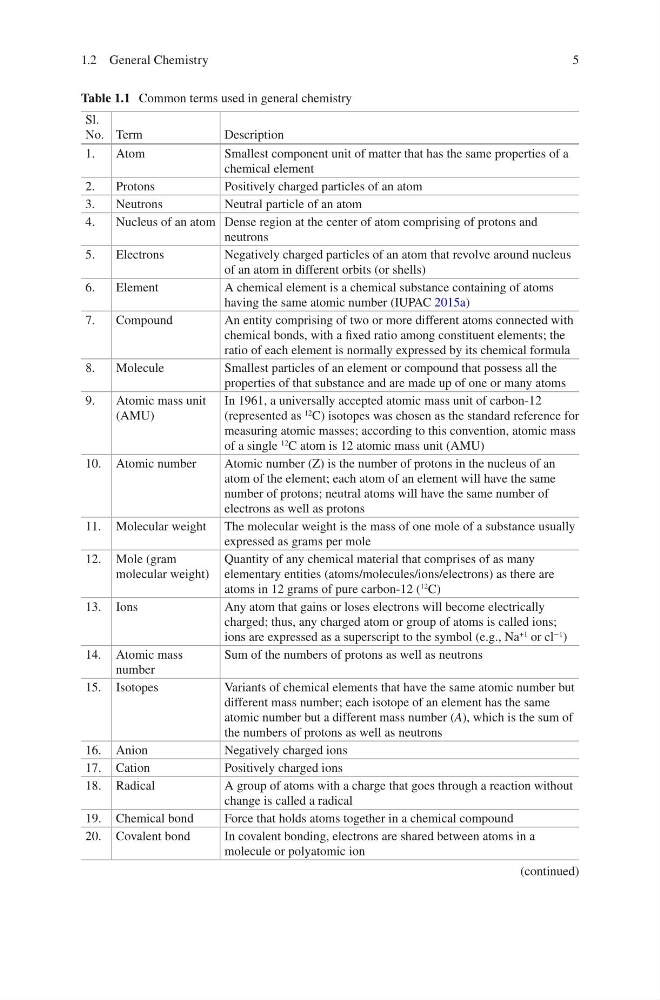
Table 1.1 Common terms used in general chemistry
Sl.
No. Term
Description
1.
Atom
Smallest component unit of matter that has the same properties of a
chemical element
2.
Protons
Positively charged particles of an atom
3.
Neutrons
Neutral particle of an atom
4.
Nucleus of an atom Dense region at the center of atom comprising of protons and
neutrons
5.
Electrons
Negatively charged particles of an atom that revolve around nucleus
of an atom in different orbits (or shells)
6.
Element
A chemical element is a chemical substance containing of atoms
having the same atomic number (IUPAC 2015a)
7.
Compound
An entity comprising of two or more different atoms connected with
chemical bonds, with a fixed ratio among constituent elements; the
ratio of each element is normally expressed by its chemical formula
8.
Molecule
Smallest particles of an element or compound that possess all the
properties of that substance and are made up of one or many atoms
9.
Atomic mass unit
(AMU)
In 1961, a universally accepted atomic mass unit of carbon-12
(represented as
12 C) isotopes was chosen as the standard reference for
measuring atomic masses; according to this convention, atomic mass
of a single
12 C atom is 12 atomic mass unit (AMU)
10. Atomic number
Atomic number (Z) is the number of protons in the nucleus of an
atom of the element; each atom of an element will have the same
number of protons; neutral atoms will have the same number of
electrons as well as protons
11. Molecular weight The molecular weight is the mass of one mole of a substance usually
expressed as grams per mole
12. Mole (gram
molecular weight)
Quantity of any chemical material that comprises of as many
elementary entities (atoms/molecules/ions/electrons) as there are
atoms in 12 grams of pure carbon-12 (
12
C)
13. Ions
Any atom that gains or loses electrons will become electrically
charged; thus, any charged atom or group of atoms is called ions;
ions are expressed as a superscript to the symbol (e.g., Na
+1 or cl
−1
)
14. Atomic mass
number
Sum of the numbers of protons as well as neutrons
15. Isotopes
Variants of chemical elements that have the same atomic number but
different mass number; each isotope of an element has the same
atomic number but a different mass number (A), which is the sum of
the numbers of protons as well as neutrons
16. Anion
Negatively charged ions
17. Cation
Positively charged ions
18. Radical
A group of atoms with a charge that goes through a reaction without
change is called a radical
19. Chemical bond
Force that holds atoms together in a chemical compound
20. Covalent bond
In covalent bonding, electrons are shared between atoms in a
molecule or polyatomic ion
(continued)
1.2 General Chemistry
Table 1.1 Common terms used in general chemistry
Sl.
No. Term
Description
1.
Atom
Smallest component unit of matter that has the same properties of a
chemical element
2.
Protons
Positively charged particles of an atom
3.
Neutrons
Neutral particle of an atom
4.
Nucleus of an atom Dense region at the center of atom comprising of protons and
neutrons
5.
Electrons
Negatively charged particles of an atom that revolve around nucleus
of an atom in different orbits (or shells)
6.
Element
A chemical element is a chemical substance containing of atoms
having the same atomic number (IUPAC 2015a)
7.
Compound
An entity comprising of two or more different atoms connected with
chemical bonds, with a fixed ratio among constituent elements; the
ratio of each element is normally expressed by its chemical formula
8.
Molecule
Smallest particles of an element or compound that possess all the
properties of that substance and are made up of one or many atoms
9.
Atomic mass unit
(AMU)
In 1961, a universally accepted atomic mass unit of carbon-12
(represented as
12 C) isotopes was chosen as the standard reference for
measuring atomic masses; according to this convention, atomic mass
of a single
12 C atom is 12 atomic mass unit (AMU)
10. Atomic number
Atomic number (Z) is the number of protons in the nucleus of an
atom of the element; each atom of an element will have the same
number of protons; neutral atoms will have the same number of
electrons as well as protons
11. Molecular weight The molecular weight is the mass of one mole of a substance usually
expressed as grams per mole
12. Mole (gram
molecular weight)
Quantity of any chemical material that comprises of as many
elementary entities (atoms/molecules/ions/electrons) as there are
atoms in 12 grams of pure carbon-12 (
12
C)
13. Ions
Any atom that gains or loses electrons will become electrically
charged; thus, any charged atom or group of atoms is called ions;
ions are expressed as a superscript to the symbol (e.g., Na
+1 or cl
−1
)
14. Atomic mass
number
Sum of the numbers of protons as well as neutrons
15. Isotopes
Variants of chemical elements that have the same atomic number but
different mass number; each isotope of an element has the same
atomic number but a different mass number (A), which is the sum of
the numbers of protons as well as neutrons
16. Anion
Negatively charged ions
17. Cation
Positively charged ions
18. Radical
A group of atoms with a charge that goes through a reaction without
change is called a radical
19. Chemical bond
Force that holds atoms together in a chemical compound
20. Covalent bond
In covalent bonding, electrons are shared between atoms in a
molecule or polyatomic ion
(continued)
1.2 General Chemistry