

4
environment is an oxidant-driven system compared to indoor environments where
gas-phase oxidant concentrations are relatively low (Abbatt and Wang 2020).
The changes in the environment could be slow due to release of pollutants or
sudden as in case of gas leakage or bomb blast. Furthermore, the earth is a continuous reactor where millions of reactions happen at a time and so is our body where
at least a few hundreds of reactions keep happening without our knowledge. We do
not have the complete control on the biochemical reactions in our body that are
directly linked to our environment. With better understanding of chemistry, the concerned experts on both environmental health and medical sciences can provide wellinformed advice to decision makers on how to take precautionary measures or
corrective actions to safeguard the public health to the maximum extent possible.
1.2 General Chemistry
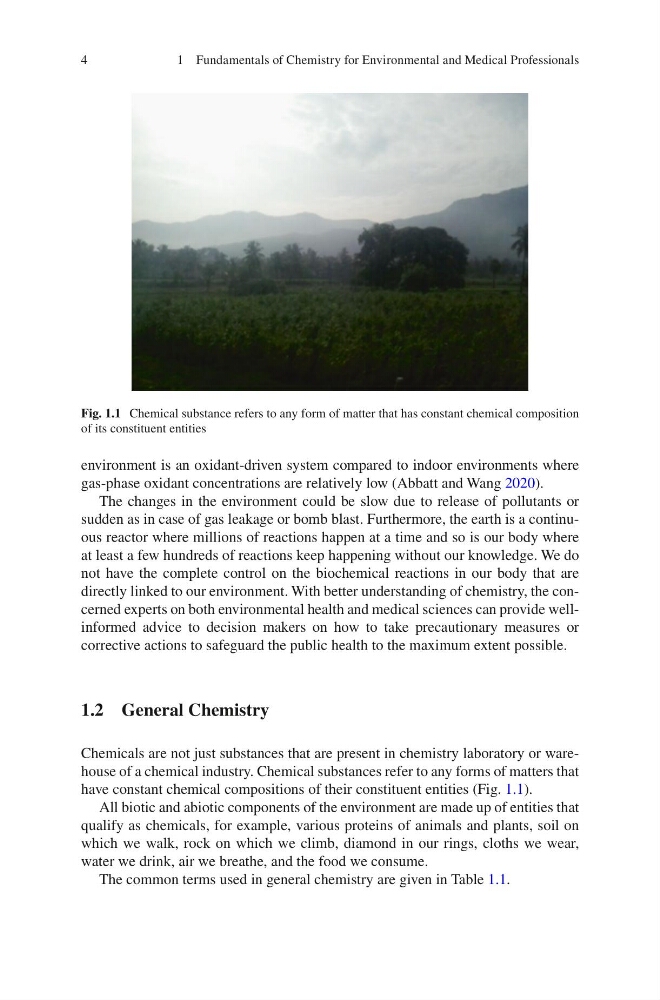
Chemicals are not just substances that are present in chemistry laboratory or warehouse of a chemical industry. Chemical substances refer to any forms of matters that
have constant chemical compositions of their constituent entities (Fig. 1.1).
All biotic and abiotic components of the environment are made up of entities that
qualify as chemicals, for example, various proteins of animals and plants, soil on
which we walk, rock on which we climb, diamond in our rings, cloths we wear,
water we drink, air we breathe, and the food we consume.
The common terms used in general chemistry are given in Table 1.1.
Fig. 1.1 Chemical substance refers to any form of matter that has constant chemical composition
of its constituent entities
1 Fundamentals of Chemistry for Environmental and Medical Professionals
environment is an oxidant-driven system compared to indoor environments where
gas-phase oxidant concentrations are relatively low (Abbatt and Wang 2020).
The changes in the environment could be slow due to release of pollutants or
sudden as in case of gas leakage or bomb blast. Furthermore, the earth is a continuous reactor where millions of reactions happen at a time and so is our body where
at least a few hundreds of reactions keep happening without our knowledge. We do
not have the complete control on the biochemical reactions in our body that are
directly linked to our environment. With better understanding of chemistry, the concerned experts on both environmental health and medical sciences can provide wellinformed advice to decision makers on how to take precautionary measures or
corrective actions to safeguard the public health to the maximum extent possible.
1.2 General Chemistry
Chemicals are not just substances that are present in chemistry laboratory or warehouse of a chemical industry. Chemical substances refer to any forms of matters that
have constant chemical compositions of their constituent entities (Fig. 1.1).
All biotic and abiotic components of the environment are made up of entities that
qualify as chemicals, for example, various proteins of animals and plants, soil on
which we walk, rock on which we climb, diamond in our rings, cloths we wear,
water we drink, air we breathe, and the food we consume.
The common terms used in general chemistry are given in Table 1.1.
Fig. 1.1 Chemical substance refers to any form of matter that has constant chemical composition
of its constituent entities
1 Fundamentals of Chemistry for Environmental and Medical Professionals