

222
Escherichia coli and enterococci that are indicator microbes have been found in
sea water. Microbial contamination by viruses, bacteria, parasites, and other organisms in sea is a global problem due to sewage and contaminated runoff exposing
humans to microbial contamination through occupational and recreational exposure
apart from consuming contaminated seafood. Seafood was responsible for outbreaks
of food poisoning in Japan (22%) and Korea (32%) from 1971 to 1990 (Lee et al.
1996b; Chan 1995).
Bacteria belonging to Vibrio species are natural inhabitants in oceans. Pathogenic
marine Vibrio species, such as Vibrio parahaemolyticus, Vibrio cholerae, and Vibrio
vulnificus, cause sickness when they are ingested in sea food (Lee et al. 1996a;
Matte et al. 1994).
Coastal areas are susceptible to pollution carried by streams as well as rivers,
which includes agricultural runoff. Several epidemiologic studies revealed bathing
in contaminated recreational water has been associated with transmission of communicable diseases, such as eye and ear infections, gastroenteritis, skin infections,
and febrile respiratory illness (Fleming et al. 2006).
Pollution and degradation of costal environment can result in decline in the natural carrying capacity of the coastal area apart from decline in coastal biodiversity.
Some coastal communities dump solid waste that can leach pollutants along with
leach from septic tanks (Fig. 6.2).
Apart from land-based sources of pollution other sources of pollution come from
shipping, offshore mining, and oil production. Resource depletion biodiversity
reduction and problems related to human health may arise from tourism (Clark 1992).
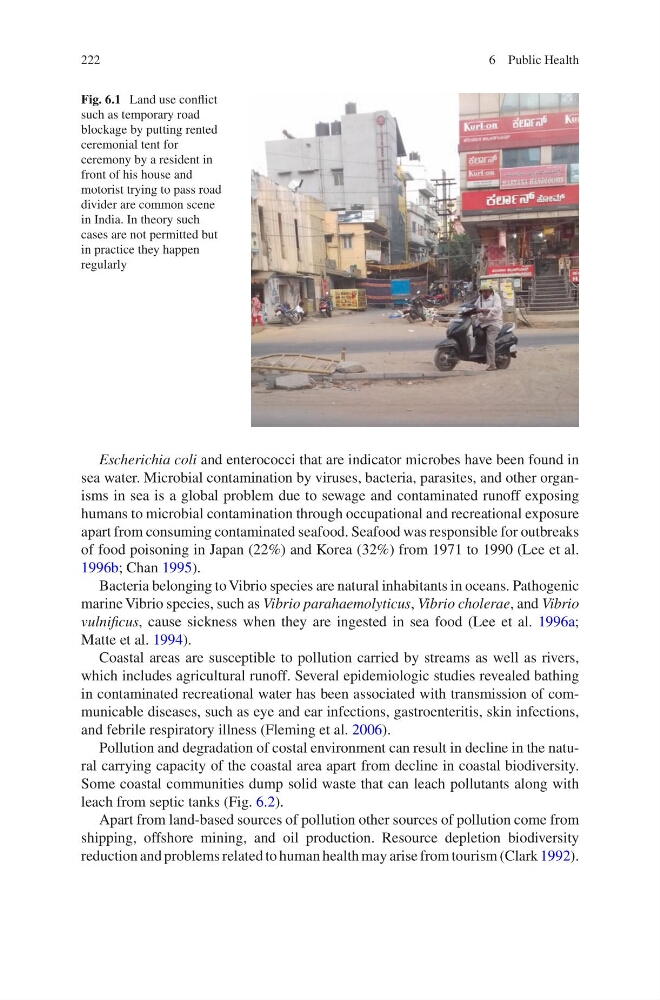
Fig. 6.1 Land use conflict
such as temporary road
blockage by putting rented
ceremonial tent for
ceremony by a resident in
front of his house and
motorist trying to pass road
divider are common scene
in India. In theory such
cases are not permitted but
in practice they happen
regularly
6 Public Health
Escherichia coli and enterococci that are indicator microbes have been found in
sea water. Microbial contamination by viruses, bacteria, parasites, and other organisms in sea is a global problem due to sewage and contaminated runoff exposing
humans to microbial contamination through occupational and recreational exposure
apart from consuming contaminated seafood. Seafood was responsible for outbreaks
of food poisoning in Japan (22%) and Korea (32%) from 1971 to 1990 (Lee et al.
1996b; Chan 1995).
Bacteria belonging to Vibrio species are natural inhabitants in oceans. Pathogenic
marine Vibrio species, such as Vibrio parahaemolyticus, Vibrio cholerae, and Vibrio
vulnificus, cause sickness when they are ingested in sea food (Lee et al. 1996a;
Matte et al. 1994).
Coastal areas are susceptible to pollution carried by streams as well as rivers,
which includes agricultural runoff. Several epidemiologic studies revealed bathing
in contaminated recreational water has been associated with transmission of communicable diseases, such as eye and ear infections, gastroenteritis, skin infections,
and febrile respiratory illness (Fleming et al. 2006).
Pollution and degradation of costal environment can result in decline in the natural carrying capacity of the coastal area apart from decline in coastal biodiversity.
Some coastal communities dump solid waste that can leach pollutants along with
leach from septic tanks (Fig. 6.2).
Apart from land-based sources of pollution other sources of pollution come from
shipping, offshore mining, and oil production. Resource depletion biodiversity
reduction and problems related to human health may arise from tourism (Clark 1992).
Fig. 6.1 Land use conflict
such as temporary road
blockage by putting rented
ceremonial tent for
ceremony by a resident in
front of his house and
motorist trying to pass road
divider are common scene
in India. In theory such
cases are not permitted but
in practice they happen
regularly
6 Public Health