

181
5.5 Pathology
Pathology is a branch of medical science concerning the cause, origin as well as the
nature of disease. It deals with the study of structural and functional alteration
within the body connected with diseases. It involves the examination of organs, tissues, bodily fluids as well as autopsies in order to study as well as diagnose disease.
Clinical pathology is a branch of medical science concerned with the diagnosis
of ailment based on the analysis of body fluid in laboratory. Environmental pathology is the study of ailment caused by exposure to external agents. A number of
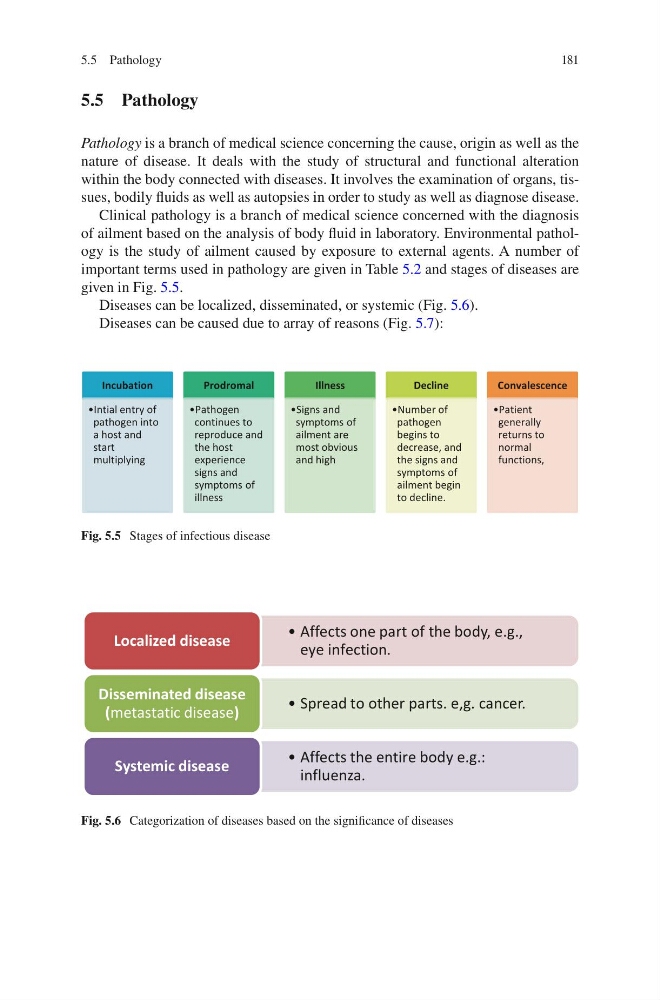
important terms used in pathology are given in Table 5.2 and stages of diseases are
given in Fig. 5.5.
Diseases can be localized, disseminated, or systemic (Fig. 5.6).
Diseases can be caused due to array of reasons (Fig. 5.7):
Incubation
•Intial entry of
pathogen into
a host and
start
multiplying
Prodromal
•Pathogen
continues to
reproduce and
the host
experience
signs and
symptoms of
illness
Illness
•Signs and
symptoms of
ailment are
most obvious
and high
Decline
•Number of
pathogen
begins to
decrease, and
the signs and
symptoms of
ailment begin
to decline.
Convalescence
•Patient
generally
returns to
normal
functions,
Fig. 5.5 Stages of infectious disease
• Affects one part of the body, e.g.,
eye infection.
Localized disease
• Spread to other parts. e,g. cancer.
Disseminated disease
(metastatic disease)
• Affects the entire body e.g.:
influenza.
Systemic disease
Fig. 5.6 Categorization of diseases based on the significance of diseases
5.5 Pathology
5.5 Pathology
Pathology is a branch of medical science concerning the cause, origin as well as the
nature of disease. It deals with the study of structural and functional alteration
within the body connected with diseases. It involves the examination of organs, tissues, bodily fluids as well as autopsies in order to study as well as diagnose disease.
Clinical pathology is a branch of medical science concerned with the diagnosis
of ailment based on the analysis of body fluid in laboratory. Environmental pathology is the study of ailment caused by exposure to external agents. A number of
important terms used in pathology are given in Table 5.2 and stages of diseases are
given in Fig. 5.5.
Diseases can be localized, disseminated, or systemic (Fig. 5.6).
Diseases can be caused due to array of reasons (Fig. 5.7):
Incubation
•Intial entry of
pathogen into
a host and
start
multiplying
Prodromal
•Pathogen
continues to
reproduce and
the host
experience
signs and
symptoms of
illness
Illness
•Signs and
symptoms of
ailment are
most obvious
and high
Decline
•Number of
pathogen
begins to
decrease, and
the signs and
symptoms of
ailment begin
to decline.
Convalescence
•Patient
generally
returns to
normal
functions,
Fig. 5.5 Stages of infectious disease
• Affects one part of the body, e.g.,
eye infection.
Localized disease
• Spread to other parts. e,g. cancer.
Disseminated disease
(metastatic disease)
• Affects the entire body e.g.:
influenza.
Systemic disease
Fig. 5.6 Categorization of diseases based on the significance of diseases
5.5 Pathology