

180
Toxicology and environmental science have close relationships. Natural
endocrine- disrupting chemicals (N-EDCs) and synthetic endocrine-disrupting
chemicals (S-EDCs) can interact with endocrine receptors and disturb hormonal
balance (Herman et al. 2020). Toxic substance can reach human body from several
sources. Study on microbial contaminants and heavy metal content of stale and
fresh tomatoes sold in selected markets in Nigeria showed presence of chromium,
copper, total heterotrophic bacteria, manganese, zinc, and total fungi (Izah and
Aigberua 2020). Studies on metallic contamination in the neighboring water system
and farmland from abandoned mines in Korea revealed pollution from Cd, As, and
Zn (Lee and Lee 2020).
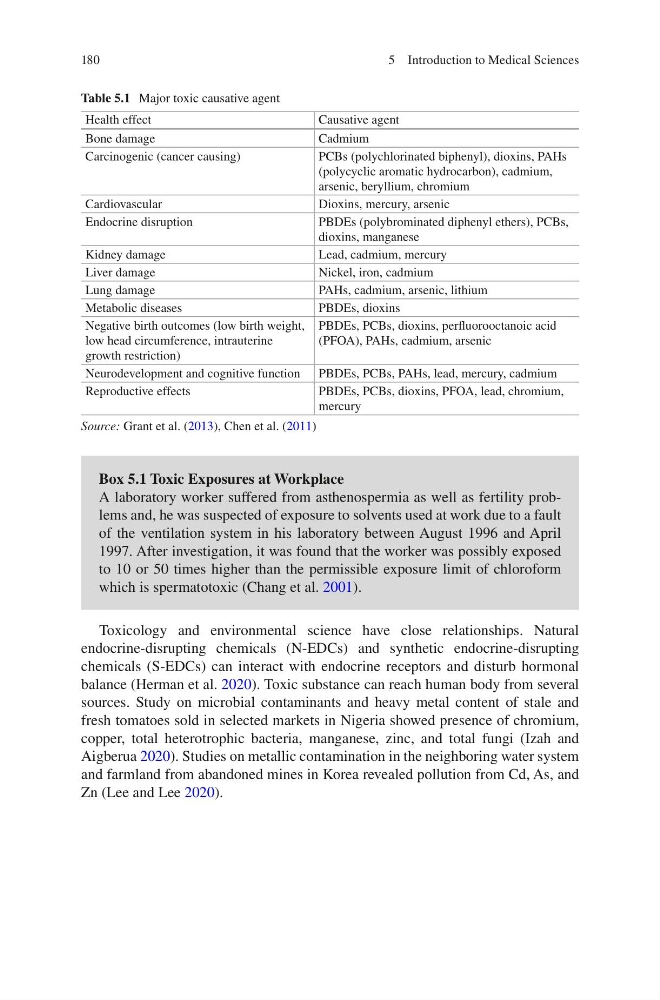
Table 5.1 Major toxic causative agent
Health effect
Causative agent
Bone damage
Cadmium
Carcinogenic (cancer causing)
PCBs (polychlorinated biphenyl), dioxins, PAHs
(polycyclic aromatic hydrocarbon), cadmium,
arsenic, beryllium, chromium
Cardiovascular
Dioxins, mercury, arsenic
Endocrine disruption
PBDEs (polybrominated diphenyl ethers), PCBs,
dioxins, manganese
Kidney damage
Lead, cadmium, mercury
Liver damage
Nickel, iron, cadmium
Lung damage
PAHs, cadmium, arsenic, lithium
Metabolic diseases
PBDEs, dioxins
Negative birth outcomes (low birth weight,
low head circumference, intrauterine
growth restriction)
PBDEs, PCBs, dioxins, perfluorooctanoic acid
(PFOA), PAHs, cadmium, arsenic
Neurodevelopment and cognitive function PBDEs, PCBs, PAHs, lead, mercury, cadmium
Reproductive effects
PBDEs, PCBs, dioxins, PFOA, lead, chromium,
mercury
Source: Grant et al. (2013), Chen et al. (2011)
Box 5.1 Toxic Exposures at Workplace
A laboratory worker suffered from asthenospermia as well as fertility problems and, he was suspected of exposure to solvents used at work due to a fault
of the ventilation system in his laboratory between August 1996 and April
1997. After investigation, it was found that the worker was possibly exposed
to 10 or 50 times higher than the permissible exposure limit of chloroform
which is spermatotoxic (Chang et al. 2001).
5 Introduction to Medical Sciences
Toxicology and environmental science have close relationships. Natural
endocrine- disrupting chemicals (N-EDCs) and synthetic endocrine-disrupting
chemicals (S-EDCs) can interact with endocrine receptors and disturb hormonal
balance (Herman et al. 2020). Toxic substance can reach human body from several
sources. Study on microbial contaminants and heavy metal content of stale and
fresh tomatoes sold in selected markets in Nigeria showed presence of chromium,
copper, total heterotrophic bacteria, manganese, zinc, and total fungi (Izah and
Aigberua 2020). Studies on metallic contamination in the neighboring water system
and farmland from abandoned mines in Korea revealed pollution from Cd, As, and
Zn (Lee and Lee 2020).
Table 5.1 Major toxic causative agent
Health effect
Causative agent
Bone damage
Cadmium
Carcinogenic (cancer causing)
PCBs (polychlorinated biphenyl), dioxins, PAHs
(polycyclic aromatic hydrocarbon), cadmium,
arsenic, beryllium, chromium
Cardiovascular
Dioxins, mercury, arsenic
Endocrine disruption
PBDEs (polybrominated diphenyl ethers), PCBs,
dioxins, manganese
Kidney damage
Lead, cadmium, mercury
Liver damage
Nickel, iron, cadmium
Lung damage
PAHs, cadmium, arsenic, lithium
Metabolic diseases
PBDEs, dioxins
Negative birth outcomes (low birth weight,
low head circumference, intrauterine
growth restriction)
PBDEs, PCBs, dioxins, perfluorooctanoic acid
(PFOA), PAHs, cadmium, arsenic
Neurodevelopment and cognitive function PBDEs, PCBs, PAHs, lead, mercury, cadmium
Reproductive effects
PBDEs, PCBs, dioxins, PFOA, lead, chromium,
mercury
Source: Grant et al. (2013), Chen et al. (2011)
Box 5.1 Toxic Exposures at Workplace
A laboratory worker suffered from asthenospermia as well as fertility problems and, he was suspected of exposure to solvents used at work due to a fault
of the ventilation system in his laboratory between August 1996 and April
1997. After investigation, it was found that the worker was possibly exposed
to 10 or 50 times higher than the permissible exposure limit of chloroform
which is spermatotoxic (Chang et al. 2001).
5 Introduction to Medical Sciences