

160
with mild anxiety and mild depression as common mental disorders (Balu
et al. 2016).
Modern health care facilities generate huge quantity of solid wastes (WHO
2018b). The health impact due to improper disposal of hospital wastes may not just
be restricted to health care personnel and people within the immediate vicinity. It
can go beyond the immediate vicinity if the contaminated syringes and waste cotton
are repacked and sold. The waste cotton may also be used to make toys or ear buds
resulting in spread of diseases. Selling expiry drugs to uneducated people would
also lead to deceases.
Apart from health issues, improper waste management can also lead to disasters.
Some of the major disasters due to improper waste disposal are listed in Table 4.4.
The solid waste management depends on socio-economic and cultural background of the society. In many parts of India, the chickens and cows are left stray to
feed on waste (Fig. 4.31), which becomes source of food (egg, milk, meat) for
humans. The waste bones from the zoos will be auctioned in many parts of the
world, which finds its way to become bone charcoal or bone powder.
Rapidly growing waste from meat shops and food waste have resulted in the
increase in street dog population. Apart from slaughtering in slaughterhouses as
well as meat shops, animals are also butchered at places of worship and individual
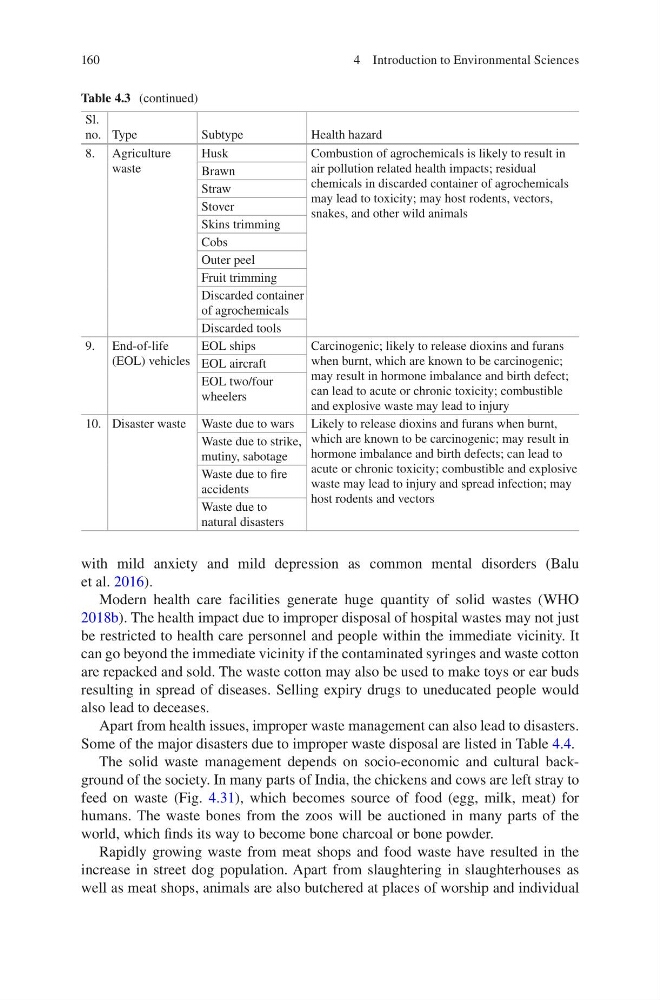
Table 4.3 (continued)
Sl.
no. Type
Subtype
Health hazard
8. Agriculture
waste
Husk
Combustion of agrochemicals is likely to result in
air pollution related health impacts; residual
chemicals in discarded container of agrochemicals
may lead to toxicity; may host rodents, vectors,
snakes, and other wild animals
Brawn
Straw
Stover
Skins trimming
Cobs
Outer peel
Fruit trimming
Discarded container
of agrochemicals
Discarded tools
9. End-of-life
(EOL) vehicles
EOL ships
Carcinogenic; likely to release dioxins and furans
when burnt, which are known to be carcinogenic;
may result in hormone imbalance and birth defect;
can lead to acute or chronic toxicity; combustible
and explosive waste may lead to injury
EOL aircraft
EOL two/four
wheelers
10. Disaster waste Waste due to wars Likely to release dioxins and furans when burnt,
which are known to be carcinogenic; may result in
hormone imbalance and birth defects; can lead to
acute or chronic toxicity; combustible and explosive
waste may lead to injury and spread infection; may
host rodents and vectors
Waste due to strike,
mutiny, sabotage
Waste due to fire
accidents
Waste due to
natural disasters
4 Introduction to Environmental Sciences
with mild anxiety and mild depression as common mental disorders (Balu
et al. 2016).
Modern health care facilities generate huge quantity of solid wastes (WHO
2018b). The health impact due to improper disposal of hospital wastes may not just
be restricted to health care personnel and people within the immediate vicinity. It
can go beyond the immediate vicinity if the contaminated syringes and waste cotton
are repacked and sold. The waste cotton may also be used to make toys or ear buds
resulting in spread of diseases. Selling expiry drugs to uneducated people would
also lead to deceases.
Apart from health issues, improper waste management can also lead to disasters.
Some of the major disasters due to improper waste disposal are listed in Table 4.4.
The solid waste management depends on socio-economic and cultural background of the society. In many parts of India, the chickens and cows are left stray to
feed on waste (Fig. 4.31), which becomes source of food (egg, milk, meat) for
humans. The waste bones from the zoos will be auctioned in many parts of the
world, which finds its way to become bone charcoal or bone powder.
Rapidly growing waste from meat shops and food waste have resulted in the
increase in street dog population. Apart from slaughtering in slaughterhouses as
well as meat shops, animals are also butchered at places of worship and individual
Table 4.3 (continued)
Sl.
no. Type
Subtype
Health hazard
8. Agriculture
waste
Husk
Combustion of agrochemicals is likely to result in
air pollution related health impacts; residual
chemicals in discarded container of agrochemicals
may lead to toxicity; may host rodents, vectors,
snakes, and other wild animals
Brawn
Straw
Stover
Skins trimming
Cobs
Outer peel
Fruit trimming
Discarded container
of agrochemicals
Discarded tools
9. End-of-life
(EOL) vehicles
EOL ships
Carcinogenic; likely to release dioxins and furans
when burnt, which are known to be carcinogenic;
may result in hormone imbalance and birth defect;
can lead to acute or chronic toxicity; combustible
and explosive waste may lead to injury
EOL aircraft
EOL two/four
wheelers
10. Disaster waste Waste due to wars Likely to release dioxins and furans when burnt,
which are known to be carcinogenic; may result in
hormone imbalance and birth defects; can lead to
acute or chronic toxicity; combustible and explosive
waste may lead to injury and spread infection; may
host rodents and vectors
Waste due to strike,
mutiny, sabotage
Waste due to fire
accidents
Waste due to
natural disasters
4 Introduction to Environmental Sciences