

161
residences generating wastes unscientifically. Apart from dog bite, indiscriminate
disposal of animal waste is also a leading cause of zoonosis. About 35 million stray
dogs live in India, with the biggest reason being open garbage (Singh 2018). Dog
bites are the major source of human infection (WHO 2012). In India alone, about
2.8 million people suffer from snake bite every year resulting in about 46,900 death
per year (WHO 2018c).
Figure 4.32 shows spillage and seepage during transportation of waste. Other
hazards due to waste processing are odors, heavy traffic, litter, noise, flies, as well
as birds.
Waste segregation plays an important role in solid waste management. But segregation may happen in crude and unsafe manner (Figs. 4.33, 4.34, and 4.35). While
some countries dump unsegregated wastes, other will segregate to maximum extent.
In the spring of 2001, six million cows, sheep, pigs, and goats were slaughtered
to control an outbreak of foot-and-mouth disease in the UK. The outbreak started on
Burnside farm, Northumberland, where uncooked food leftovers were fed to pigs.
As per the regulations, food wastes had to be cooked to sterilize to prevent disease
transfer (Erasmus 2018).
Feeding animals with food waste is practiced in many places of the world as
waste treatment process. A countrywide ban in China on food waste usage as pig
feed due to African swine fever epidemic resulted in use of cockroach in food waste
management (New York Post 2018). Termites can also be used for waste treatment
in order to produce hydrogen and for increasing the soil fertility (Hussein 2014).
In many parts of the world, waste management is not a priority and still done
crudely (Figs. 4.36, 4.37, and 4.38).
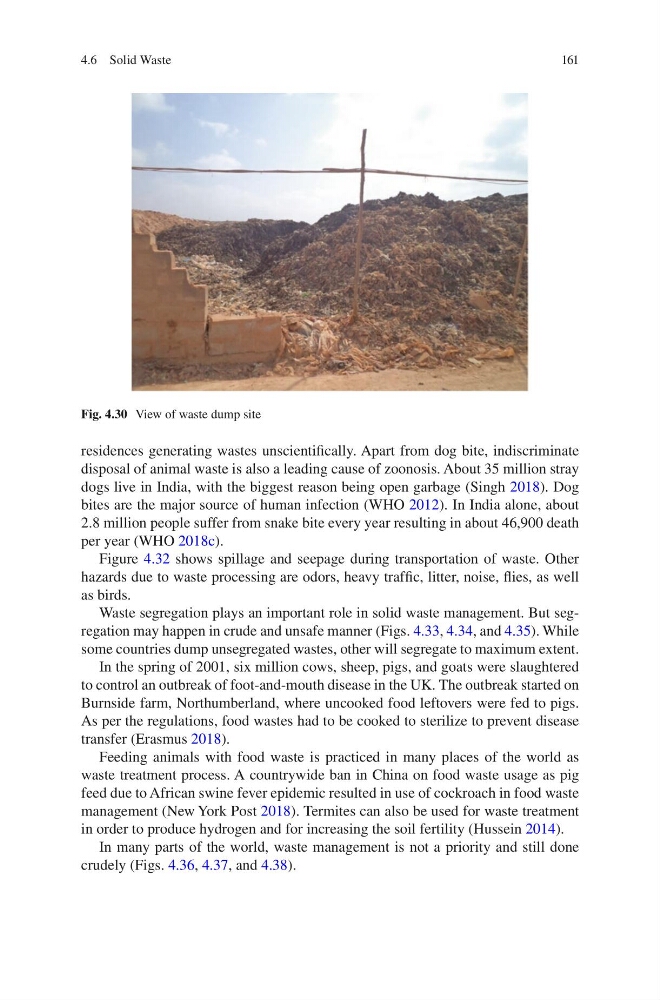
Fig. 4.30 View of waste dump site
4.6 Solid Waste
residences generating wastes unscientifically. Apart from dog bite, indiscriminate
disposal of animal waste is also a leading cause of zoonosis. About 35 million stray
dogs live in India, with the biggest reason being open garbage (Singh 2018). Dog
bites are the major source of human infection (WHO 2012). In India alone, about
2.8 million people suffer from snake bite every year resulting in about 46,900 death
per year (WHO 2018c).
Figure 4.32 shows spillage and seepage during transportation of waste. Other
hazards due to waste processing are odors, heavy traffic, litter, noise, flies, as well
as birds.
Waste segregation plays an important role in solid waste management. But segregation may happen in crude and unsafe manner (Figs. 4.33, 4.34, and 4.35). While
some countries dump unsegregated wastes, other will segregate to maximum extent.
In the spring of 2001, six million cows, sheep, pigs, and goats were slaughtered
to control an outbreak of foot-and-mouth disease in the UK. The outbreak started on
Burnside farm, Northumberland, where uncooked food leftovers were fed to pigs.
As per the regulations, food wastes had to be cooked to sterilize to prevent disease
transfer (Erasmus 2018).
Feeding animals with food waste is practiced in many places of the world as
waste treatment process. A countrywide ban in China on food waste usage as pig
feed due to African swine fever epidemic resulted in use of cockroach in food waste
management (New York Post 2018). Termites can also be used for waste treatment
in order to produce hydrogen and for increasing the soil fertility (Hussein 2014).
In many parts of the world, waste management is not a priority and still done
crudely (Figs. 4.36, 4.37, and 4.38).
Fig. 4.30 View of waste dump site
4.6 Solid Waste