

136
Even though megacities in many developed nations appear to have resolved the
economic and health problems, rapid growth in the developing world has resulted in
shortage of basic social services and infrastructure, and pollution (Ethan et al.
2000). Demand of food and water has depleted ground water and surface water
sources around urban bodies of developing countries, forcing village dwellers to
migrate away from villages. The release of untreated and partially treated wastewater and solid waste has impacted quality of water and air.
4.4 Climate Change
The term climate refers to the average weather conditions over a long duration of
time (typically averaged over 30 years). Climate is never static. Earth has changed
from being a global snowball to warmer planet in the past few billion years.
Global climate changes depend on Milankovitch cycles (deviations in axial tilt,
eccentricity, as well as precession of the earth’s orbit that result in cyclical changes
in earth’s climate), aerosols, increase in greenhouse gases (GHGs) in atmosphere,
and deforestation.
More energy from the sun is entering than exiting the top of the earth’s atmosphere resulting in radiative imbalance since at least about 1970. Global mean
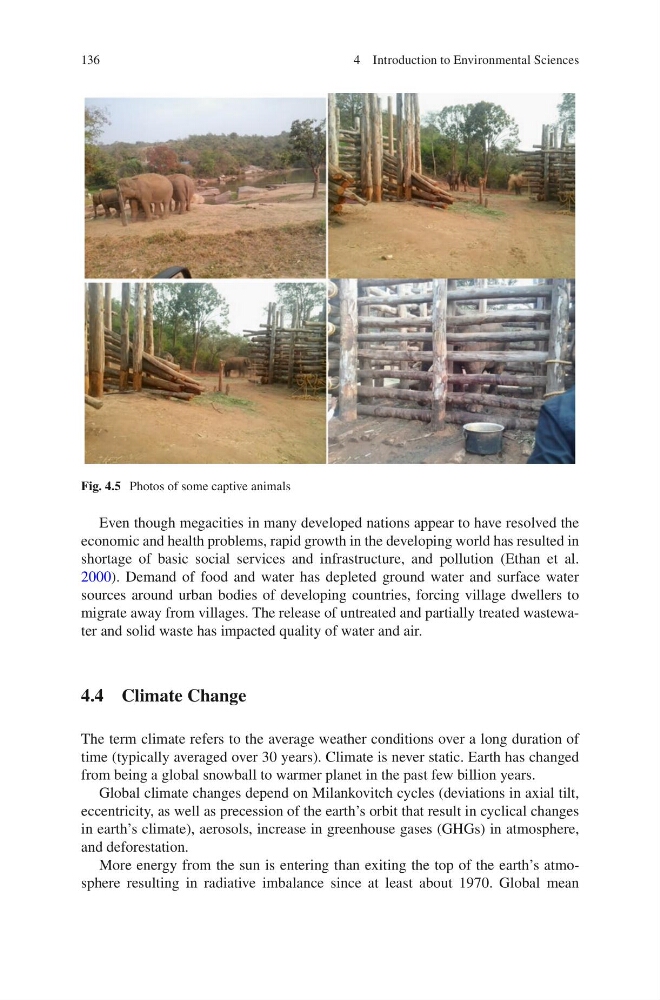
Fig. 4.5 Photos of some captive animals
4 Introduction to Environmental Sciences
Even though megacities in many developed nations appear to have resolved the
economic and health problems, rapid growth in the developing world has resulted in
shortage of basic social services and infrastructure, and pollution (Ethan et al.
2000). Demand of food and water has depleted ground water and surface water
sources around urban bodies of developing countries, forcing village dwellers to
migrate away from villages. The release of untreated and partially treated wastewater and solid waste has impacted quality of water and air.
4.4 Climate Change
The term climate refers to the average weather conditions over a long duration of
time (typically averaged over 30 years). Climate is never static. Earth has changed
from being a global snowball to warmer planet in the past few billion years.
Global climate changes depend on Milankovitch cycles (deviations in axial tilt,
eccentricity, as well as precession of the earth’s orbit that result in cyclical changes
in earth’s climate), aerosols, increase in greenhouse gases (GHGs) in atmosphere,
and deforestation.
More energy from the sun is entering than exiting the top of the earth’s atmosphere resulting in radiative imbalance since at least about 1970. Global mean
Fig. 4.5 Photos of some captive animals
4 Introduction to Environmental Sciences