

137
surface temperature (GMST) has increased since the end of nineteenth century with
a warming of 0.65–1.06 °C over the period 1880–2012, about 0.69–1.08 °C over the
period 1901–2012, and about 0.49–0.89 °C over the period 1951–2012 (Stocker
et al. 2013).
Climate change will affect health of humans due to the following:
• Varying weather patterns (humidity, temperature, precipitation, extreme events,
and sea-level rise)
• Changes in the quality of the environment
• Changes in food production
• Changes in human settlements
• Changes in the economy (Chandrappa et al. 2011)
Human health is sensitive to shifts in climate change and weather patterns
directly by the following (Smith et al. 2014):
• Changes in temperature and precipitation
• Occurrences of heat waves, droughts, floods, and fires
The climate change can indirectly affect health by the following (Smith
et al. 2014):
• Ecological disruptions
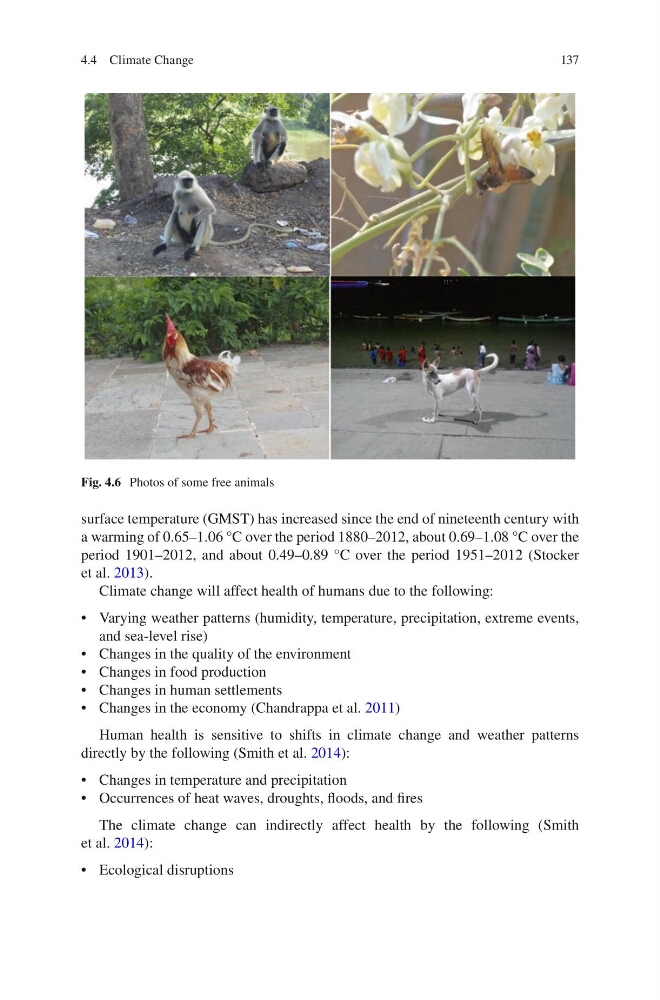
Fig. 4.6 Photos of some free animals
4.4 Climate Change
surface temperature (GMST) has increased since the end of nineteenth century with
a warming of 0.65–1.06 °C over the period 1880–2012, about 0.69–1.08 °C over the
period 1901–2012, and about 0.49–0.89 °C over the period 1951–2012 (Stocker
et al. 2013).
Climate change will affect health of humans due to the following:
• Varying weather patterns (humidity, temperature, precipitation, extreme events,
and sea-level rise)
• Changes in the quality of the environment
• Changes in food production
• Changes in human settlements
• Changes in the economy (Chandrappa et al. 2011)
Human health is sensitive to shifts in climate change and weather patterns
directly by the following (Smith et al. 2014):
• Changes in temperature and precipitation
• Occurrences of heat waves, droughts, floods, and fires
The climate change can indirectly affect health by the following (Smith
et al. 2014):
• Ecological disruptions
Fig. 4.6 Photos of some free animals
4.4 Climate Change