

134
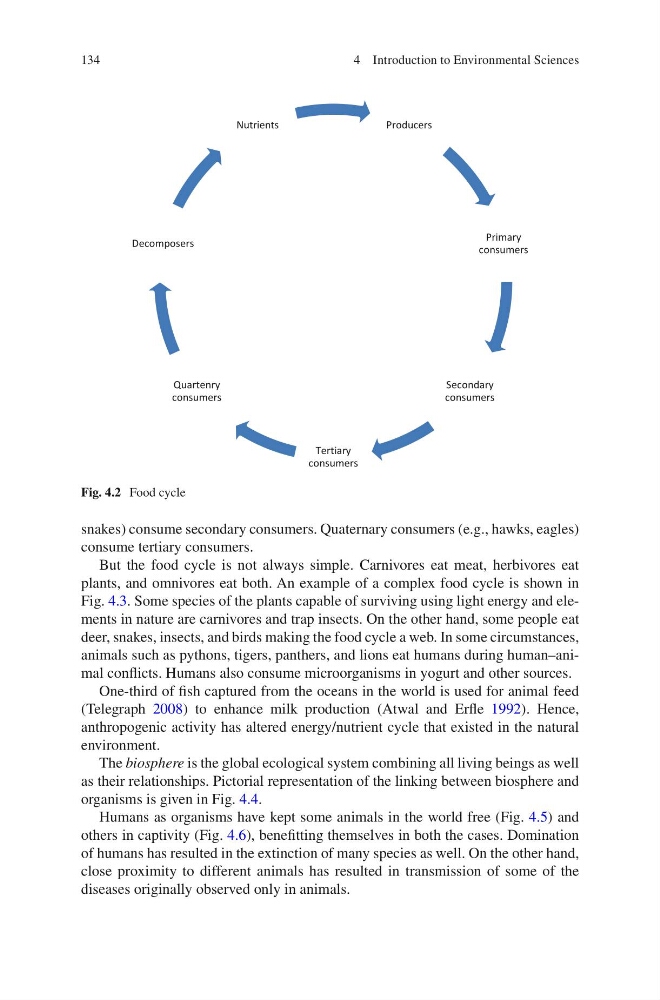
snakes) consume secondary consumers. Quaternary consumers (e.g., hawks, eagles)
consume tertiary consumers.
But the food cycle is not always simple. Carnivores eat meat, herbivores eat
plants, and omnivores eat both. An example of a complex food cycle is shown in
Fig. 4.3. Some species of the plants capable of surviving using light energy and elements in nature are carnivores and trap insects. On the other hand, some people eat
deer, snakes, insects, and birds making the food cycle a web. In some circumstances,
animals such as pythons, tigers, panthers, and lions eat humans during human–animal conflicts. Humans also consume microorganisms in yogurt and other sources.
One-third of fish captured from the oceans in the world is used for animal feed
(Telegraph 2008) to enhance milk production (Atwal and Erfle 1992). Hence,
anthropogenic activity has altered energy/nutrient cycle that existed in the natural
environment.
The biosphere is the global ecological system combining all living beings as well
as their relationships. Pictorial representation of the linking between biosphere and
organisms is given in Fig. 4.4.
Humans as organisms have kept some animals in the world free (Fig. 4.5) and
others in captivity (Fig. 4.6), benefitting themselves in both the cases. Domination
of humans has resulted in the extinction of many species as well. On the other hand,
close proximity to different animals has resulted in transmission of some of the
diseases originally observed only in animals.
Producers
Primary
consumers
Secondary
consumers
Tertiary
consumers
Quartenry
consumers
Decomposers
Nutrients
Fig. 4.2 Food cycle
4 Introduction to Environmental Sciences
snakes) consume secondary consumers. Quaternary consumers (e.g., hawks, eagles)
consume tertiary consumers.
But the food cycle is not always simple. Carnivores eat meat, herbivores eat
plants, and omnivores eat both. An example of a complex food cycle is shown in
Fig. 4.3. Some species of the plants capable of surviving using light energy and elements in nature are carnivores and trap insects. On the other hand, some people eat
deer, snakes, insects, and birds making the food cycle a web. In some circumstances,
animals such as pythons, tigers, panthers, and lions eat humans during human–animal conflicts. Humans also consume microorganisms in yogurt and other sources.
One-third of fish captured from the oceans in the world is used for animal feed
(Telegraph 2008) to enhance milk production (Atwal and Erfle 1992). Hence,
anthropogenic activity has altered energy/nutrient cycle that existed in the natural
environment.
The biosphere is the global ecological system combining all living beings as well
as their relationships. Pictorial representation of the linking between biosphere and
organisms is given in Fig. 4.4.
Humans as organisms have kept some animals in the world free (Fig. 4.5) and
others in captivity (Fig. 4.6), benefitting themselves in both the cases. Domination
of humans has resulted in the extinction of many species as well. On the other hand,
close proximity to different animals has resulted in transmission of some of the
diseases originally observed only in animals.
Producers
Primary
consumers
Secondary
consumers
Tertiary
consumers
Quartenry
consumers
Decomposers
Nutrients
Fig. 4.2 Food cycle
4 Introduction to Environmental Sciences