

133
4.3 Physical and Biotic Environment
The term environment refers to everything that is around us, which includes living
and non-living things. Several organisms together make communities. Communities
and their physical environment make the ecosystem. Energy and mass can neither
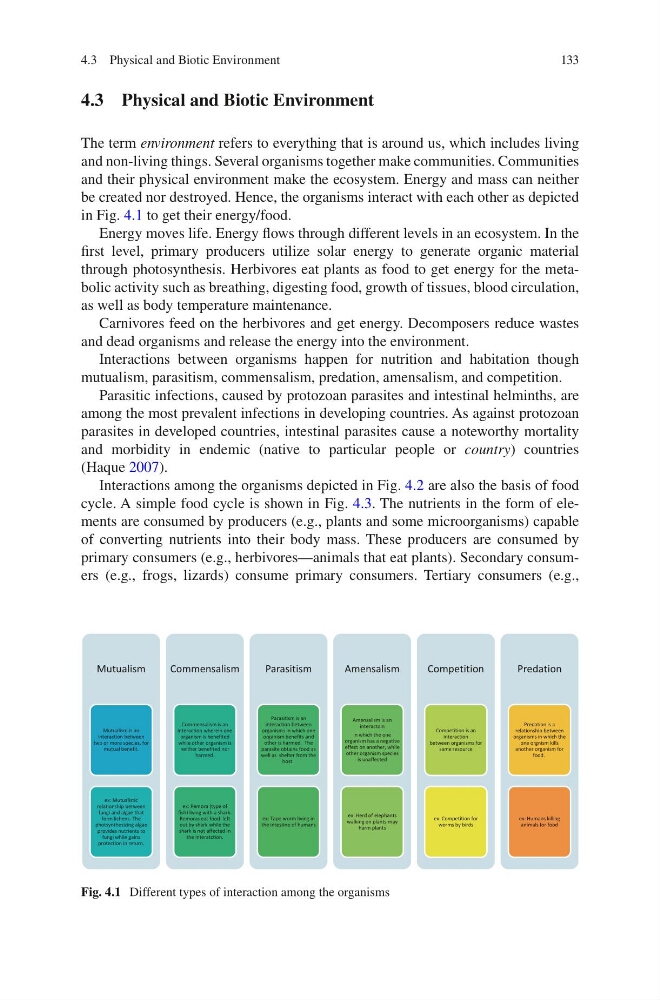
be created nor destroyed. Hence, the organisms interact with each other as depicted
in Fig. 4.1 to get their energy/food.
Energy moves life. Energy flows through different levels in an ecosystem. In the
first level, primary producers utilize solar energy to generate organic material
through photosynthesis. Herbivores eat plants as food to get energy for the metabolic activity such as breathing, digesting food, growth of tissues, blood circulation,
as well as body temperature maintenance.
Carnivores feed on the herbivores and get energy. Decomposers reduce wastes
and dead organisms and release the energy into the environment.
Interactions between organisms happen for nutrition and habitation though
mutualism, parasitism, commensalism, predation, amensalism, and competition.
Parasitic infections, caused by protozoan parasites and intestinal helminths, are
among the most prevalent infections in developing countries. As against protozoan
parasites in developed countries, intestinal parasites cause a noteworthy mortality
and morbidity in endemic (native to particular people or country) countries
(Haque 2007).
Interactions among the organisms depicted in Fig. 4.2 are also the basis of food
cycle. A simple food cycle is shown in Fig. 4.3. The nutrients in the form of elements are consumed by producers (e.g., plants and some microorganisms) capable
of converting nutrients into their body mass. These producers are consumed by
primary consumers (e.g., herbivores—animals that eat plants). Secondary consumers (e.g., frogs, lizards) consume primary consumers. Tertiary consumers (e.g.,
Mutualism
Mutualism is an
interaction between
two or more species, for
mutual benefit.
ex: Mutualistic
relationship between
fungi and algae that
form lichens. The
photsynthesizing algae
provides nutrients to
fungi while gains
protection in return.
Commensalism
Commensalism is an
interaction wherein one
organism is benefited
while other organism is
neither benefited nor
harmed.
ex: Remora (type of
fish) living with a shark.
Remoras eat food left
out by shark while the
shark is not affected in
the interatction.
Parasitism
Parasitism is an
interaction between
organisms in which one
organism benefits and
other is harmed. The
parasite obtains food as
well as shelter from the
host.
ex: Tape worm living in
the intestine of humans
Amensalism
Amensalism is an
interactoin
in which the one
organism has a negative
effect on another, while
other organism species
is unaffected
ex: Herd of elephants
walking on plants may
harm plants
Competition
Competition is an
interaction
between organisms for
same resource
ex: Competition for
worms by birds
Predation
Predation is a
relationship between
organisms in which the
one orgnism kills
another organism for
food.
ex: Humans killing
animals for food
Fig. 4.1 Different types of interaction among the organisms
4.3 Physical and Biotic Environment
4.3 Physical and Biotic Environment
The term environment refers to everything that is around us, which includes living
and non-living things. Several organisms together make communities. Communities
and their physical environment make the ecosystem. Energy and mass can neither
be created nor destroyed. Hence, the organisms interact with each other as depicted
in Fig. 4.1 to get their energy/food.
Energy moves life. Energy flows through different levels in an ecosystem. In the
first level, primary producers utilize solar energy to generate organic material
through photosynthesis. Herbivores eat plants as food to get energy for the metabolic activity such as breathing, digesting food, growth of tissues, blood circulation,
as well as body temperature maintenance.
Carnivores feed on the herbivores and get energy. Decomposers reduce wastes
and dead organisms and release the energy into the environment.
Interactions between organisms happen for nutrition and habitation though
mutualism, parasitism, commensalism, predation, amensalism, and competition.
Parasitic infections, caused by protozoan parasites and intestinal helminths, are
among the most prevalent infections in developing countries. As against protozoan
parasites in developed countries, intestinal parasites cause a noteworthy mortality
and morbidity in endemic (native to particular people or country) countries
(Haque 2007).
Interactions among the organisms depicted in Fig. 4.2 are also the basis of food
cycle. A simple food cycle is shown in Fig. 4.3. The nutrients in the form of elements are consumed by producers (e.g., plants and some microorganisms) capable
of converting nutrients into their body mass. These producers are consumed by
primary consumers (e.g., herbivores—animals that eat plants). Secondary consumers (e.g., frogs, lizards) consume primary consumers. Tertiary consumers (e.g.,
Mutualism
Mutualism is an
interaction between
two or more species, for
mutual benefit.
ex: Mutualistic
relationship between
fungi and algae that
form lichens. The
photsynthesizing algae
provides nutrients to
fungi while gains
protection in return.
Commensalism
Commensalism is an
interaction wherein one
organism is benefited
while other organism is
neither benefited nor
harmed.
ex: Remora (type of
fish) living with a shark.
Remoras eat food left
out by shark while the
shark is not affected in
the interatction.
Parasitism
Parasitism is an
interaction between
organisms in which one
organism benefits and
other is harmed. The
parasite obtains food as
well as shelter from the
host.
ex: Tape worm living in
the intestine of humans
Amensalism
Amensalism is an
interactoin
in which the one
organism has a negative
effect on another, while
other organism species
is unaffected
ex: Herd of elephants
walking on plants may
harm plants
Competition
Competition is an
interaction
between organisms for
same resource
ex: Competition for
worms by birds
Predation
Predation is a
relationship between
organisms in which the
one orgnism kills
another organism for
food.
ex: Humans killing
animals for food
Fig. 4.1 Different types of interaction among the organisms
4.3 Physical and Biotic Environment