

121
Many of the vector-borne diseases are preventable through proper environmental
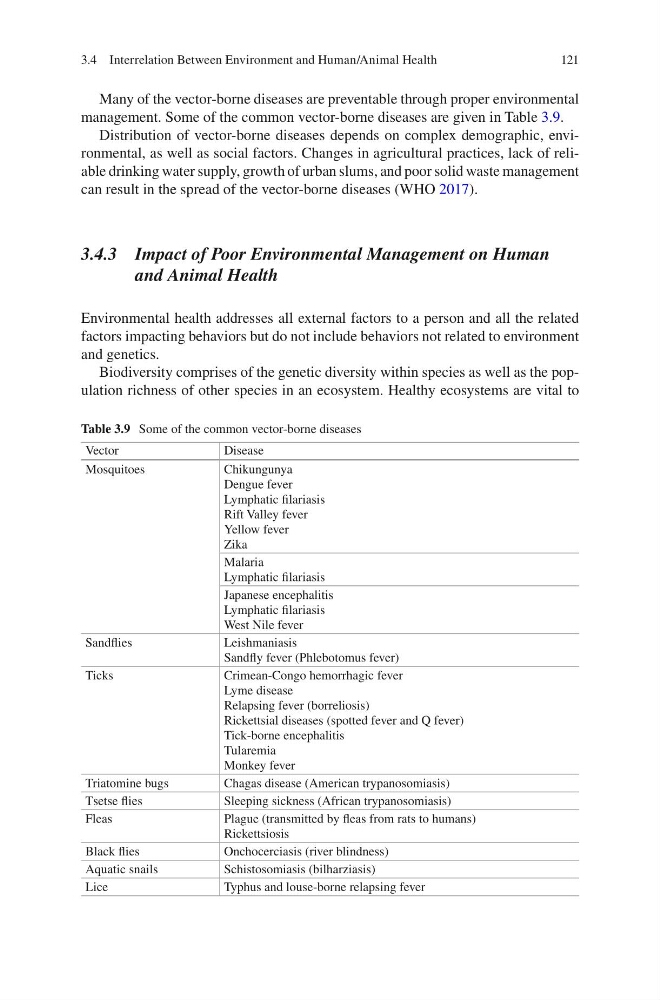
management. Some of the common vector-borne diseases are given in Table 3.9.
Distribution of vector-borne diseases depends on complex demographic, environmental, as well as social factors. Changes in agricultural practices, lack of reliable drinking water supply, growth of urban slums, and poor solid waste management
can result in the spread of the vector-borne diseases (WHO 2017).
3.4.3 Impact of Poor Environmental Management on Human
and Animal Health
Environmental health addresses all external factors to a person and all the related
factors impacting behaviors but do not include behaviors not related to environment
and genetics.
Biodiversity comprises of the genetic diversity within species as well as the population richness of other species in an ecosystem. Healthy ecosystems are vital to
Table 3.9 Some of the common vector-borne diseases
Vector
Disease
Mosquitoes
Chikungunya
Dengue fever
Lymphatic filariasis
Rift Valley fever
Yellow fever
Zika
Malaria
Lymphatic filariasis
Japanese encephalitis
Lymphatic filariasis
West Nile fever
Sandflies
Leishmaniasis
Sandfly fever (Phlebotomus fever)
Ticks
Crimean-Congo hemorrhagic fever
Lyme disease
Relapsing fever (borreliosis)
Rickettsial diseases (spotted fever and Q fever)
Tick-borne encephalitis
Tularemia
Monkey fever
Triatomine bugs
Chagas disease (American trypanosomiasis)
Tsetse flies
Sleeping sickness (African trypanosomiasis)
Fleas
Plague (transmitted by fleas from rats to humans)
Rickettsiosis
Black flies
Onchocerciasis (river blindness)
Aquatic snails
Schistosomiasis (bilharziasis)
Lice
Typhus and louse-borne relapsing fever
3.4 Interrelation Between Environment and Human/Animal Health
Many of the vector-borne diseases are preventable through proper environmental
management. Some of the common vector-borne diseases are given in Table 3.9.
Distribution of vector-borne diseases depends on complex demographic, environmental, as well as social factors. Changes in agricultural practices, lack of reliable drinking water supply, growth of urban slums, and poor solid waste management
can result in the spread of the vector-borne diseases (WHO 2017).
3.4.3 Impact of Poor Environmental Management on Human
and Animal Health
Environmental health addresses all external factors to a person and all the related
factors impacting behaviors but do not include behaviors not related to environment
and genetics.
Biodiversity comprises of the genetic diversity within species as well as the population richness of other species in an ecosystem. Healthy ecosystems are vital to
Table 3.9 Some of the common vector-borne diseases
Vector
Disease
Mosquitoes
Chikungunya
Dengue fever
Lymphatic filariasis
Rift Valley fever
Yellow fever
Zika
Malaria
Lymphatic filariasis
Japanese encephalitis
Lymphatic filariasis
West Nile fever
Sandflies
Leishmaniasis
Sandfly fever (Phlebotomus fever)
Ticks
Crimean-Congo hemorrhagic fever
Lyme disease
Relapsing fever (borreliosis)
Rickettsial diseases (spotted fever and Q fever)
Tick-borne encephalitis
Tularemia
Monkey fever
Triatomine bugs
Chagas disease (American trypanosomiasis)
Tsetse flies
Sleeping sickness (African trypanosomiasis)
Fleas
Plague (transmitted by fleas from rats to humans)
Rickettsiosis
Black flies
Onchocerciasis (river blindness)
Aquatic snails
Schistosomiasis (bilharziasis)
Lice
Typhus and louse-borne relapsing fever
3.4 Interrelation Between Environment and Human/Animal Health