

122
the human existence, prosperity, and well-being (WWF 2016). Humans cannot live
in isolation from the environment. Early industrial societies frequently discharged
waste/emissions from industrial operations directly into the air, groundwater, and
water bodies (WWF 2016), the trend that is now being carried out in the developing world.
As per Smith et al. (1999), 25–33% of the global burden of disease occurs due to
the environmental risk factors. As per the findings of WHO (2016), 23% of global
deaths as well as 26% of deaths among the children under five are attributed to
modifiable environmental factors. Disease burden linked to the environment varies
from country to country. Overall, 9–14% of disease burden is linked to the environment in some developed countries whereas 23–31% in some developing countries,
thereby inferring that most of the deaths and disease could be tackled through
improvements in the environment in low- and middle-income countries (WHO 2016).
The Japanese encephalitis is transmitted by Culex mosquitoes, that nourish on
infected pigs, birds, and other mammals, which spread the infection to humans
around paddy fields (Fig. 3.14) and irrigation systems.
Improper increase in livestock production contributes to land degradation due to
overgrazing, erosion, decrease in soil fertility, and desertification. Animal health
activities such as vaccination or parasite control programs may lead to land degradation (FAO 1991).
Increase in livestock production can also lead to increase in waste, such as
manure from feedlots resulting in pollution. Improper disposal of waste from livestock management firms may increase predatory animal species such as hyenas and
dogs on land and sharks in sea.
The decrease in the population of one species in a locality may lead to unexpected consequences. Disproportionate use of parasiticides and antibiotics can lead
to the development of strains of pathogens resistant to the drug used. Poisoning
coyotes to control rabies in Mexico led to rise in the population of jackrabbit that
became a pest in agriculture (FAO 1991).
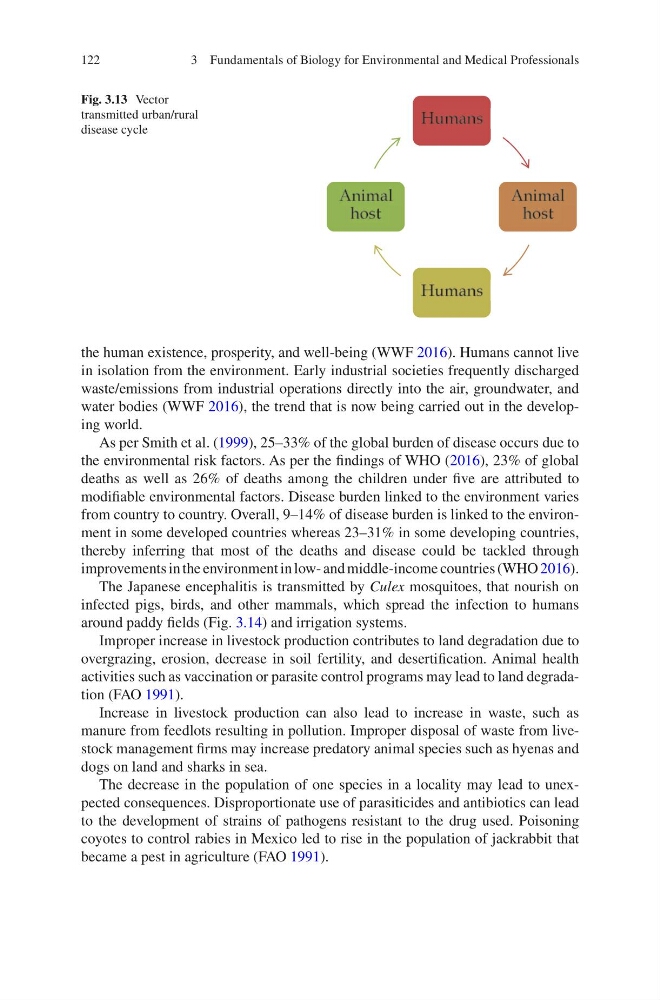
Fig. 3.13 Vector
transmitted urban/rural
disease cycle
3 Fundamentals of Biology for Environmental and Medical Professionals
the human existence, prosperity, and well-being (WWF 2016). Humans cannot live
in isolation from the environment. Early industrial societies frequently discharged
waste/emissions from industrial operations directly into the air, groundwater, and
water bodies (WWF 2016), the trend that is now being carried out in the developing world.
As per Smith et al. (1999), 25–33% of the global burden of disease occurs due to
the environmental risk factors. As per the findings of WHO (2016), 23% of global
deaths as well as 26% of deaths among the children under five are attributed to
modifiable environmental factors. Disease burden linked to the environment varies
from country to country. Overall, 9–14% of disease burden is linked to the environment in some developed countries whereas 23–31% in some developing countries,
thereby inferring that most of the deaths and disease could be tackled through
improvements in the environment in low- and middle-income countries (WHO 2016).
The Japanese encephalitis is transmitted by Culex mosquitoes, that nourish on
infected pigs, birds, and other mammals, which spread the infection to humans
around paddy fields (Fig. 3.14) and irrigation systems.
Improper increase in livestock production contributes to land degradation due to
overgrazing, erosion, decrease in soil fertility, and desertification. Animal health
activities such as vaccination or parasite control programs may lead to land degradation (FAO 1991).
Increase in livestock production can also lead to increase in waste, such as
manure from feedlots resulting in pollution. Improper disposal of waste from livestock management firms may increase predatory animal species such as hyenas and
dogs on land and sharks in sea.
The decrease in the population of one species in a locality may lead to unexpected consequences. Disproportionate use of parasiticides and antibiotics can lead
to the development of strains of pathogens resistant to the drug used. Poisoning
coyotes to control rabies in Mexico led to rise in the population of jackrabbit that
became a pest in agriculture (FAO 1991).
Fig. 3.13 Vector
transmitted urban/rural
disease cycle
3 Fundamentals of Biology for Environmental and Medical Professionals