

119
Emergence of zoonotic diseases from wildlife depends on the zoonotic pool, that
is, the diversity of wildlife microbes (Morse 1993), impact of environmental change
on the occurrence of pathogens in wildlife, and the frequency of the zoonotic pool
Table 3.8 (continued)
Disease
Main reservoir of
causative agents
Usual mode of transmission to
humans
Rat bite fever (Haverhill fever)
Rats
Bite/scratch, milk, water
Rift Valley fever
Cattle, goats, sheep
Direct contact, mosquito bite
Ringworm
Cats, dogs, cattle,
many animal species
Direct contact
Streptococcal sepsis
Pigs
Direct contact, meat
Streptococcal sepsis
Horses, cattle
Direct contact, milk
Tick-borne encephalitis
Rodents, small
mammals, livestock
Tick bite, unpasteurized milk
products
Toxocariasis
Dogs, cats
Direct contact
Toxoplasmosis
Cats, ruminants
Ingestion of fecal oocysts, meat
Trichinellosis
Pigs, wild boar
Pork products
Tularemia
Rabbits, wild animals,
environment, ticks
Direct contact, aerosol, ticks,
inoculation
Ebola, Crimean-Congo
hemorrhagic fever, Lassa and
Marburg viruses
Rodents, ticks,
livestock, primates,
bats
Direct contact, inoculation, ticks
West Nile fever
Wild birds,
mosquitoes
Mosquito bite
Zika fever
Monkey and rodents Mosquito
Zoonotic diphtheria
Cattle, farm animals,
dogs
Direct contact, milk
Source: EMPRI (2018), Public Health England (2013), and Park et al. (2016)
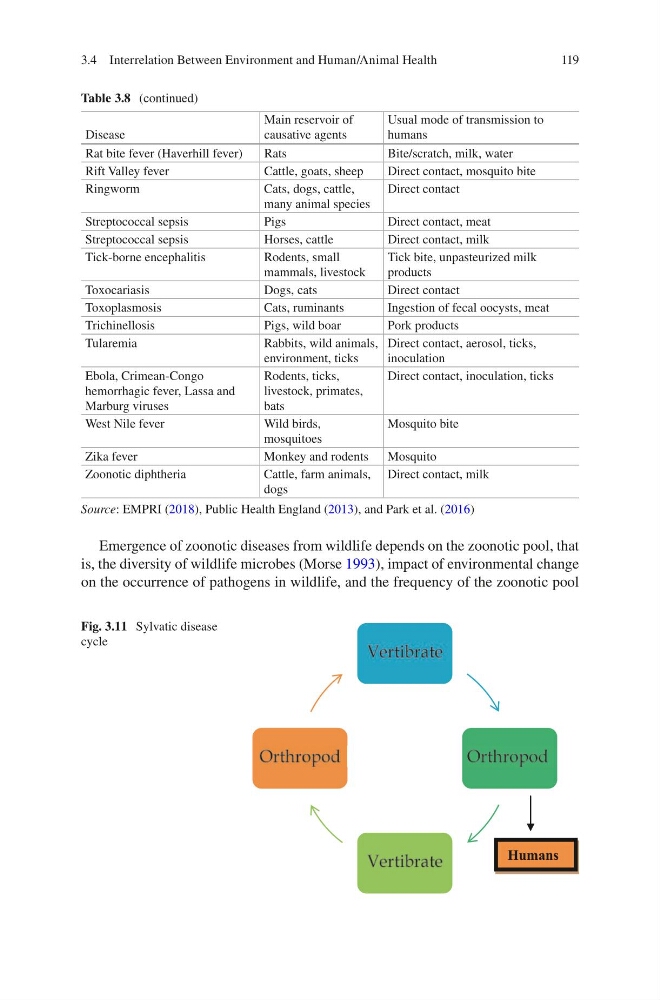
Humans
Fig. 3.11 Sylvatic disease
cycle
3.4 Interrelation Between Environment and Human/Animal Health
Emergence of zoonotic diseases from wildlife depends on the zoonotic pool, that
is, the diversity of wildlife microbes (Morse 1993), impact of environmental change
on the occurrence of pathogens in wildlife, and the frequency of the zoonotic pool
Table 3.8 (continued)
Disease
Main reservoir of
causative agents
Usual mode of transmission to
humans
Rat bite fever (Haverhill fever)
Rats
Bite/scratch, milk, water
Rift Valley fever
Cattle, goats, sheep
Direct contact, mosquito bite
Ringworm
Cats, dogs, cattle,
many animal species
Direct contact
Streptococcal sepsis
Pigs
Direct contact, meat
Streptococcal sepsis
Horses, cattle
Direct contact, milk
Tick-borne encephalitis
Rodents, small
mammals, livestock
Tick bite, unpasteurized milk
products
Toxocariasis
Dogs, cats
Direct contact
Toxoplasmosis
Cats, ruminants
Ingestion of fecal oocysts, meat
Trichinellosis
Pigs, wild boar
Pork products
Tularemia
Rabbits, wild animals,
environment, ticks
Direct contact, aerosol, ticks,
inoculation
Ebola, Crimean-Congo
hemorrhagic fever, Lassa and
Marburg viruses
Rodents, ticks,
livestock, primates,
bats
Direct contact, inoculation, ticks
West Nile fever
Wild birds,
mosquitoes
Mosquito bite
Zika fever
Monkey and rodents Mosquito
Zoonotic diphtheria
Cattle, farm animals,
dogs
Direct contact, milk
Source: EMPRI (2018), Public Health England (2013), and Park et al. (2016)
Humans
Fig. 3.11 Sylvatic disease
cycle
3.4 Interrelation Between Environment and Human/Animal Health