

108
1. They have optimal growth temperature to match with the body temperature of
the host. Hence, the pathogenic bacteria of human have optimum growth temperature of around 35–37 °C.
2. They may have capsules to prevent the bacterial cell from being phagocytosed
(bacteria getting enveloped and destroyed) and adhere to host cells.
3. They may generate materials that are toxic to their host.
4. They may have enzymes such as DNAase (capable to denature DNA) and coagulase (capable to clot blood).
5. They may possess antigen (substance that induces an immune response in the
host body).
6. They may have flagella.
7. They may have resistance to antibiotics (a substance that destroys or inhibits the
growth of microorganisms).
Infection and disease are not recent phenomena. Diseases make living organisms
weak, making them vulnerable to predators or death, eliminating weaker organisms
from the ecosystem. Examples of intervention to reduce or eliminate infectious and
parasitic diseases in human beings are given in Table 3.6.
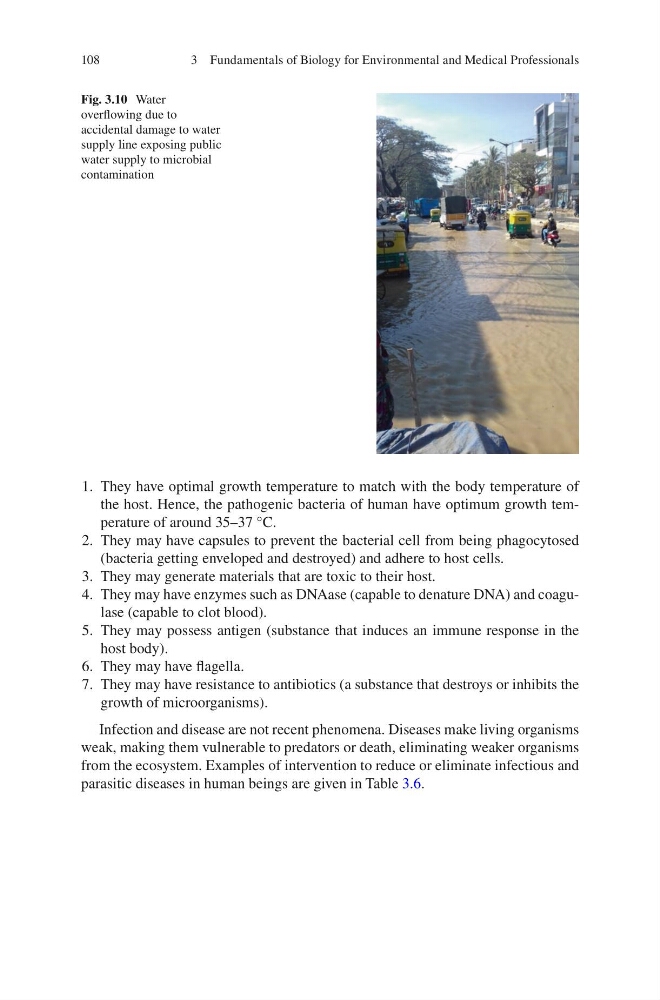
Fig. 3.10 Water
overflowing due to
accidental damage to water
supply line exposing public
water supply to microbial
contamination
3 Fundamentals of Biology for Environmental and Medical Professionals
1. They have optimal growth temperature to match with the body temperature of
the host. Hence, the pathogenic bacteria of human have optimum growth temperature of around 35–37 °C.
2. They may have capsules to prevent the bacterial cell from being phagocytosed
(bacteria getting enveloped and destroyed) and adhere to host cells.
3. They may generate materials that are toxic to their host.
4. They may have enzymes such as DNAase (capable to denature DNA) and coagulase (capable to clot blood).
5. They may possess antigen (substance that induces an immune response in the
host body).
6. They may have flagella.
7. They may have resistance to antibiotics (a substance that destroys or inhibits the
growth of microorganisms).
Infection and disease are not recent phenomena. Diseases make living organisms
weak, making them vulnerable to predators or death, eliminating weaker organisms
from the ecosystem. Examples of intervention to reduce or eliminate infectious and
parasitic diseases in human beings are given in Table 3.6.
Fig. 3.10 Water
overflowing due to
accidental damage to water
supply line exposing public
water supply to microbial
contamination
3 Fundamentals of Biology for Environmental and Medical Professionals