

107
Dengue, Rotavirus infection, severe acute respiratory syndrome (SARS), Middle
East respiratory syndrome (MERS), and Coronavirus disease 2019 (COVID-19).
The reservoir of infectious agents is the place where the agent usually lives,
grows, and multiplies, such as humans, animals, lakes, and soil.
An infectious agent may affect in many ways. Infection may be transmitted
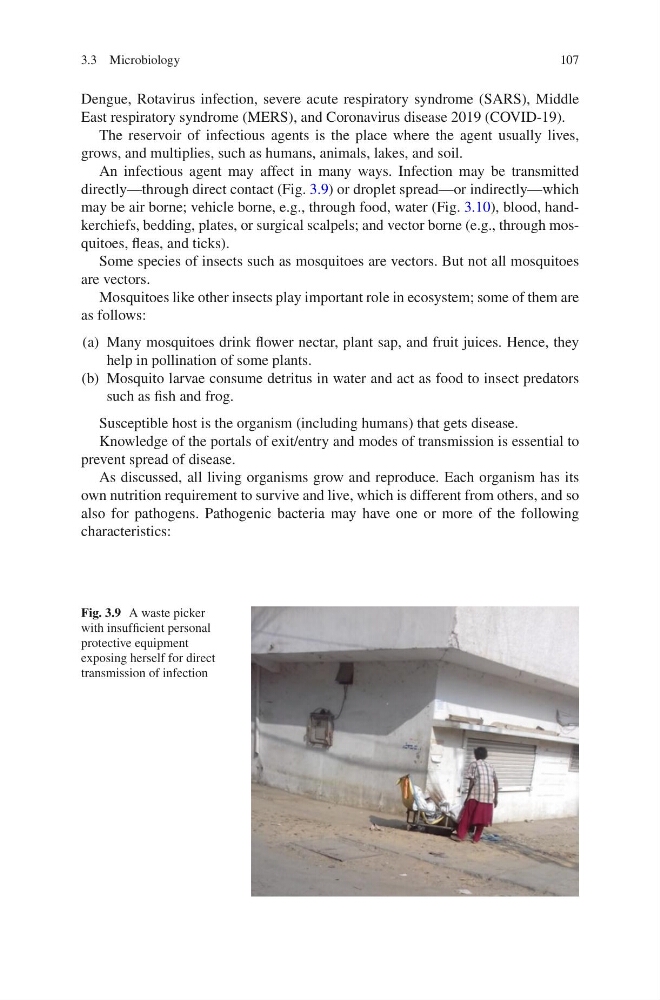
directly—through direct contact (Fig. 3.9) or droplet spread—or indirectly—which
may be air borne; vehicle borne, e.g., through food, water (Fig. 3.10), blood, handkerchiefs, bedding, plates, or surgical scalpels; and vector borne (e.g., through mosquitoes, fleas, and ticks).
Some species of insects such as mosquitoes are vectors. But not all mosquitoes
are vectors.
Mosquitoes like other insects play important role in ecosystem; some of them are
as follows:
(a) Many mosquitoes drink flower nectar, plant sap, and fruit juices. Hence, they
help in pollination of some plants.
(b) Mosquito larvae consume detritus in water and act as food to insect predators
such as fish and frog.
Susceptible host is the organism (including humans) that gets disease.
Knowledge of the portals of exit/entry and modes of transmission is essential to
prevent spread of disease.
As discussed, all living organisms grow and reproduce. Each organism has its
own nutrition requirement to survive and live, which is different from others, and so
also for pathogens. Pathogenic bacteria may have one or more of the following
characteristics:
Fig. 3.9 A waste picker
with insufficient personal
protective equipment
exposing herself for direct
transmission of infection
3.3 Microbiology
Dengue, Rotavirus infection, severe acute respiratory syndrome (SARS), Middle
East respiratory syndrome (MERS), and Coronavirus disease 2019 (COVID-19).
The reservoir of infectious agents is the place where the agent usually lives,
grows, and multiplies, such as humans, animals, lakes, and soil.
An infectious agent may affect in many ways. Infection may be transmitted
directly—through direct contact (Fig. 3.9) or droplet spread—or indirectly—which
may be air borne; vehicle borne, e.g., through food, water (Fig. 3.10), blood, handkerchiefs, bedding, plates, or surgical scalpels; and vector borne (e.g., through mosquitoes, fleas, and ticks).
Some species of insects such as mosquitoes are vectors. But not all mosquitoes
are vectors.
Mosquitoes like other insects play important role in ecosystem; some of them are
as follows:
(a) Many mosquitoes drink flower nectar, plant sap, and fruit juices. Hence, they
help in pollination of some plants.
(b) Mosquito larvae consume detritus in water and act as food to insect predators
such as fish and frog.
Susceptible host is the organism (including humans) that gets disease.
Knowledge of the portals of exit/entry and modes of transmission is essential to
prevent spread of disease.
As discussed, all living organisms grow and reproduce. Each organism has its
own nutrition requirement to survive and live, which is different from others, and so
also for pathogens. Pathogenic bacteria may have one or more of the following
characteristics:
Fig. 3.9 A waste picker
with insufficient personal
protective equipment
exposing herself for direct
transmission of infection
3.3 Microbiology