

104
3. Cross-contamination by contaminated food
4. Eating/drinking raw food from unsafe sources
5. Food handling by infected persons
6. Improper storing
7. Inadequate cooking
8. Inadequate reheating
9. Using of food ingredients from unsafe sources
Bacteria
Bacteria are single-celled protists that feed on soluble food. Although they may
form chains as well as clusters, they are independent organisms.
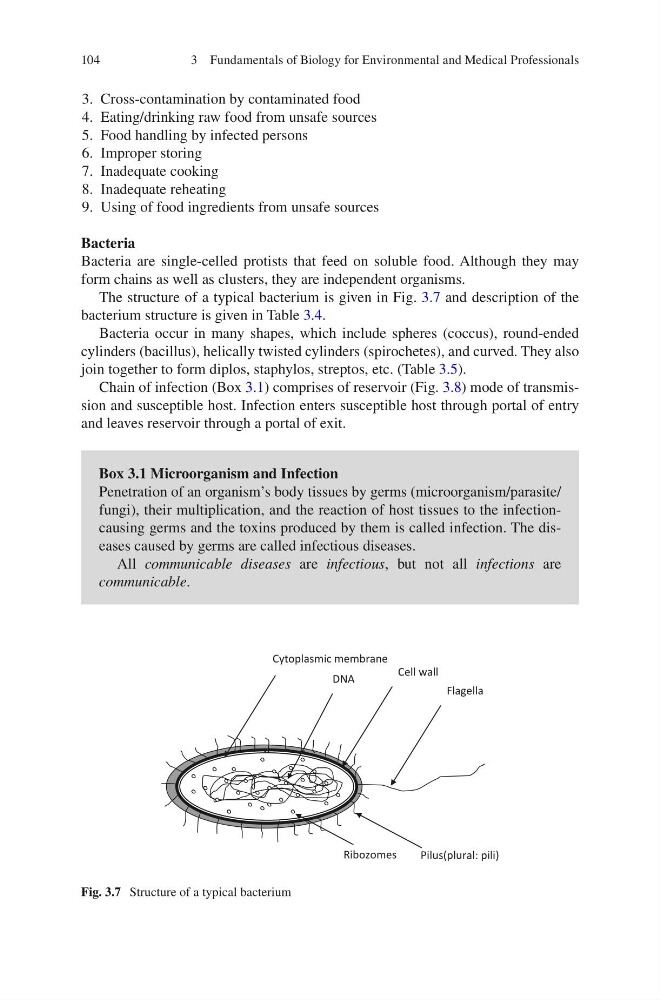
The structure of a typical bacterium is given in Fig. 3.7 and description of the
bacterium structure is given in Table 3.4.
Bacteria occur in many shapes, which include spheres (coccus), round-ended
cylinders (bacillus), helically twisted cylinders (spirochetes), and curved. They also
join together to form diplos, staphylos, streptos, etc. (Table 3.5).
Chain of infection (Box 3.1) comprises of reservoir (Fig. 3.8) mode of transmission and susceptible host. Infection enters susceptible host through portal of entry
and leaves reservoir through a portal of exit.
Cell wall
Cytoplasmic membrane
Flagella
Ribozomes
Pilus(plural: pili)
DNA
Fig. 3.7 Structure of a typical bacterium
Box 3.1 Microorganism and Infection
Penetration of an organism’s body tissues by germs (microorganism/parasite/
fungi), their multiplication, and the reaction of host tissues to the infectioncausing germs and the toxins produced by them is called infection. The diseases caused by germs are called infectious diseases.
All communicable diseases are infectious, but not all infections are
communicable.
3 Fundamentals of Biology for Environmental and Medical Professionals
3. Cross-contamination by contaminated food
4. Eating/drinking raw food from unsafe sources
5. Food handling by infected persons
6. Improper storing
7. Inadequate cooking
8. Inadequate reheating
9. Using of food ingredients from unsafe sources
Bacteria
Bacteria are single-celled protists that feed on soluble food. Although they may
form chains as well as clusters, they are independent organisms.
The structure of a typical bacterium is given in Fig. 3.7 and description of the
bacterium structure is given in Table 3.4.
Bacteria occur in many shapes, which include spheres (coccus), round-ended
cylinders (bacillus), helically twisted cylinders (spirochetes), and curved. They also
join together to form diplos, staphylos, streptos, etc. (Table 3.5).
Chain of infection (Box 3.1) comprises of reservoir (Fig. 3.8) mode of transmission and susceptible host. Infection enters susceptible host through portal of entry
and leaves reservoir through a portal of exit.
Cell wall
Cytoplasmic membrane
Flagella
Ribozomes
Pilus(plural: pili)
DNA
Fig. 3.7 Structure of a typical bacterium
Box 3.1 Microorganism and Infection
Penetration of an organism’s body tissues by germs (microorganism/parasite/
fungi), their multiplication, and the reaction of host tissues to the infectioncausing germs and the toxins produced by them is called infection. The diseases caused by germs are called infectious diseases.
All communicable diseases are infectious, but not all infections are
communicable.
3 Fundamentals of Biology for Environmental and Medical Professionals