

85
affect health.
Application of heat is well known in the following:
• Transportation
• Industry
• Domestic activity
• Mining
• Wars and mutiny
• Waste management
The above applications are also the causes of many types of pollution and release
many pollutants. Table 2.12 gives the common terms used in thermal physics.
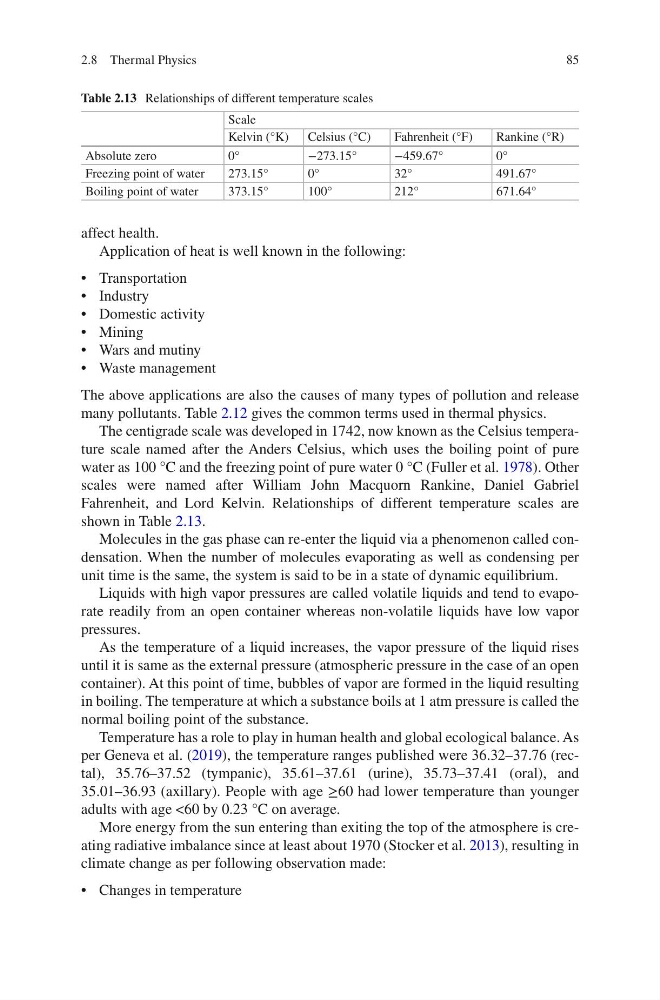
The centigrade scale was developed in 1742, now known as the Celsius temperature scale named after the Anders Celsius, which uses the boiling point of pure
water as 100 °C and the freezing point of pure water 0 °C (Fuller et al. 1978). Other
scales were named after William John Macquorn Rankine, Daniel Gabriel
Fahrenheit, and Lord Kelvin. Relationships of different temperature scales are
shown in Table 2.13.
Molecules in the gas phase can re-enter the liquid via a phenomenon called condensation. When the number of molecules evaporating as well as condensing per
unit time is the same, the system is said to be in a state of dynamic equilibrium.
Liquids with high vapor pressures are called volatile liquids and tend to evaporate readily from an open container whereas non-volatile liquids have low vapor
pressures.
As the temperature of a liquid increases, the vapor pressure of the liquid rises
until it is same as the external pressure (atmospheric pressure in the case of an open
container). At this point of time, bubbles of vapor are formed in the liquid resulting
in boiling. The temperature at which a substance boils at 1 atm pressure is called the
normal boiling point of the substance.
Temperature has a role to play in human health and global ecological balance. As
per Geneva et al. (2019), the temperature ranges published were 36.32–37.76 (rectal), 35.76–37.52 (tympanic), 35.61–37.61 (urine), 35.73–37.41 (oral), and
35.01–36.93 (axillary). People with age ≥60 had lower temperature than younger
adults with age <60 by 0.23 °C on average.
More energy from the sun entering than exiting the top of the atmosphere is creating radiative imbalance since at least about 1970 (Stocker et al. 2013), resulting in
climate change as per following observation made:
• Changes in temperature
Table 2.13 Relationships of different temperature scales
Scale
Kelvin (°K)
Celsius (°C)
Fahrenheit (°F)
Rankine (°R)
Absolute zero
0°
−273.15°
−459.67°
0°
Freezing point of water
273.15°
0°
32°
491.67°
Boiling point of water
373.15°
100°
212°
671.64°
2.8 Thermal Physics
affect health.
Application of heat is well known in the following:
• Transportation
• Industry
• Domestic activity
• Mining
• Wars and mutiny
• Waste management
The above applications are also the causes of many types of pollution and release
many pollutants. Table 2.12 gives the common terms used in thermal physics.
The centigrade scale was developed in 1742, now known as the Celsius temperature scale named after the Anders Celsius, which uses the boiling point of pure
water as 100 °C and the freezing point of pure water 0 °C (Fuller et al. 1978). Other
scales were named after William John Macquorn Rankine, Daniel Gabriel
Fahrenheit, and Lord Kelvin. Relationships of different temperature scales are
shown in Table 2.13.
Molecules in the gas phase can re-enter the liquid via a phenomenon called condensation. When the number of molecules evaporating as well as condensing per
unit time is the same, the system is said to be in a state of dynamic equilibrium.
Liquids with high vapor pressures are called volatile liquids and tend to evaporate readily from an open container whereas non-volatile liquids have low vapor
pressures.
As the temperature of a liquid increases, the vapor pressure of the liquid rises
until it is same as the external pressure (atmospheric pressure in the case of an open
container). At this point of time, bubbles of vapor are formed in the liquid resulting
in boiling. The temperature at which a substance boils at 1 atm pressure is called the
normal boiling point of the substance.
Temperature has a role to play in human health and global ecological balance. As
per Geneva et al. (2019), the temperature ranges published were 36.32–37.76 (rectal), 35.76–37.52 (tympanic), 35.61–37.61 (urine), 35.73–37.41 (oral), and
35.01–36.93 (axillary). People with age ≥60 had lower temperature than younger
adults with age <60 by 0.23 °C on average.
More energy from the sun entering than exiting the top of the atmosphere is creating radiative imbalance since at least about 1970 (Stocker et al. 2013), resulting in
climate change as per following observation made:
• Changes in temperature
Table 2.13 Relationships of different temperature scales
Scale
Kelvin (°K)
Celsius (°C)
Fahrenheit (°F)
Rankine (°R)
Absolute zero
0°
−273.15°
−459.67°
0°
Freezing point of water
273.15°
0°
32°
491.67°
Boiling point of water
373.15°
100°
212°
671.64°
2.8 Thermal Physics