

86
• Changes in energy budget and heat content
• Changes in circulation and modes of variability
• Changes in the water cycle and cryosphere
• Changes in sea level
• Changes in extreme climatological events
• Changes in carbon and other biogeochemical cycles
Cold spells and heat waves have shown adverse effects on mortality. Cold spells
were responsible for a greater proportion of deaths compared to heat waves, while
moderate high/low temperatures responsible for most of the total health burden.
With global populations rapidly aging, the age group of more than 60 years is
expected to cover 21.1% of the population by 2050, which is expected to increase
temperature-related mortality and morbidity in future (Schneider and Breitner
2016). Further, it is projected that a reduction in the green cover by 10% would raise
urban temperatures by 8.2 °C over the next 70 years (Gill et al. 2007), which highlights the importance of maintaining global temperature to safeguard health of
humans across the world.
2.9 Thermodynamics
Thermodynamics is specialization of physical science that is concerned with the
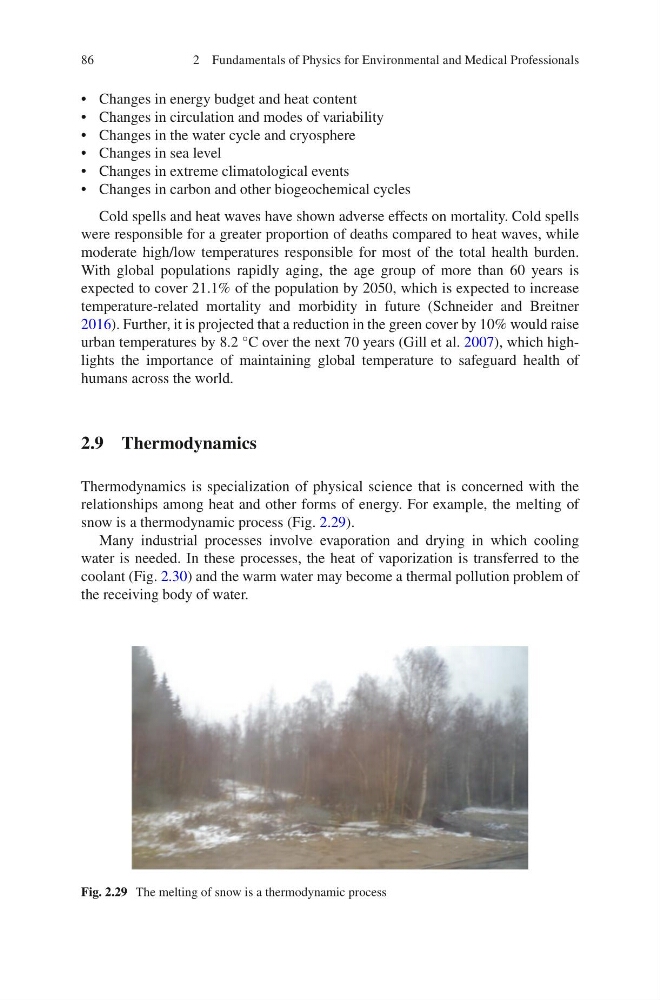
relationships among heat and other forms of energy. For example, the melting of
snow is a thermodynamic process (Fig. 2.29).
Many industrial processes involve evaporation and drying in which cooling
water is needed. In these processes, the heat of vaporization is transferred to the
coolant (Fig. 2.30) and the warm water may become a thermal pollution problem of
the receiving body of water.
Fig. 2.29 The melting of snow is a thermodynamic process
2 Fundamentals of Physics for Environmental and Medical Professionals
• Changes in energy budget and heat content
• Changes in circulation and modes of variability
• Changes in the water cycle and cryosphere
• Changes in sea level
• Changes in extreme climatological events
• Changes in carbon and other biogeochemical cycles
Cold spells and heat waves have shown adverse effects on mortality. Cold spells
were responsible for a greater proportion of deaths compared to heat waves, while
moderate high/low temperatures responsible for most of the total health burden.
With global populations rapidly aging, the age group of more than 60 years is
expected to cover 21.1% of the population by 2050, which is expected to increase
temperature-related mortality and morbidity in future (Schneider and Breitner
2016). Further, it is projected that a reduction in the green cover by 10% would raise
urban temperatures by 8.2 °C over the next 70 years (Gill et al. 2007), which highlights the importance of maintaining global temperature to safeguard health of
humans across the world.
2.9 Thermodynamics
Thermodynamics is specialization of physical science that is concerned with the
relationships among heat and other forms of energy. For example, the melting of
snow is a thermodynamic process (Fig. 2.29).
Many industrial processes involve evaporation and drying in which cooling
water is needed. In these processes, the heat of vaporization is transferred to the
coolant (Fig. 2.30) and the warm water may become a thermal pollution problem of
the receiving body of water.
Fig. 2.29 The melting of snow is a thermodynamic process
2 Fundamentals of Physics for Environmental and Medical Professionals