

Corrosion of Metallic Coatings
293
2. Cr(VI) will be included in the conversion coating and will be reduced
to Cr(III) to passivate the surface when it is damaged, preventing
hydrogen gas from developing.
3. The rate of cathodic oxygen reactions is strongly reduced.
Most chromate conversion coatings are amorphous gel-like precipitates,
so they are excellent in continuity. The service life depends on thickness, the
characteristics of the base metal, coating conditions — particularly dry heat
— and the environmental conditions under which the chromated products
are used.
When a chromated product is exposed to the atmosphere, hexavalent chromium slowly leaches from the film, with the result that the surface appearance changes from iridescent yellow to either a green color or to clear. The
structure of the film consists of more of the insoluble trivalent chromium
compounds. Passivation is provided for any damaged areas by the leached
hexavalent chromium.
The longer the time of wetness, the shorter the service life of the coating because chromate coatings absorb moisture and moisture results in the
leaching of hexavalent chromium. The leaching behavior of a chromate film
is also affected by its aging process, drying process, and long-term storage.
Aging of a chromate coating reduces its protective ability.
Chrome baths always contain a source of hexavalent chromium ion
(e.g., chromate, dichromate, or chromic acid) and an acid to produce a low
pH, which is usually in the range of 0 to 3. A source of fluoride ions is
also usually present. These fluoride ions will attack the original (natural) aluminum oxide film, exposing the base metal substrate to the bath
solution. Fluoride also prevents the aluminum ions (which are released by
the dissolution of the oxide layer) from precipitating by forming complex
ions. The fluoride concentration is critical. If the concentration is too low,
a conversion layer will not form because of the failure of the fluoride to
attack the natural oxide layer, while too high a concentration results in
poor adherence of the coating due to reaction of the fluoride with the aluminum metal substrate.
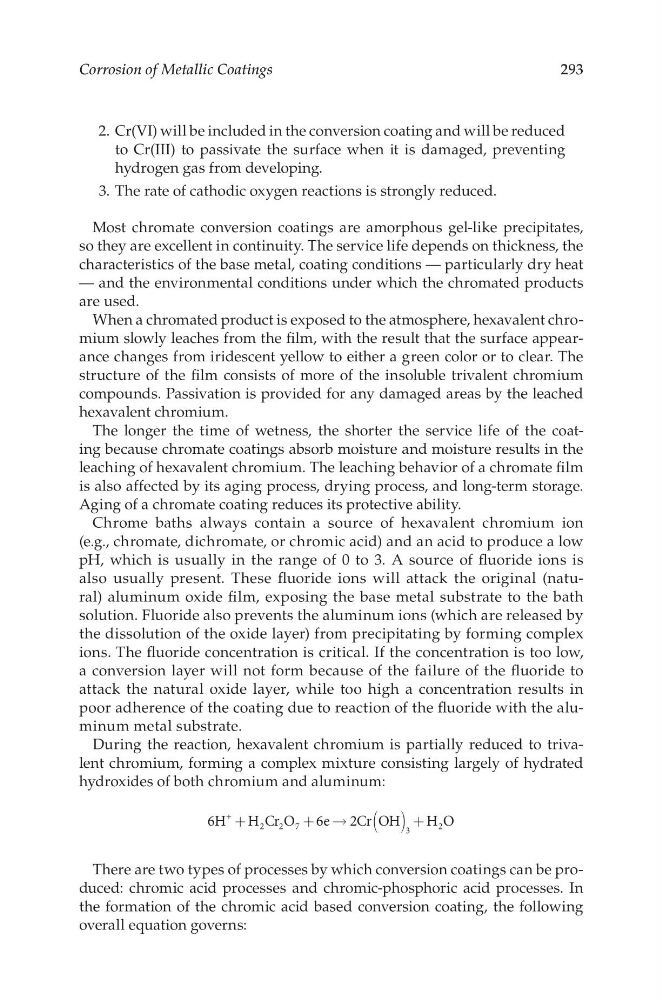
During the reaction, hexavalent chromium is partially reduced to trivalent chromium, forming a complex mixture consisting largely of hydrated
hydroxides of both chromium and aluminum:
6H H Cr O
e 2Cr OH
H
+
2
2 7
2
+
+ →
( ) +
6
3
O
There are two types of processes by which conversion coatings can be produced: chromic acid processes and chromic-phosphoric acid processes. In
the formation of the chromic acid based conversion coating, the following
overall equation governs:
293
2. Cr(VI) will be included in the conversion coating and will be reduced
to Cr(III) to passivate the surface when it is damaged, preventing
hydrogen gas from developing.
3. The rate of cathodic oxygen reactions is strongly reduced.
Most chromate conversion coatings are amorphous gel-like precipitates,
so they are excellent in continuity. The service life depends on thickness, the
characteristics of the base metal, coating conditions — particularly dry heat
— and the environmental conditions under which the chromated products
are used.
When a chromated product is exposed to the atmosphere, hexavalent chromium slowly leaches from the film, with the result that the surface appearance changes from iridescent yellow to either a green color or to clear. The
structure of the film consists of more of the insoluble trivalent chromium
compounds. Passivation is provided for any damaged areas by the leached
hexavalent chromium.
The longer the time of wetness, the shorter the service life of the coating because chromate coatings absorb moisture and moisture results in the
leaching of hexavalent chromium. The leaching behavior of a chromate film
is also affected by its aging process, drying process, and long-term storage.
Aging of a chromate coating reduces its protective ability.
Chrome baths always contain a source of hexavalent chromium ion
(e.g., chromate, dichromate, or chromic acid) and an acid to produce a low
pH, which is usually in the range of 0 to 3. A source of fluoride ions is
also usually present. These fluoride ions will attack the original (natural) aluminum oxide film, exposing the base metal substrate to the bath
solution. Fluoride also prevents the aluminum ions (which are released by
the dissolution of the oxide layer) from precipitating by forming complex
ions. The fluoride concentration is critical. If the concentration is too low,
a conversion layer will not form because of the failure of the fluoride to
attack the natural oxide layer, while too high a concentration results in
poor adherence of the coating due to reaction of the fluoride with the aluminum metal substrate.
During the reaction, hexavalent chromium is partially reduced to trivalent chromium, forming a complex mixture consisting largely of hydrated
hydroxides of both chromium and aluminum:
6H H Cr O
e 2Cr OH
H
+
2
2 7
2
+
+ →
( ) +
6
3
O
There are two types of processes by which conversion coatings can be produced: chromic acid processes and chromic-phosphoric acid processes. In
the formation of the chromic acid based conversion coating, the following
overall equation governs: