

294
Fundamentals of Corrosion
6H Cr O 3OHF 12Al 18HNO
3Cr O Al O 10Al
2
2 7
3
2 3
2 3
+
+
+
→
+
+
F F 6Cr NO
30H O
3
3 3
2
+
( ) +
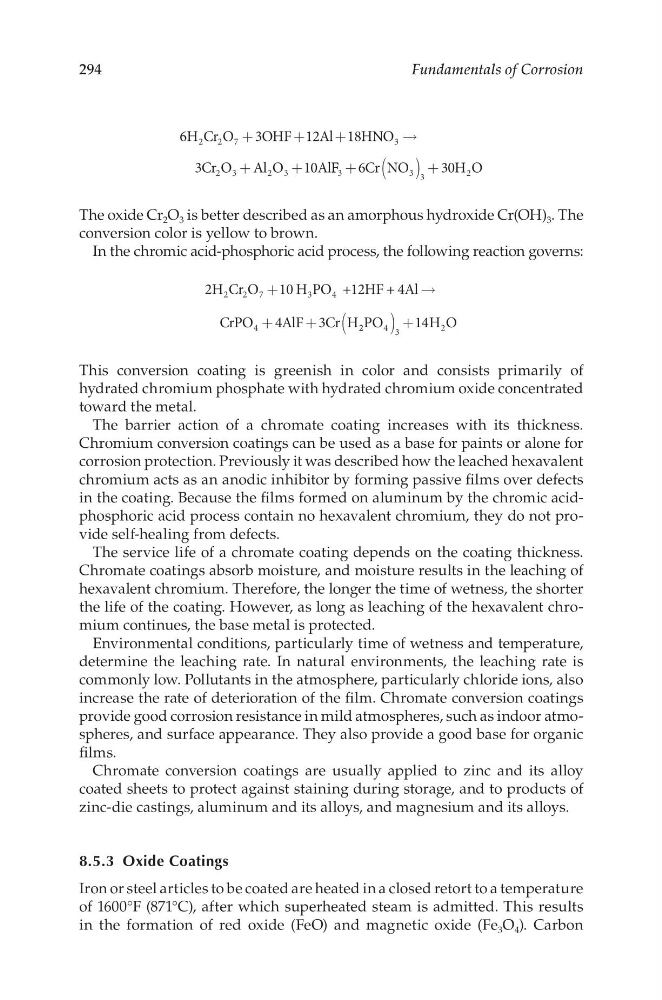
The oxide Cr 2 O 3 is better described as an amorphous hydroxide Cr(OH) 3 . The
conversion color is yellow to brown.
In the chromic acid-phosphoric acid process, the following reaction governs:
2H Cr O
HPO +12HF + 4Al
CrPO 4AlF 3Cr H
2
2 7
3
4
4
+
→
+
+
10
2 2
4
2
PO
H O
(
) +
3
14
This conversion coating is greenish in color and consists primarily of
hydrated chromium phosphate with hydrated chromium oxide concentrated
toward the metal.
The barrier action of a chromate coating increases with its thickness.
Chromium conversion coatings can be used as a base for paints or alone for
corrosion protection. Previously it was described how the leached hexavalent
chromium acts as an anodic inhibitor by forming passive films over defects
in the coating. Because the films formed on aluminum by the chromic acidphosphoric acid process contain no hexavalent chromium, they do not provide self-healing from defects.
The service life of a chromate coating depends on the coating thickness.
Chromate coatings absorb moisture, and moisture results in the leaching of
hexavalent chromium. Therefore, the longer the time of wetness, the shorter
the life of the coating. However, as long as leaching of the hexavalent chromium continues, the base metal is protected.
Environmental conditions, particularly time of wetness and temperature,
determine the leaching rate. In natural environments, the leaching rate is
commonly low. Pollutants in the atmosphere, particularly chloride ions, also
increase the rate of deterioration of the film. Chromate conversion coatings
provide good corrosion resistance in mild atmospheres, such as indoor atmospheres, and surface appearance. They also provide a good base for organic
films.
Chromate conversion coatings are usually applied to zinc and its alloy
coated sheets to protect against staining during storage, and to products of
zinc-die castings, aluminum and its alloys, and magnesium and its alloys.
8.5.3 Oxide Coatings
Iron or steel articles to be coated are heated in a closed retort to a temperature
of 1600°F (871°C), after which superheated steam is admitted. This results
in the formation of red oxide (FeO) and magnetic oxide (Fe 3 O 4 ). Carbon
Fundamentals of Corrosion
6H Cr O 3OHF 12Al 18HNO
3Cr O Al O 10Al
2
2 7
3
2 3
2 3
+
+
+
→
+
+
F F 6Cr NO
30H O
3
3 3
2
+
( ) +
The oxide Cr 2 O 3 is better described as an amorphous hydroxide Cr(OH) 3 . The
conversion color is yellow to brown.
In the chromic acid-phosphoric acid process, the following reaction governs:
2H Cr O
HPO +12HF + 4Al
CrPO 4AlF 3Cr H
2
2 7
3
4
4
+
→
+
+
10
2 2
4
2
PO
H O
(
) +
3
14
This conversion coating is greenish in color and consists primarily of
hydrated chromium phosphate with hydrated chromium oxide concentrated
toward the metal.
The barrier action of a chromate coating increases with its thickness.
Chromium conversion coatings can be used as a base for paints or alone for
corrosion protection. Previously it was described how the leached hexavalent
chromium acts as an anodic inhibitor by forming passive films over defects
in the coating. Because the films formed on aluminum by the chromic acidphosphoric acid process contain no hexavalent chromium, they do not provide self-healing from defects.
The service life of a chromate coating depends on the coating thickness.
Chromate coatings absorb moisture, and moisture results in the leaching of
hexavalent chromium. Therefore, the longer the time of wetness, the shorter
the life of the coating. However, as long as leaching of the hexavalent chromium continues, the base metal is protected.
Environmental conditions, particularly time of wetness and temperature,
determine the leaching rate. In natural environments, the leaching rate is
commonly low. Pollutants in the atmosphere, particularly chloride ions, also
increase the rate of deterioration of the film. Chromate conversion coatings
provide good corrosion resistance in mild atmospheres, such as indoor atmospheres, and surface appearance. They also provide a good base for organic
films.
Chromate conversion coatings are usually applied to zinc and its alloy
coated sheets to protect against staining during storage, and to products of
zinc-die castings, aluminum and its alloys, and magnesium and its alloys.
8.5.3 Oxide Coatings
Iron or steel articles to be coated are heated in a closed retort to a temperature
of 1600°F (871°C), after which superheated steam is admitted. This results
in the formation of red oxide (FeO) and magnetic oxide (Fe 3 O 4 ). Carbon