

292
Fundamentals of Corrosion
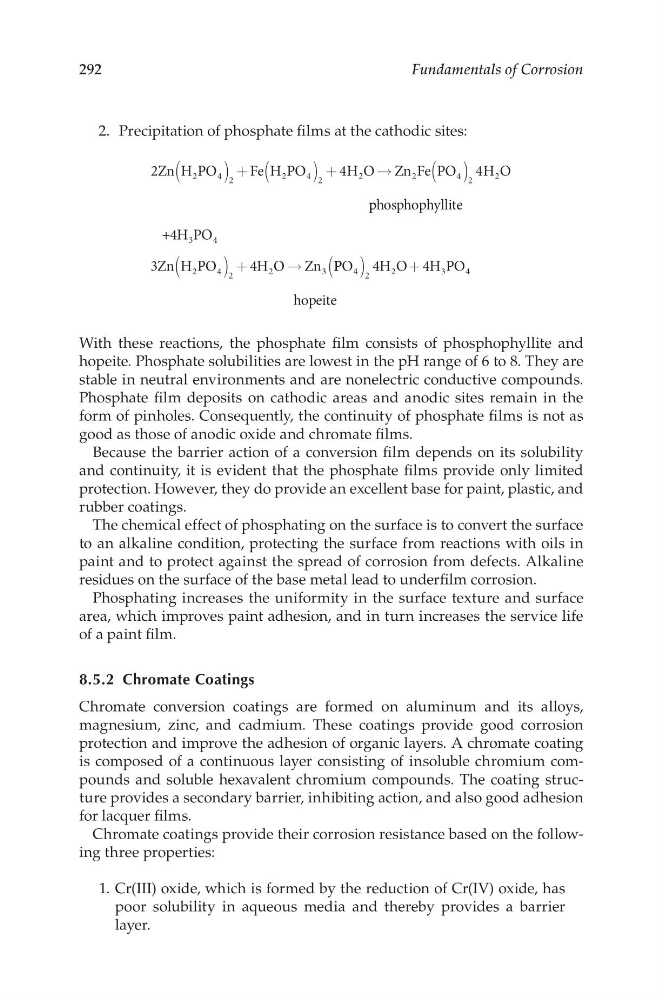
2. Precipitation of phosphate films at the cathodic sites:
2Zn H PO
Fe H PO
HO Zn Fe PO
H O
2
2
2
2
2
4 2
4 2
4 2
4
4
(
) + (
) +
→
( )
p phosphophyllite
+4H PO
3Zn H PO
4H O Zn
3
4
2
4
2
3
(
) +
→
2
P PO 4H O 4H PO
hopeite
4
2
3
4
( )
+
2
With these reactions, the phosphate film consists of phosphophyllite and
hopeite. Phosphate solubilities are lowest in the pH range of 6 to 8. They are
stable in neutral environments and are nonelectric conductive compounds.
Phosphate film deposits on cathodic areas and anodic sites remain in the
form of pinholes. Consequently, the continuity of phosphate films is not as
good as those of anodic oxide and chromate films.
Because the barrier action of a conversion film depends on its solubility
and continuity, it is evident that the phosphate films provide only limited
protection. However, they do provide an excellent base for paint, plastic, and
rubber coatings.
The chemical effect of phosphating on the surface is to convert the surface
to an alkaline condition, protecting the surface from reactions with oils in
paint and to protect against the spread of corrosion from defects. Alkaline
residues on the surface of the base metal lead to underfilm corrosion.
Phosphating increases the uniformity in the surface texture and surface
area, which improves paint adhesion, and in turn increases the service life
of a paint film.
8.5.2 Chromate Coatings
Chromate conversion coatings are formed on aluminum and its alloys,
magnesium, zinc, and cadmium. These coatings provide good corrosion
protection and improve the adhesion of organic layers. A chromate coating
is composed of a continuous layer consisting of insoluble chromium compounds and soluble hexavalent chromium compounds. The coating structure provides a secondary barrier, inhibiting action, and also good adhesion
for lacquer films.
Chromate coatings provide their corrosion resistance based on the following three properties:
1. Cr(III) oxide, which is formed by the reduction of Cr(IV) oxide, has
poor solubility in aqueous media and thereby provides a barrier
layer.
Fundamentals of Corrosion
2. Precipitation of phosphate films at the cathodic sites:
2Zn H PO
Fe H PO
HO Zn Fe PO
H O
2
2
2
2
2
4 2
4 2
4 2
4
4
(
) + (
) +
→
( )
p phosphophyllite
+4H PO
3Zn H PO
4H O Zn
3
4
2
4
2
3
(
) +
→
2
P PO 4H O 4H PO
hopeite
4
2
3
4
( )
+
2
With these reactions, the phosphate film consists of phosphophyllite and
hopeite. Phosphate solubilities are lowest in the pH range of 6 to 8. They are
stable in neutral environments and are nonelectric conductive compounds.
Phosphate film deposits on cathodic areas and anodic sites remain in the
form of pinholes. Consequently, the continuity of phosphate films is not as
good as those of anodic oxide and chromate films.
Because the barrier action of a conversion film depends on its solubility
and continuity, it is evident that the phosphate films provide only limited
protection. However, they do provide an excellent base for paint, plastic, and
rubber coatings.
The chemical effect of phosphating on the surface is to convert the surface
to an alkaline condition, protecting the surface from reactions with oils in
paint and to protect against the spread of corrosion from defects. Alkaline
residues on the surface of the base metal lead to underfilm corrosion.
Phosphating increases the uniformity in the surface texture and surface
area, which improves paint adhesion, and in turn increases the service life
of a paint film.
8.5.2 Chromate Coatings
Chromate conversion coatings are formed on aluminum and its alloys,
magnesium, zinc, and cadmium. These coatings provide good corrosion
protection and improve the adhesion of organic layers. A chromate coating
is composed of a continuous layer consisting of insoluble chromium compounds and soluble hexavalent chromium compounds. The coating structure provides a secondary barrier, inhibiting action, and also good adhesion
for lacquer films.
Chromate coatings provide their corrosion resistance based on the following three properties:
1. Cr(III) oxide, which is formed by the reduction of Cr(IV) oxide, has
poor solubility in aqueous media and thereby provides a barrier
layer.