

Corrosion of Metallic Coatings
257
direction. The behaviors of these electrode potentials are called anodic and
cathodic polarization. Each reaction-rate curve (E–i curve) is also called an
anodic or cathodic polarization curve.
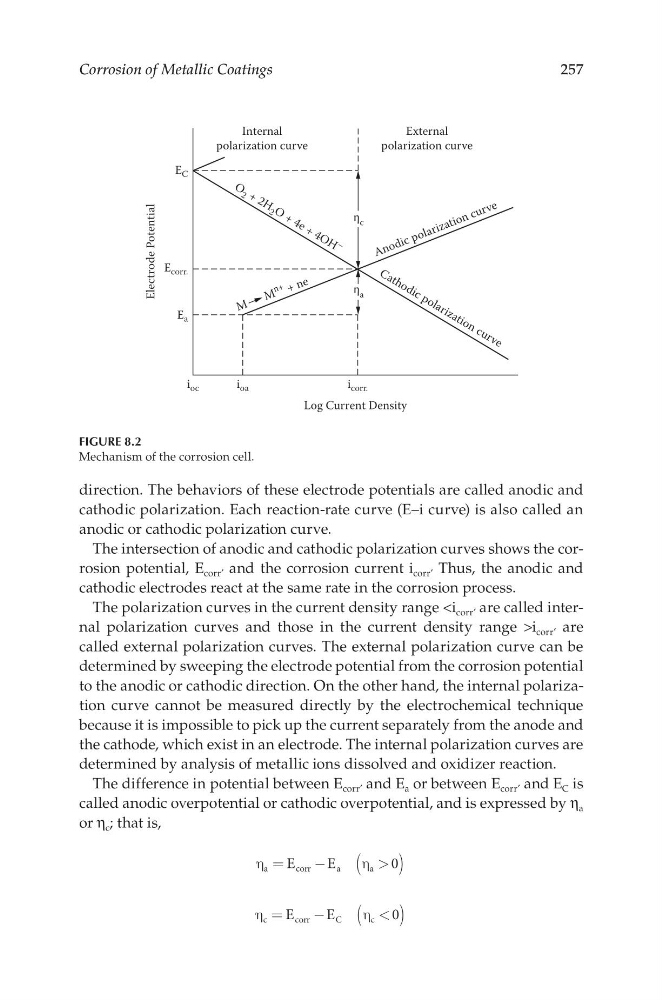
The intersection of anodic and cathodic polarization curves shows the corrosion potential, E corr′ and the corrosion current i corr′ Thus, the anodic and
cathodic electrodes react at the same rate in the corrosion process.
The polarization curves in the current density range i corr′ are
called external polarization curves. The external polarization curve can be
determined by sweeping the electrode potential from the corrosion potential
to the anodic or cathodic direction. On the other hand, the internal polarization curve cannot be measured directly by the electrochemical technique
because it is impossible to pick up the current separately from the anode and
the cathode, which exist in an electrode. The internal polarization curves are
determined by analysis of metallic ions dissolved and oxidizer reaction.
The difference in potential between E corr′ and E a or between E corr′ and E C is
called anodic overpotential or cathodic overpotential, and is expressed by η a
or η c ; that is,
η
η
a
c orr
a
a
E
E
=
−
>
(
)
0
η
η
c
c orr
C
c
E
E
=
−
<
(
)
0
Log Current Density
Electrode Potential
C a t h o d i c p o l a r i z a t i o n c u r v e
A n o d ic p o la r iz a ti o n c u r v e
i corr.
i oa
M
n + + n e
M
i oc
E a
E C
E corr.
Internal
polarization curve
External
polarization curve
η c
η a
O
2 + 2 H
2 O + 4 e + 4 O H –
FigurE 8.2
Mechanism of the corrosion cell.
257
direction. The behaviors of these electrode potentials are called anodic and
cathodic polarization. Each reaction-rate curve (E–i curve) is also called an
anodic or cathodic polarization curve.
The intersection of anodic and cathodic polarization curves shows the corrosion potential, E corr′ and the corrosion current i corr′ Thus, the anodic and
cathodic electrodes react at the same rate in the corrosion process.
The polarization curves in the current density range i corr′ are
called external polarization curves. The external polarization curve can be
determined by sweeping the electrode potential from the corrosion potential
to the anodic or cathodic direction. On the other hand, the internal polarization curve cannot be measured directly by the electrochemical technique
because it is impossible to pick up the current separately from the anode and
the cathode, which exist in an electrode. The internal polarization curves are
determined by analysis of metallic ions dissolved and oxidizer reaction.
The difference in potential between E corr′ and E a or between E corr′ and E C is
called anodic overpotential or cathodic overpotential, and is expressed by η a
or η c ; that is,
η
η
a
c orr
a
a
E
E
=
−
>
(
)
0
η
η
c
c orr
C
c
E
E
=
−
<
(
)
0
Log Current Density
Electrode Potential
C a t h o d i c p o l a r i z a t i o n c u r v e
A n o d ic p o la r iz a ti o n c u r v e
i corr.
i oa
M
n + + n e
M
i oc
E a
E C
E corr.
Internal
polarization curve
External
polarization curve
η c
η a
O
2 + 2 H
2 O + 4 e + 4 O H –
FigurE 8.2
Mechanism of the corrosion cell.