

258
Fundamentals of Corrosion
η a corr
/i ′ or η C corr
/i ′ represent the anodic or the cathodic reaction resistance.
The corrosion reaction starts as soon as the cell circuit is formed. That is,
E
E
i
R
C
a
C
a
corr
− =
+ + ′
η
η
where R is the resistance of the electrolyte between the anode and cathode.
Thus, the electromotive force of a corrosion cell is dissipated as the corrosion
current passes through three processes: the anodic process, the cathodic process, and the transit process in the electrolyte.
In general, when the electrode is polarized, the overpotential η observed
is composed of the activation overpotential η a and the concentration overpotential η c (Figure 8.3.) That is,
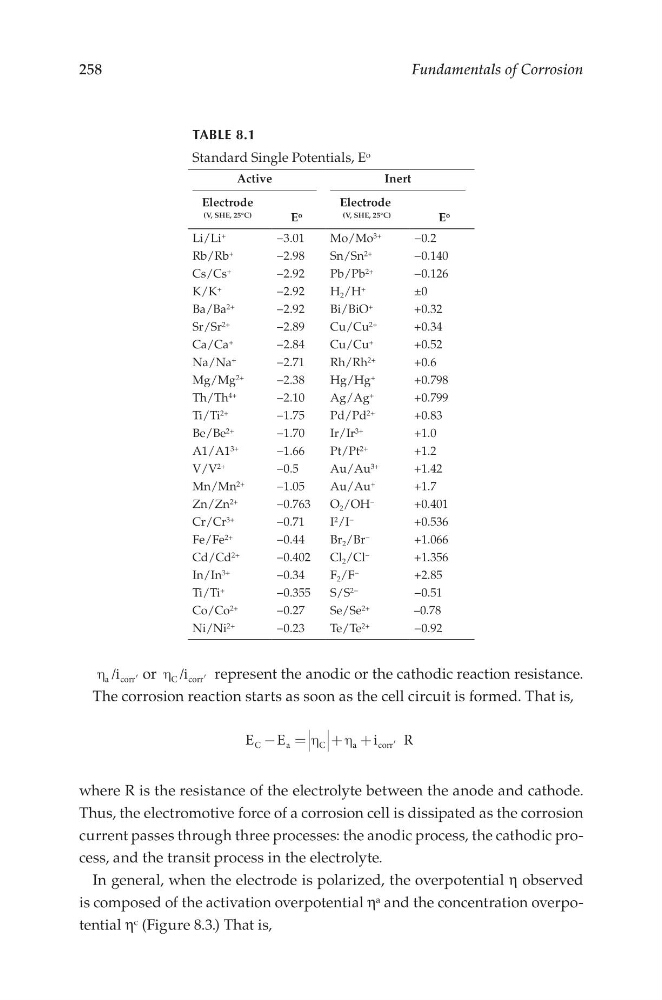
TabLE 8.1
Standard Single Potentials, E o
Active
Inert
Electrode
(V, SHE, 25°C)
E o
Electrode
(V, SHE, 25°C)
E o
Li/Li +
−3.01
Mo/Mo 3+
−0.2
Rb/Rb +
−2.98
Sn/Sn 2+
−0.140
Cs/Cs +
−2.92
Pb/Pb 2+
−0.126
K/K +
−2.92
H 2 /H +
±0
Ba/Ba 2+
−2.92
Bi/BiO +
+0.32
Sr/Sr 2+
−2.89
Cu/Cu 2+
+0.34
Ca/Ca +
−2.84
Cu/Cu +
+0.52
Na/Na +
−2.71
Rh/Rh 2+
+0.6
Mg/Mg 2+
−2.38
Hg/Hg +
+0.798
Th/Th 4+
−2.10
Ag/Ag +
+0.799
Ti/Ti 2+
−1.75
Pd/Pd 2+
+0.83
Be/Be 2+
−1.70
Ir/Ir 3+
+1.0
A1/A1 3+
−1.66
Pt/Pt 2+
+1.2
V/V 2+
−0.5
Au/Au 3+
+1.42
Mn/Mn 2+
−1.05
Au/Au +
+1.7
Zn/Zn 2+
−0.763
O 2 /OH −
+0.401
Cr/Cr 3+
−0.71
I 2 /I −
+0.536
Fe/Fe 2+
−0.44
Br 2 /Br −
+1.066
Cd/Cd 2+
−0.402
Cl 2 /Cl −
+1.356
In/In 3+
−0.34
F 2 /F −
+2.85
Ti/Ti +
−0.355
S/S 2−
−0.51
Co/Co 2+
−0.27
Se/Se 2+
–0.78
Ni/Ni 2+
−0.23
Te/Te 2+
−0.92
Fundamentals of Corrosion
η a corr
/i ′ or η C corr
/i ′ represent the anodic or the cathodic reaction resistance.
The corrosion reaction starts as soon as the cell circuit is formed. That is,
E
E
i
R
C
a
C
a
corr
− =
+ + ′
η
η
where R is the resistance of the electrolyte between the anode and cathode.
Thus, the electromotive force of a corrosion cell is dissipated as the corrosion
current passes through three processes: the anodic process, the cathodic process, and the transit process in the electrolyte.
In general, when the electrode is polarized, the overpotential η observed
is composed of the activation overpotential η a and the concentration overpotential η c (Figure 8.3.) That is,
TabLE 8.1
Standard Single Potentials, E o
Active
Inert
Electrode
(V, SHE, 25°C)
E o
Electrode
(V, SHE, 25°C)
E o
Li/Li +
−3.01
Mo/Mo 3+
−0.2
Rb/Rb +
−2.98
Sn/Sn 2+
−0.140
Cs/Cs +
−2.92
Pb/Pb 2+
−0.126
K/K +
−2.92
H 2 /H +
±0
Ba/Ba 2+
−2.92
Bi/BiO +
+0.32
Sr/Sr 2+
−2.89
Cu/Cu 2+
+0.34
Ca/Ca +
−2.84
Cu/Cu +
+0.52
Na/Na +
−2.71
Rh/Rh 2+
+0.6
Mg/Mg 2+
−2.38
Hg/Hg +
+0.798
Th/Th 4+
−2.10
Ag/Ag +
+0.799
Ti/Ti 2+
−1.75
Pd/Pd 2+
+0.83
Be/Be 2+
−1.70
Ir/Ir 3+
+1.0
A1/A1 3+
−1.66
Pt/Pt 2+
+1.2
V/V 2+
−0.5
Au/Au 3+
+1.42
Mn/Mn 2+
−1.05
Au/Au +
+1.7
Zn/Zn 2+
−0.763
O 2 /OH −
+0.401
Cr/Cr 3+
−0.71
I 2 /I −
+0.536
Fe/Fe 2+
−0.44
Br 2 /Br −
+1.066
Cd/Cd 2+
−0.402
Cl 2 /Cl −
+1.356
In/In 3+
−0.34
F 2 /F −
+2.85
Ti/Ti +
−0.355
S/S 2−
−0.51
Co/Co 2+
−0.27
Se/Se 2+
–0.78
Ni/Ni 2+
−0.23
Te/Te 2+
−0.92