

Corrosion of Paint
249
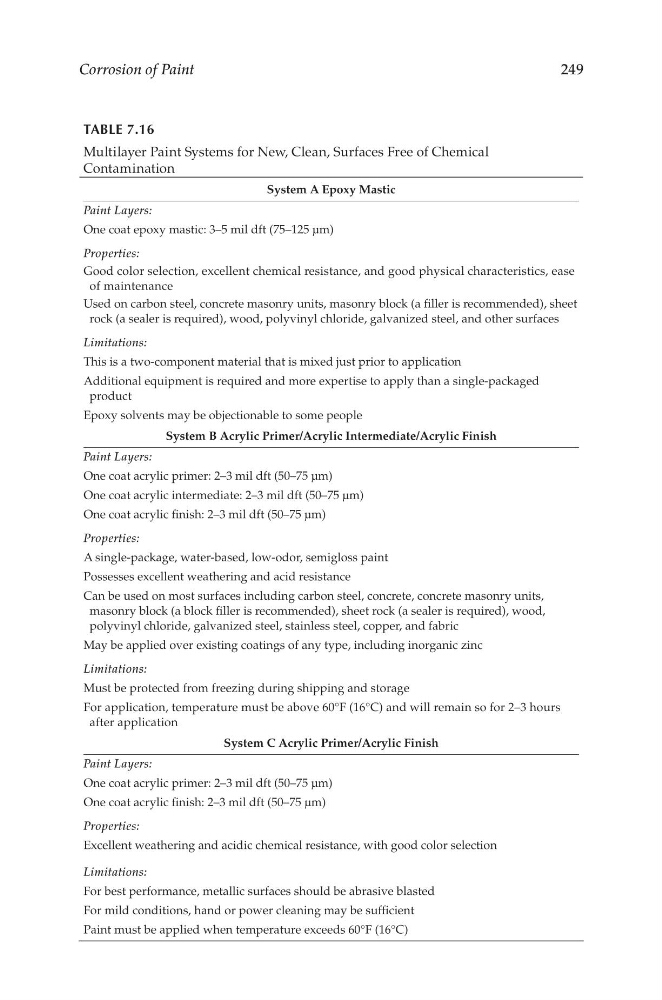
TabLE 7.16
Multilayer Paint Systems for New, Clean, Surfaces Free of Chemical
Contamination
System A Epoxy Mastic
Paint Layers:
One coat epoxy mastic: 3–5 mil dft (75–125 μm)
Properties:
Good color selection, excellent chemical resistance, and good physical characteristics, ease
of maintenance
Used on carbon steel, concrete masonry units, masonry block (a filler is recommended), sheet
rock (a sealer is required), wood, polyvinyl chloride, galvanized steel, and other surfaces
Limitations:
This is a two-component material that is mixed just prior to application
Additional equipment is required and more expertise to apply than a single-packaged
product
Epoxy solvents may be objectionable to some people
System B Acrylic Primer/Acrylic Intermediate/Acrylic Finish
Paint Layers:
One coat acrylic primer: 2–3 mil dft (50–75 μm)
One coat acrylic intermediate: 2–3 mil dft (50–75 μm)
One coat acrylic finish: 2–3 mil dft (50–75 μm)
Properties:
A single-package, water-based, low-odor, semigloss paint
Possesses excellent weathering and acid resistance
Can be used on most surfaces including carbon steel, concrete, concrete masonry units,
masonry block (a block filler is recommended), sheet rock (a sealer is required), wood,
polyvinyl chloride, galvanized steel, stainless steel, copper, and fabric
May be applied over existing coatings of any type, including inorganic zinc
Limitations:
Must be protected from freezing during shipping and storage
For application, temperature must be above 60°F (16°C) and will remain so for 2–3 hours
after application
System C Acrylic Primer/Acrylic Finish
Paint Layers:
One coat acrylic primer: 2–3 mil dft (50–75 μm)
One coat acrylic finish: 2–3 mil dft (50–75 μm)
Properties:
Excellent weathering and acidic chemical resistance, with good color selection
Limitations:
For best performance, metallic surfaces should be abrasive blasted
For mild conditions, hand or power cleaning may be sufficient
Paint must be applied when temperature exceeds 60°F (16°C)
249
TabLE 7.16
Multilayer Paint Systems for New, Clean, Surfaces Free of Chemical
Contamination
System A Epoxy Mastic
Paint Layers:
One coat epoxy mastic: 3–5 mil dft (75–125 μm)
Properties:
Good color selection, excellent chemical resistance, and good physical characteristics, ease
of maintenance
Used on carbon steel, concrete masonry units, masonry block (a filler is recommended), sheet
rock (a sealer is required), wood, polyvinyl chloride, galvanized steel, and other surfaces
Limitations:
This is a two-component material that is mixed just prior to application
Additional equipment is required and more expertise to apply than a single-packaged
product
Epoxy solvents may be objectionable to some people
System B Acrylic Primer/Acrylic Intermediate/Acrylic Finish
Paint Layers:
One coat acrylic primer: 2–3 mil dft (50–75 μm)
One coat acrylic intermediate: 2–3 mil dft (50–75 μm)
One coat acrylic finish: 2–3 mil dft (50–75 μm)
Properties:
A single-package, water-based, low-odor, semigloss paint
Possesses excellent weathering and acid resistance
Can be used on most surfaces including carbon steel, concrete, concrete masonry units,
masonry block (a block filler is recommended), sheet rock (a sealer is required), wood,
polyvinyl chloride, galvanized steel, stainless steel, copper, and fabric
May be applied over existing coatings of any type, including inorganic zinc
Limitations:
Must be protected from freezing during shipping and storage
For application, temperature must be above 60°F (16°C) and will remain so for 2–3 hours
after application
System C Acrylic Primer/Acrylic Finish
Paint Layers:
One coat acrylic primer: 2–3 mil dft (50–75 μm)
One coat acrylic finish: 2–3 mil dft (50–75 μm)
Properties:
Excellent weathering and acidic chemical resistance, with good color selection
Limitations:
For best performance, metallic surfaces should be abrasive blasted
For mild conditions, hand or power cleaning may be sufficient
Paint must be applied when temperature exceeds 60°F (16°C)