

248
Fundamentals of Corrosion
7.9.2 area 2: Temporary Protection, Normally Dry interiors
This area consists of office space or dry storage areas (warehouses) or
other locations exposed to generally mild conditions or areas where oilbased paints presently last for 10 or more years. If located in an industrial
environment, there is the possibility of exposure to occasional fumes,
splashing, or spillage of corrosive materials. Because of this, it is suggested that an industrial-grade acrylic coating system or a single coat of
epoxy be applied.
This recommendation is not suitable for interior surfaces that are frequently
cleaned or exposed to steam cleaning. Refer to Area 4. Recommended for
this area are systems A and C in Table 7.16.
7.9.3 area 3: Normally Dry Exteriors
This includes such areas as parking lots, water storage tanks, exterior storage sheds, and lighting or power line poles that are exposed to sunlight in a
relatively dry location. Under these conditions, oil-based paints should last 6
or more years. Those materials that are resistant to UV rays and are normally
rated for exterior use include acrylics, alkyds, silicones, and polyurethanes.
Epoxies will lose gloss, normally chalk, and fade rapidly when exposed to
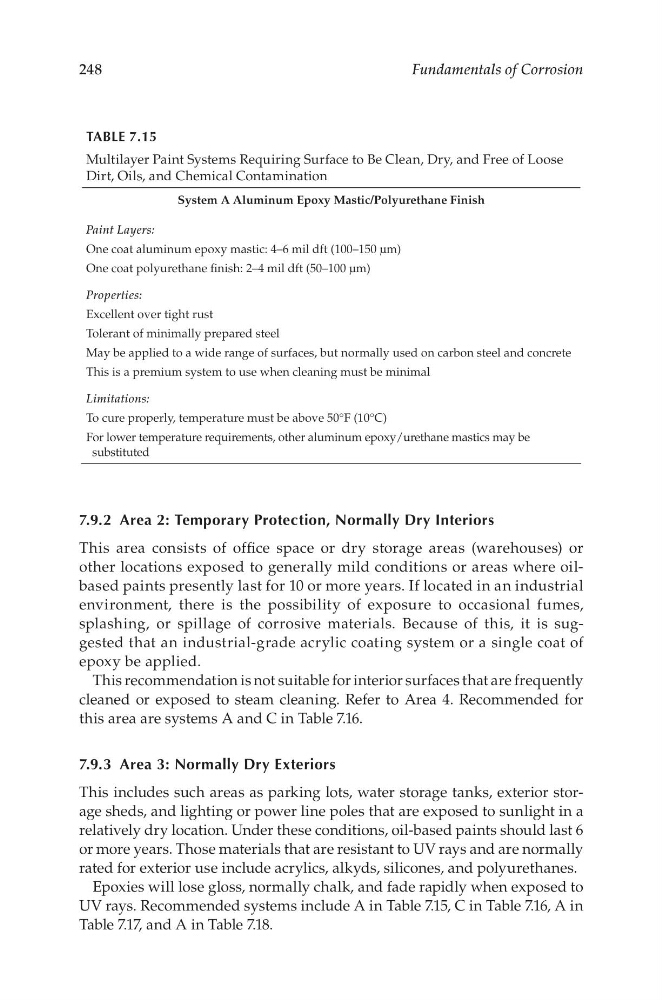
UV rays. Recommended systems include A in Table 7.15, C in Table 7.16, A in
Table 7.17, and A in Table 7.18.
TabLE 7.15
Multilayer Paint Systems Requiring Surface to Be Clean, Dry, and Free of Loose
Dirt, Oils, and Chemical Contamination
System A Aluminum Epoxy Mastic/Polyurethane Finish
Paint Layers:
One coat aluminum epoxy mastic: 4–6 mil dft (100–150 μm)
One coat polyurethane finish: 2–4 mil dft (50–100 μm)
Properties:
Excellent over tight rust
Tolerant of minimally prepared steel
May be applied to a wide range of surfaces, but normally used on carbon steel and concrete
This is a premium system to use when cleaning must be minimal
Limitations:
To cure properly, temperature must be above 50°F (10°C)
For lower temperature requirements, other aluminum epoxy/urethane mastics may be
substituted
Fundamentals of Corrosion
7.9.2 area 2: Temporary Protection, Normally Dry interiors
This area consists of office space or dry storage areas (warehouses) or
other locations exposed to generally mild conditions or areas where oilbased paints presently last for 10 or more years. If located in an industrial
environment, there is the possibility of exposure to occasional fumes,
splashing, or spillage of corrosive materials. Because of this, it is suggested that an industrial-grade acrylic coating system or a single coat of
epoxy be applied.
This recommendation is not suitable for interior surfaces that are frequently
cleaned or exposed to steam cleaning. Refer to Area 4. Recommended for
this area are systems A and C in Table 7.16.
7.9.3 area 3: Normally Dry Exteriors
This includes such areas as parking lots, water storage tanks, exterior storage sheds, and lighting or power line poles that are exposed to sunlight in a
relatively dry location. Under these conditions, oil-based paints should last 6
or more years. Those materials that are resistant to UV rays and are normally
rated for exterior use include acrylics, alkyds, silicones, and polyurethanes.
Epoxies will lose gloss, normally chalk, and fade rapidly when exposed to
UV rays. Recommended systems include A in Table 7.15, C in Table 7.16, A in
Table 7.17, and A in Table 7.18.
TabLE 7.15
Multilayer Paint Systems Requiring Surface to Be Clean, Dry, and Free of Loose
Dirt, Oils, and Chemical Contamination
System A Aluminum Epoxy Mastic/Polyurethane Finish
Paint Layers:
One coat aluminum epoxy mastic: 4–6 mil dft (100–150 μm)
One coat polyurethane finish: 2–4 mil dft (50–100 μm)
Properties:
Excellent over tight rust
Tolerant of minimally prepared steel
May be applied to a wide range of surfaces, but normally used on carbon steel and concrete
This is a premium system to use when cleaning must be minimal
Limitations:
To cure properly, temperature must be above 50°F (10°C)
For lower temperature requirements, other aluminum epoxy/urethane mastics may be
substituted