

Corrosion of Paint
247
7.9.1 area 1: Mild Exposure
This is an area where structural steel is embedded in concrete, encased
in masonry, or protected by noncorrosive type fire-proofing. In many
instances, no coating will be applied to the steel. However, it is a good
idea to coat the steel substrate with a protective coating to protect it during construction and in case it ends up being intentionally or unintentionally exposed.
A good practice would be to apply a general-use epoxy primer, 3 to 5 mil
dry film thickness (dft) (75 to 125 μm). If the surface cannot be abrasiveblasted, a surface-tolerant epoxy mastic may be used.
Recommended systems are found in Table 7.16, systems A and C.
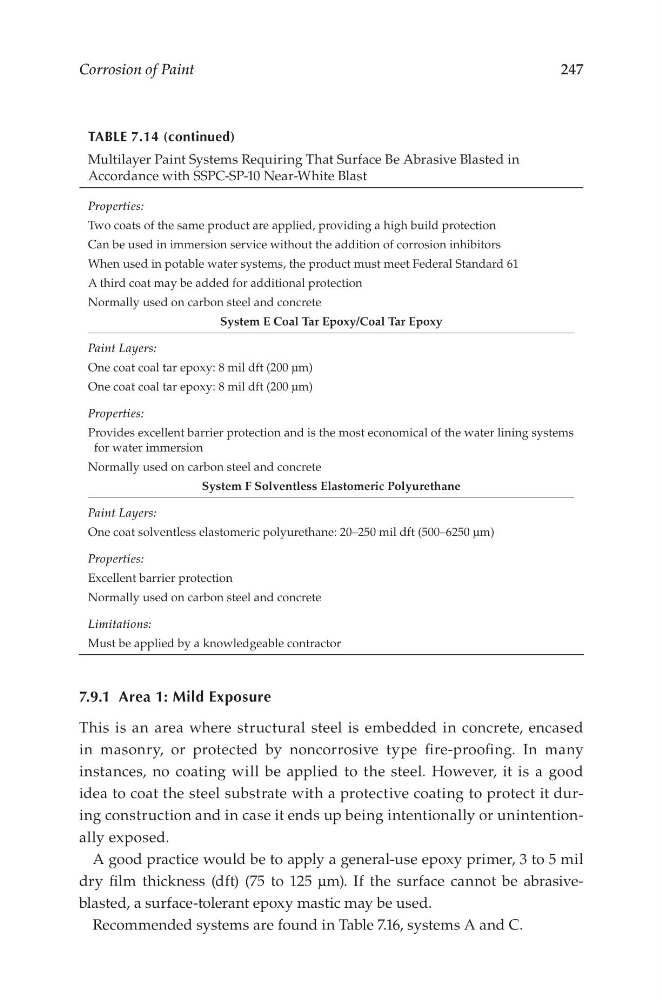
TabLE 7.14 (continued)
Multilayer Paint Systems Requiring That Surface Be Abrasive Blasted in
Accordance with SSPC-SP-10 Near-White Blast
Properties:
Two coats of the same product are applied, providing a high build protection
Can be used in immersion service without the addition of corrosion inhibitors
When used in potable water systems, the product must meet Federal Standard 61
A third coat may be added for additional protection
Normally used on carbon steel and concrete
System E Coal Tar Epoxy/Coal Tar Epoxy
Paint Layers:
One coat coal tar epoxy: 8 mil dft (200 μm)
One coat coal tar epoxy: 8 mil dft (200 μm)
Properties:
Provides excellent barrier protection and is the most economical of the water lining systems
for water immersion
Normally used on carbon steel and concrete
System F Solventless Elastomeric Polyurethane
Paint Layers:
One coat solventless elastomeric polyurethane: 20–250 mil dft (500–6250 μm)
Properties:
Excellent barrier protection
Normally used on carbon steel and concrete
Limitations:
Must be applied by a knowledgeable contractor
247
7.9.1 area 1: Mild Exposure
This is an area where structural steel is embedded in concrete, encased
in masonry, or protected by noncorrosive type fire-proofing. In many
instances, no coating will be applied to the steel. However, it is a good
idea to coat the steel substrate with a protective coating to protect it during construction and in case it ends up being intentionally or unintentionally exposed.
A good practice would be to apply a general-use epoxy primer, 3 to 5 mil
dry film thickness (dft) (75 to 125 μm). If the surface cannot be abrasiveblasted, a surface-tolerant epoxy mastic may be used.
Recommended systems are found in Table 7.16, systems A and C.
TabLE 7.14 (continued)
Multilayer Paint Systems Requiring That Surface Be Abrasive Blasted in
Accordance with SSPC-SP-10 Near-White Blast
Properties:
Two coats of the same product are applied, providing a high build protection
Can be used in immersion service without the addition of corrosion inhibitors
When used in potable water systems, the product must meet Federal Standard 61
A third coat may be added for additional protection
Normally used on carbon steel and concrete
System E Coal Tar Epoxy/Coal Tar Epoxy
Paint Layers:
One coat coal tar epoxy: 8 mil dft (200 μm)
One coat coal tar epoxy: 8 mil dft (200 μm)
Properties:
Provides excellent barrier protection and is the most economical of the water lining systems
for water immersion
Normally used on carbon steel and concrete
System F Solventless Elastomeric Polyurethane
Paint Layers:
One coat solventless elastomeric polyurethane: 20–250 mil dft (500–6250 μm)
Properties:
Excellent barrier protection
Normally used on carbon steel and concrete
Limitations:
Must be applied by a knowledgeable contractor