

250
Fundamentals of Corrosion
7.9.4 area 4: Freshwater Exposure
Under this category, the surface to be protected is frequently wetted by freshwater from condensation, splash, or spray. Included are interior or exterior areas
that are frequently exposed to cleaning or washing, including steam cleaning.
The systems used for these surfaces make use of inorganic zinc as a primer.
Inorganic zinc is the best coating that can be applied to steel because it provides the longest term of protection. In some instances, it may be necessary
to substitute an organic zinc (an organic binder such as epoxy or polyurethane with zinc added) for the inorganic zinc.
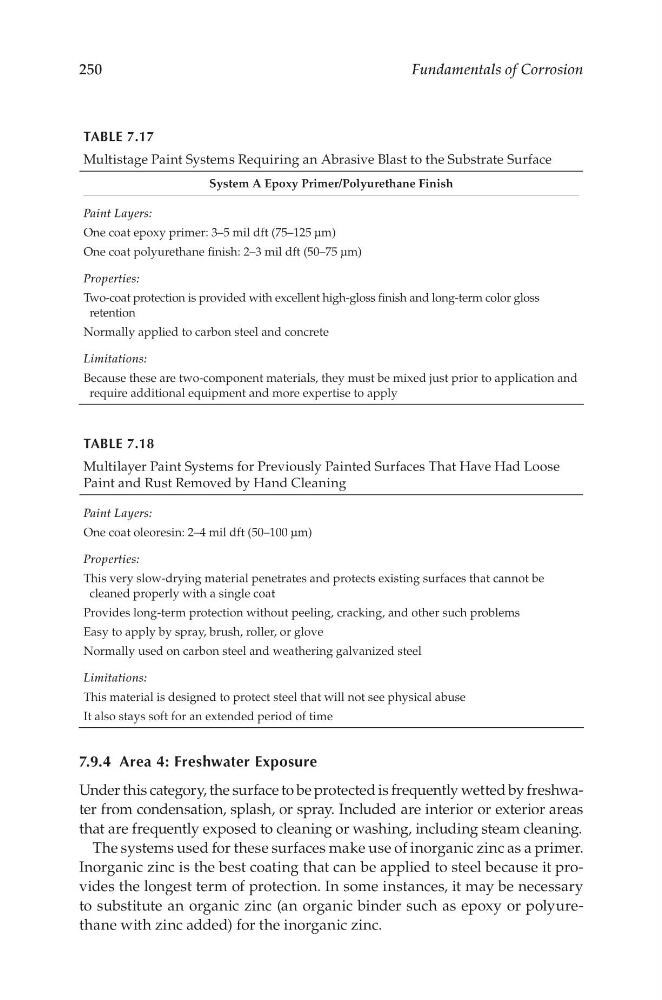
TabLE 7.17
Multistage Paint Systems Requiring an Abrasive Blast to the Substrate Surface
System A Epoxy Primer/Polyurethane Finish
Paint Layers:
One coat epoxy primer: 3–5 mil dft (75–125 μm)
One coat polyurethane finish: 2–3 mil dft (50–75 μm)
Properties:
Two-coat protection is provided with excellent high-gloss finish and long-term color gloss
retention
Normally applied to carbon steel and concrete
Limitations:
Because these are two-component materials, they must be mixed just prior to application and
require additional equipment and more expertise to apply
TabLE 7.18
Multilayer Paint Systems for Previously Painted Surfaces That Have Had Loose
Paint and Rust Removed by Hand Cleaning
Paint Layers:
One coat oleoresin: 2–4 mil dft (50–100 μm)
Properties:
This very slow-drying material penetrates and protects existing surfaces that cannot be
cleaned properly with a single coat
Provides long-term protection without peeling, cracking, and other such problems
Easy to apply by spray, brush, roller, or glove
Normally used on carbon steel and weathering galvanized steel
Limitations:
This material is designed to protect steel that will not see physical abuse
It also stays soft for an extended period of time
Fundamentals of Corrosion
7.9.4 area 4: Freshwater Exposure
Under this category, the surface to be protected is frequently wetted by freshwater from condensation, splash, or spray. Included are interior or exterior areas
that are frequently exposed to cleaning or washing, including steam cleaning.
The systems used for these surfaces make use of inorganic zinc as a primer.
Inorganic zinc is the best coating that can be applied to steel because it provides the longest term of protection. In some instances, it may be necessary
to substitute an organic zinc (an organic binder such as epoxy or polyurethane with zinc added) for the inorganic zinc.
TabLE 7.17
Multistage Paint Systems Requiring an Abrasive Blast to the Substrate Surface
System A Epoxy Primer/Polyurethane Finish
Paint Layers:
One coat epoxy primer: 3–5 mil dft (75–125 μm)
One coat polyurethane finish: 2–3 mil dft (50–75 μm)
Properties:
Two-coat protection is provided with excellent high-gloss finish and long-term color gloss
retention
Normally applied to carbon steel and concrete
Limitations:
Because these are two-component materials, they must be mixed just prior to application and
require additional equipment and more expertise to apply
TabLE 7.18
Multilayer Paint Systems for Previously Painted Surfaces That Have Had Loose
Paint and Rust Removed by Hand Cleaning
Paint Layers:
One coat oleoresin: 2–4 mil dft (50–100 μm)
Properties:
This very slow-drying material penetrates and protects existing surfaces that cannot be
cleaned properly with a single coat
Provides long-term protection without peeling, cracking, and other such problems
Easy to apply by spray, brush, roller, or glove
Normally used on carbon steel and weathering galvanized steel
Limitations:
This material is designed to protect steel that will not see physical abuse
It also stays soft for an extended period of time