

212
Fundamentals of Corrosion
in the matrix but they diffuse and react at temperatures higher than T g . The
principal chains of polymers with ketone groups form radicals:
RCOR ´
R=COR ´
CO + R ´
ROCOR ´
OCOR ´
CO 2 + R ´
The resultant radicals accelerate the degradation of the polymer and, in some
cases, HCl (from polyvinyl chloride) or CH 4 is produced.
7.3.3.2 Cohesive Failure
In chemical terms, there is a similarity between paints on one side and
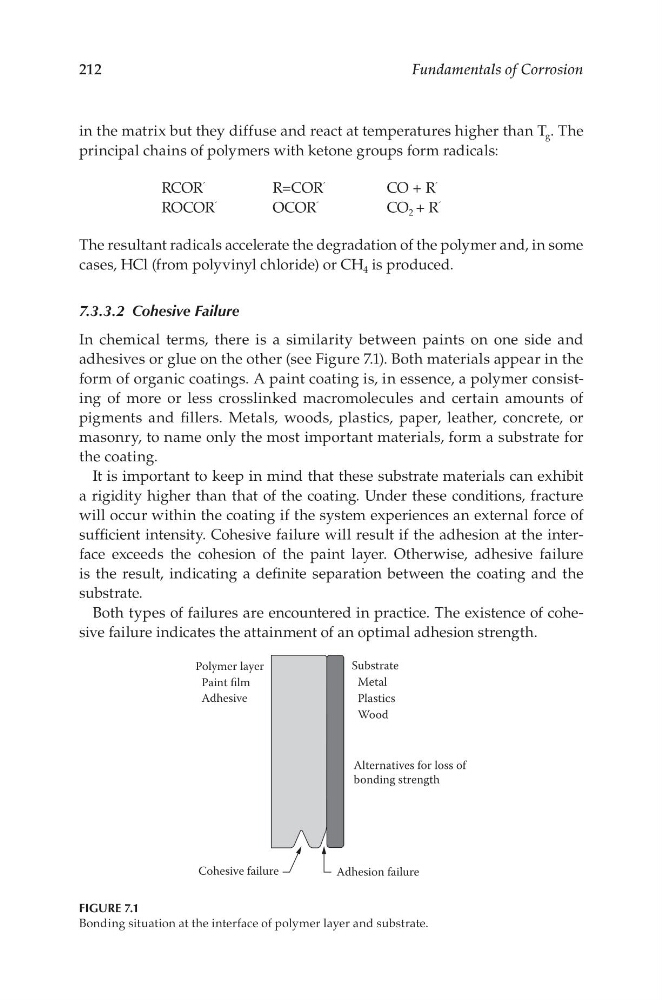
adhesives or glue on the other (see Figure 7.1). Both materials appear in the
form of organic coatings. A paint coating is, in essence, a polymer consisting of more or less crosslinked macromolecules and certain amounts of
pigments and fillers. Metals, woods, plastics, paper, leather, concrete, or
masonry, to name only the most important materials, form a substrate for
the coating.
It is important to keep in mind that these substrate materials can exhibit
a rigidity higher than that of the coating. Under these conditions, fracture
will occur within the coating if the system experiences an external force of
sufficient intensity. Cohesive failure will result if the adhesion at the interface exceeds the cohesion of the paint layer. Otherwise, adhesive failure
is the result, indicating a definite separation between the coating and the
substrate.
Both types of failures are encountered in practice. The existence of cohesive failure indicates the attainment of an optimal adhesion strength.
Adhesion failure
Alternatives for loss of
bonding strength
Substrate
Metal
Plastics
Wood
Cohesive failure
Polymer layer
Paint film
Adhesive
FigurE 7.1
Bonding situation at the interface of polymer layer and substrate.
Fundamentals of Corrosion
in the matrix but they diffuse and react at temperatures higher than T g . The
principal chains of polymers with ketone groups form radicals:
RCOR ´
R=COR ´
CO + R ´
ROCOR ´
OCOR ´
CO 2 + R ´
The resultant radicals accelerate the degradation of the polymer and, in some
cases, HCl (from polyvinyl chloride) or CH 4 is produced.
7.3.3.2 Cohesive Failure
In chemical terms, there is a similarity between paints on one side and
adhesives or glue on the other (see Figure 7.1). Both materials appear in the
form of organic coatings. A paint coating is, in essence, a polymer consisting of more or less crosslinked macromolecules and certain amounts of
pigments and fillers. Metals, woods, plastics, paper, leather, concrete, or
masonry, to name only the most important materials, form a substrate for
the coating.
It is important to keep in mind that these substrate materials can exhibit
a rigidity higher than that of the coating. Under these conditions, fracture
will occur within the coating if the system experiences an external force of
sufficient intensity. Cohesive failure will result if the adhesion at the interface exceeds the cohesion of the paint layer. Otherwise, adhesive failure
is the result, indicating a definite separation between the coating and the
substrate.
Both types of failures are encountered in practice. The existence of cohesive failure indicates the attainment of an optimal adhesion strength.
Adhesion failure
Alternatives for loss of
bonding strength
Substrate
Metal
Plastics
Wood
Cohesive failure
Polymer layer
Paint film
Adhesive
FigurE 7.1
Bonding situation at the interface of polymer layer and substrate.