

Corrosion of Paint
211
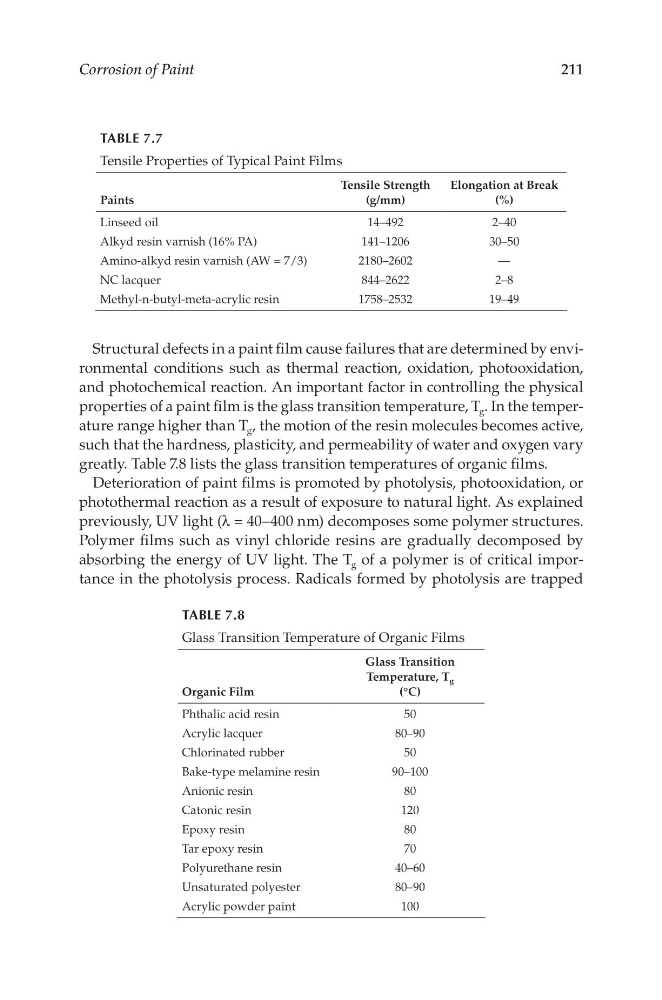
Structural defects in a paint film cause failures that are determined by environmental conditions such as thermal reaction, oxidation, photooxidation,
and photochemical reaction. An important factor in controlling the physical
properties of a paint film is the glass transition temperature, T g . In the temperature range higher than T g , the motion of the resin molecules becomes active,
such that the hardness, plasticity, and permeability of water and oxygen vary
greatly. Table 7.8 lists the glass transition temperatures of organic films.
Deterioration of paint films is promoted by photolysis, photooxidation, or
photothermal reaction as a result of exposure to natural light. As explained
previously, UV light (λ = 40–400 nm) decomposes some polymer structures.
Polymer films such as vinyl chloride resins are gradually decomposed by
absorbing the energy of UV light. The T g of a polymer is of critical importance in the photolysis process. Radicals formed by photolysis are trapped
TabLE 7.7
Tensile Properties of Typical Paint Films
Paints
Tensile Strength
(g/mm)
Elongation at Break
(%)
Linseed oil
14–492
2–40
Alkyd resin varnish (16% PA)
141–1206
30–50
Amino-alkyd resin varnish (AW = 7/3)
2180–2602
—
NC lacquer
844–2622
2–8
Methyl-n-butyl-meta-acrylic resin
1758–2532
19–49
TabLE 7.8
Glass Transition Temperature of Organic Films
Organic Film
Glass Transition
Temperature, T g
(°C)
Phthalic acid resin
50
Acrylic lacquer
80–90
Chlorinated rubber
50
Bake-type melamine resin
90–100
Anionic resin
80
Catonic resin
120
Epoxy resin
80
Tar epoxy resin
70
Polyurethane resin
40–60
Unsaturated polyester
80–90
Acrylic powder paint
100
211
Structural defects in a paint film cause failures that are determined by environmental conditions such as thermal reaction, oxidation, photooxidation,
and photochemical reaction. An important factor in controlling the physical
properties of a paint film is the glass transition temperature, T g . In the temperature range higher than T g , the motion of the resin molecules becomes active,
such that the hardness, plasticity, and permeability of water and oxygen vary
greatly. Table 7.8 lists the glass transition temperatures of organic films.
Deterioration of paint films is promoted by photolysis, photooxidation, or
photothermal reaction as a result of exposure to natural light. As explained
previously, UV light (λ = 40–400 nm) decomposes some polymer structures.
Polymer films such as vinyl chloride resins are gradually decomposed by
absorbing the energy of UV light. The T g of a polymer is of critical importance in the photolysis process. Radicals formed by photolysis are trapped
TabLE 7.7
Tensile Properties of Typical Paint Films
Paints
Tensile Strength
(g/mm)
Elongation at Break
(%)
Linseed oil
14–492
2–40
Alkyd resin varnish (16% PA)
141–1206
30–50
Amino-alkyd resin varnish (AW = 7/3)
2180–2602
—
NC lacquer
844–2622
2–8
Methyl-n-butyl-meta-acrylic resin
1758–2532
19–49
TabLE 7.8
Glass Transition Temperature of Organic Films
Organic Film
Glass Transition
Temperature, T g
(°C)
Phthalic acid resin
50
Acrylic lacquer
80–90
Chlorinated rubber
50
Bake-type melamine resin
90–100
Anionic resin
80
Catonic resin
120
Epoxy resin
80
Tar epoxy resin
70
Polyurethane resin
40–60
Unsaturated polyester
80–90
Acrylic powder paint
100