

Corrosion of Paint
213
7.3.3.3 Stress and Chemical Failures
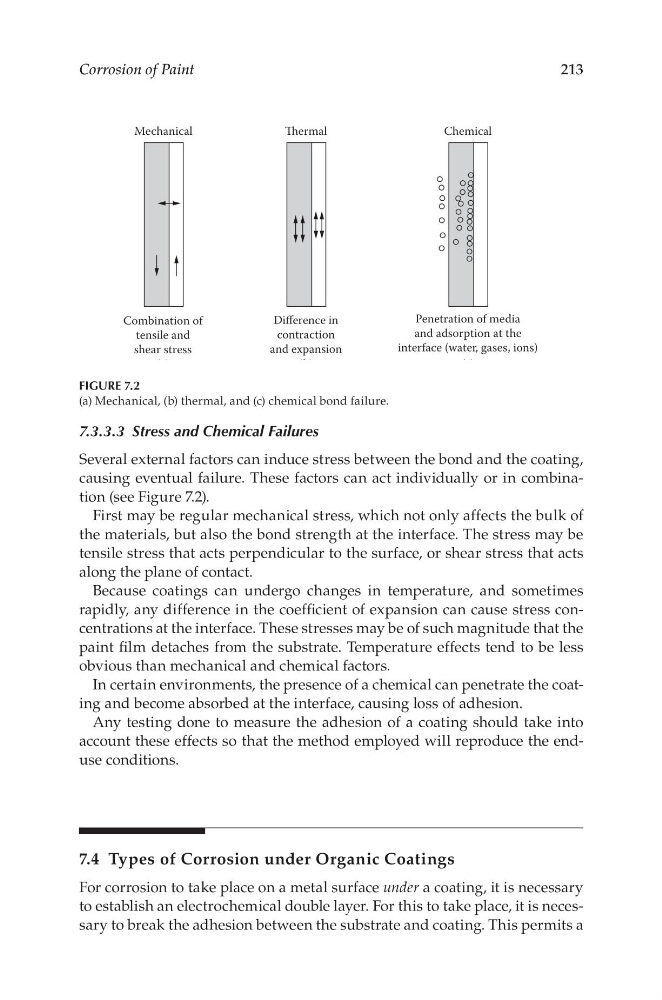
Several external factors can induce stress between the bond and the coating,
causing eventual failure. These factors can act individually or in combination (see Figure 7.2).
First may be regular mechanical stress, which not only affects the bulk of
the materials, but also the bond strength at the interface. The stress may be
tensile stress that acts perpendicular to the surface, or shear stress that acts
along the plane of contact.
Because coatings can undergo changes in temperature, and sometimes
rapidly, any difference in the coefficient of expansion can cause stress concentrations at the interface. These stresses may be of such magnitude that the
paint film detaches from the substrate. Temperature effects tend to be less
obvious than mechanical and chemical factors.
In certain environments, the presence of a chemical can penetrate the coating and become absorbed at the interface, causing loss of adhesion.
Any testing done to measure the adhesion of a coating should take into
account these effects so that the method employed will reproduce the enduse conditions.
7.4 Types of Corrosion under Organic Coatings
For corrosion to take place on a metal surface under a coating, it is necessary
to establish an electrochemical double layer. For this to take place, it is necessary to break the adhesion between the substrate and coating. This permits a
Penetration of media
and adsorption at the
interface (water, gases, ions)
Difference in
contraction
and expansion
Combination of
tensile and
shear stress
Mechanical
Th ermal
C hemical
(a)
(b)
(c)
FigurE 7.2
(a) Mechanical, (b) thermal, and (c) chemical bond failure.
213
7.3.3.3 Stress and Chemical Failures
Several external factors can induce stress between the bond and the coating,
causing eventual failure. These factors can act individually or in combination (see Figure 7.2).
First may be regular mechanical stress, which not only affects the bulk of
the materials, but also the bond strength at the interface. The stress may be
tensile stress that acts perpendicular to the surface, or shear stress that acts
along the plane of contact.
Because coatings can undergo changes in temperature, and sometimes
rapidly, any difference in the coefficient of expansion can cause stress concentrations at the interface. These stresses may be of such magnitude that the
paint film detaches from the substrate. Temperature effects tend to be less
obvious than mechanical and chemical factors.
In certain environments, the presence of a chemical can penetrate the coating and become absorbed at the interface, causing loss of adhesion.
Any testing done to measure the adhesion of a coating should take into
account these effects so that the method employed will reproduce the enduse conditions.
7.4 Types of Corrosion under Organic Coatings
For corrosion to take place on a metal surface under a coating, it is necessary
to establish an electrochemical double layer. For this to take place, it is necessary to break the adhesion between the substrate and coating. This permits a
Penetration of media
and adsorption at the
interface (water, gases, ions)
Difference in
contraction
and expansion
Combination of
tensile and
shear stress
Mechanical
Th ermal
C hemical
(a)
(b)
(c)
FigurE 7.2
(a) Mechanical, (b) thermal, and (c) chemical bond failure.