

Atmospheric Corrosion
107
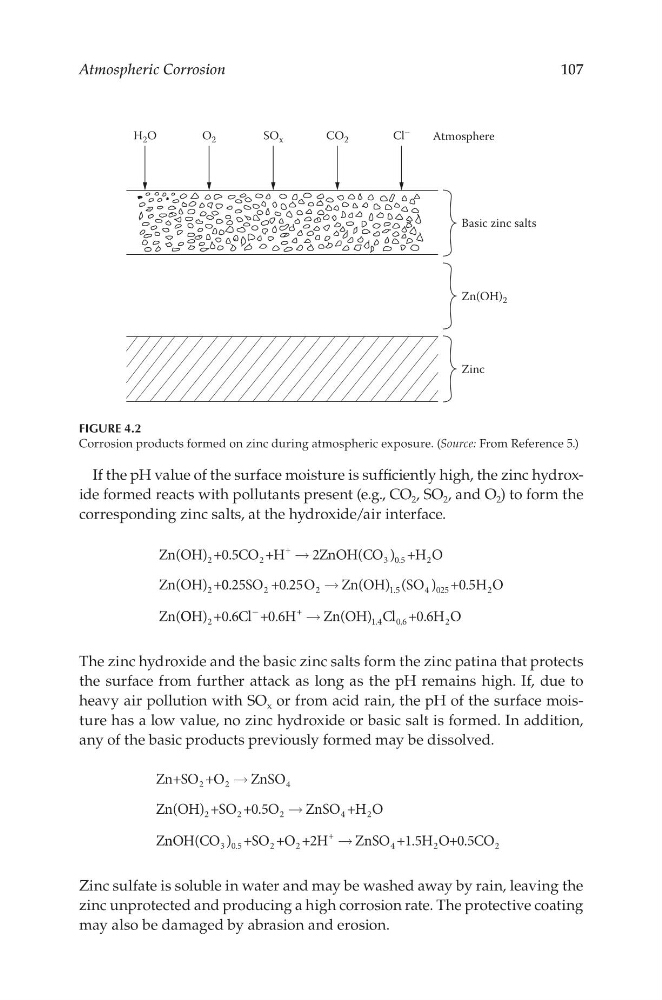
If the pH value of the surface moisture is sufficiently high, the zinc hydroxide formed reacts with pollutants present (e.g., CO 2 , SO 2 , and O 2 ) to form the
corresponding zinc salts, at the hydroxide/air interface.
Zn(OH) +0.5CO +H
2ZnOH(CO ) +H O
Zn(OH) +
2
2
+
3 0.5
2
2
→
0 0.25SO +0.25O
Zn(OH) (SO ) +0.5H O
Zn(
2
2
1.5
4 025
2
→
O OH) +0.6Cl +0.6H
Zn(OH) Cl +0.6H O
2
+
1.4
0.6
2
−
→
The zinc hydroxide and the basic zinc salts form the zinc patina that protects
the surface from further attack as long as the pH remains high. If, due to
heavy air pollution with SO x or from acid rain, the pH of the surface moisture has a low value, no zinc hydroxide or basic salt is formed. In addition,
any of the basic products previously formed may be dissolved.
Zn+SO +O
ZnSO
Zn(OH) +SO +0.5O
ZnSO +H O
Z
2
2
4
2
2
2
4
2
→
→
n nOH(CO ) +SO +O +2H
ZnSO +1.5H O+0.5CO
3 0.5
2
2
+
4
2
2
→
Zinc sulfate is soluble in water and may be washed away by rain, leaving the
zinc unprotected and producing a high corrosion rate. The protective coating
may also be damaged by abrasion and erosion.
Basic zinc salts
Atmosphere
Cl –
CO 2
O 2
H 2 O
S O x
Zn(OH) 2
Zinc
FigurE 4.2
Corrosion products formed on zinc during atmospheric exposure. (Source: From Reference 5.)
107
If the pH value of the surface moisture is sufficiently high, the zinc hydroxide formed reacts with pollutants present (e.g., CO 2 , SO 2 , and O 2 ) to form the
corresponding zinc salts, at the hydroxide/air interface.
Zn(OH) +0.5CO +H
2ZnOH(CO ) +H O
Zn(OH) +
2
2
+
3 0.5
2
2
→
0 0.25SO +0.25O
Zn(OH) (SO ) +0.5H O
Zn(
2
2
1.5
4 025
2
→
O OH) +0.6Cl +0.6H
Zn(OH) Cl +0.6H O
2
+
1.4
0.6
2
−
→
The zinc hydroxide and the basic zinc salts form the zinc patina that protects
the surface from further attack as long as the pH remains high. If, due to
heavy air pollution with SO x or from acid rain, the pH of the surface moisture has a low value, no zinc hydroxide or basic salt is formed. In addition,
any of the basic products previously formed may be dissolved.
Zn+SO +O
ZnSO
Zn(OH) +SO +0.5O
ZnSO +H O
Z
2
2
4
2
2
2
4
2
→
→
n nOH(CO ) +SO +O +2H
ZnSO +1.5H O+0.5CO
3 0.5
2
2
+
4
2
2
→
Zinc sulfate is soluble in water and may be washed away by rain, leaving the
zinc unprotected and producing a high corrosion rate. The protective coating
may also be damaged by abrasion and erosion.
Basic zinc salts
Atmosphere
Cl –
CO 2
O 2
H 2 O
S O x
Zn(OH) 2
Zinc
FigurE 4.2
Corrosion products formed on zinc during atmospheric exposure. (Source: From Reference 5.)