

108
Fundamentals of Corrosion
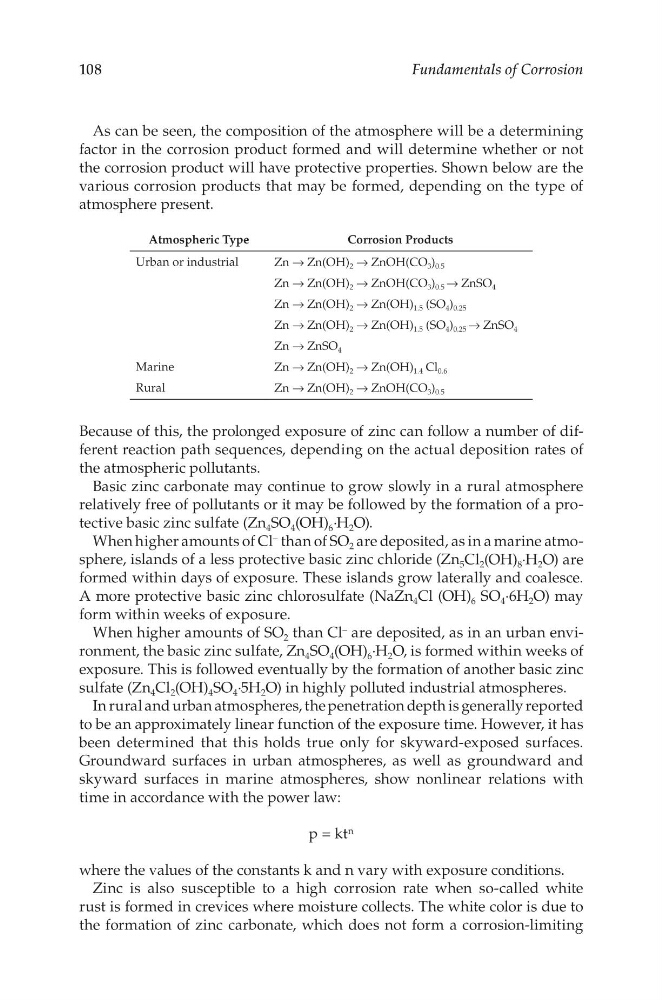
As can be seen, the composition of the atmosphere will be a determining
factor in the corrosion product formed and will determine whether or not
the corrosion product will have protective properties. Shown below are the
various corrosion products that may be formed, depending on the type of
atmosphere present.
Atmospheric Type
Corrosion Products
Urban or industrial
Zn → Zn(OH) 2 → ZnOH(CO 3 ) 0.5
Zn → Zn(OH) 2 → ZnOH(CO 3 ) 0.5 → ZnSO 4
Zn → Zn(OH) 2 → Zn(OH) 1.5 (SO 4 ) 0.25
Zn → Zn(OH) 2 → Zn(OH) 1.5 (SO 4 ) 0.25 → ZnSO 4
Zn → ZnSO 4
Marine
Zn → Zn(OH) 2 → Zn(OH) 1.4 Cl 0.6
Rural
Zn → Zn(OH) 2 → ZnOH(CO 3 ) 0.5
Because of this, the prolonged exposure of zinc can follow a number of different reaction path sequences, depending on the actual deposition rates of
the atmospheric pollutants.
Basic zinc carbonate may continue to grow slowly in a rural atmosphere
relatively free of pollutants or it may be followed by the formation of a protective basic zinc sulfate (Zn 4 SO 4 (OH) 6 ∙H 2 O).
When higher amounts of Cl − than of SO 2 are deposited, as in a marine atmosphere, islands of a less protective basic zinc chloride (Zn 5 Cl 2 (OH) 8 ∙H 2 O) are
formed within days of exposure. These islands grow laterally and coalesce.
A more protective basic zinc chlorosulfate (NaZn 4 Cl (OH) 6 SO 4 ∙6H 2 O) may
form within weeks of exposure.
When higher amounts of SO 2 than Cl – are deposited, as in an urban environment, the basic zinc sulfate, Zn 4 SO 4 (OH) 6 ∙H 2 O, is formed within weeks of
exposure. This is followed eventually by the formation of another basic zinc
sulfate (Zn 4 Cl 2 (OH) 4 SO 4 ∙5H 2 O) in highly polluted industrial atmospheres.
In rural and urban atmospheres, the penetration depth is generally reported
to be an approximately linear function of the exposure time. However, it has
been determined that this holds true only for skyward-exposed surfaces.
Groundward surfaces in urban atmospheres, as well as groundward and
skyward surfaces in marine atmospheres, show nonlinear relations with
time in accordance with the power law:
p = kt n
where the values of the constants k and n vary with exposure conditions.
Zinc is also susceptible to a high corrosion rate when so-called white
rust is formed in crevices where moisture collects. The white color is due to
the formation of zinc carbonate, which does not form a corrosion-limiting
Fundamentals of Corrosion
As can be seen, the composition of the atmosphere will be a determining
factor in the corrosion product formed and will determine whether or not
the corrosion product will have protective properties. Shown below are the
various corrosion products that may be formed, depending on the type of
atmosphere present.
Atmospheric Type
Corrosion Products
Urban or industrial
Zn → Zn(OH) 2 → ZnOH(CO 3 ) 0.5
Zn → Zn(OH) 2 → ZnOH(CO 3 ) 0.5 → ZnSO 4
Zn → Zn(OH) 2 → Zn(OH) 1.5 (SO 4 ) 0.25
Zn → Zn(OH) 2 → Zn(OH) 1.5 (SO 4 ) 0.25 → ZnSO 4
Zn → ZnSO 4
Marine
Zn → Zn(OH) 2 → Zn(OH) 1.4 Cl 0.6
Rural
Zn → Zn(OH) 2 → ZnOH(CO 3 ) 0.5
Because of this, the prolonged exposure of zinc can follow a number of different reaction path sequences, depending on the actual deposition rates of
the atmospheric pollutants.
Basic zinc carbonate may continue to grow slowly in a rural atmosphere
relatively free of pollutants or it may be followed by the formation of a protective basic zinc sulfate (Zn 4 SO 4 (OH) 6 ∙H 2 O).
When higher amounts of Cl − than of SO 2 are deposited, as in a marine atmosphere, islands of a less protective basic zinc chloride (Zn 5 Cl 2 (OH) 8 ∙H 2 O) are
formed within days of exposure. These islands grow laterally and coalesce.
A more protective basic zinc chlorosulfate (NaZn 4 Cl (OH) 6 SO 4 ∙6H 2 O) may
form within weeks of exposure.
When higher amounts of SO 2 than Cl – are deposited, as in an urban environment, the basic zinc sulfate, Zn 4 SO 4 (OH) 6 ∙H 2 O, is formed within weeks of
exposure. This is followed eventually by the formation of another basic zinc
sulfate (Zn 4 Cl 2 (OH) 4 SO 4 ∙5H 2 O) in highly polluted industrial atmospheres.
In rural and urban atmospheres, the penetration depth is generally reported
to be an approximately linear function of the exposure time. However, it has
been determined that this holds true only for skyward-exposed surfaces.
Groundward surfaces in urban atmospheres, as well as groundward and
skyward surfaces in marine atmospheres, show nonlinear relations with
time in accordance with the power law:
p = kt n
where the values of the constants k and n vary with exposure conditions.
Zinc is also susceptible to a high corrosion rate when so-called white
rust is formed in crevices where moisture collects. The white color is due to
the formation of zinc carbonate, which does not form a corrosion-limiting