

106
Fundamentals of Corrosion
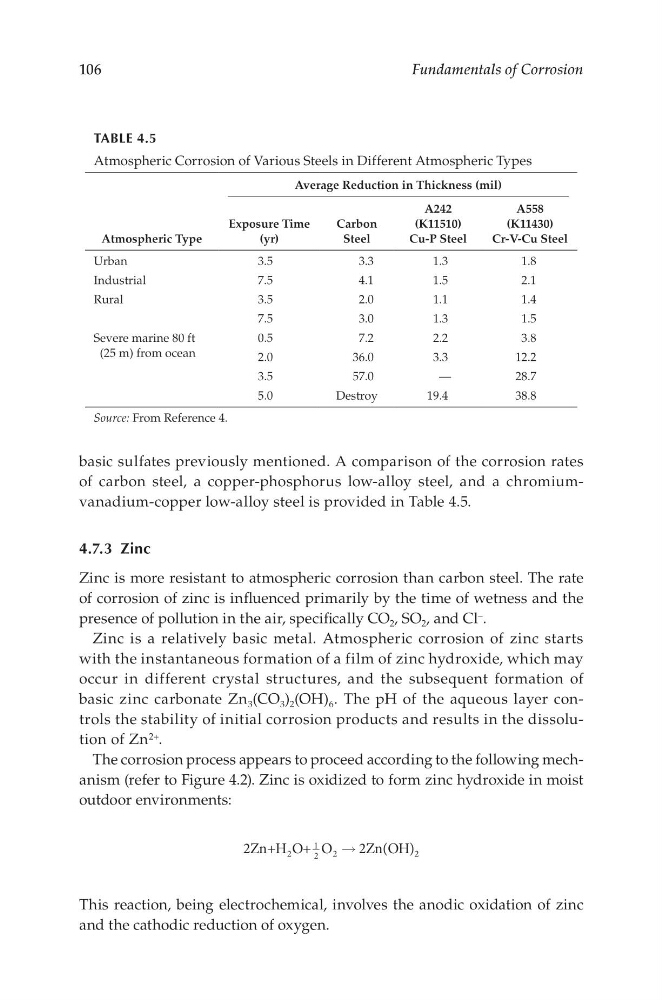
basic sulfates previously mentioned. A comparison of the corrosion rates
of carbon steel, a copper-phosphorus low-alloy steel, and a chromiumvanadium-copper low-alloy steel is provided in Table 4.5.
4.7.3 Zinc
Zinc is more resistant to atmospheric corrosion than carbon steel. The rate
of corrosion of zinc is influenced primarily by the time of wetness and the
presence of pollution in the air, specifically CO 2 , SO 2 , and Cl − .
Zinc is a relatively basic metal. Atmospheric corrosion of zinc starts
with the instantaneous formation of a film of zinc hydroxide, which may
occur in different crystal structures, and the subsequent formation of
basic zinc carbonate Zn 3 (CO 3 ) 2 (OH) 6 . The pH of the aqueous layer controls the stability of initial corrosion products and results in the dissolution of Zn 2+ .
The corrosion process appears to proceed according to the following mechanism (refer to Figure 4.2). Zinc is oxidized to form zinc hydroxide in moist
outdoor environments:
2Zn+H O+ O
2Zn(OH)
2
1
2
2
2
→
This reaction, being electrochemical, involves the anodic oxidation of zinc
and the cathodic reduction of oxygen.
TabLE 4.5
Atmospheric Corrosion of Various Steels in Different Atmospheric Types
Atmospheric Type
Average Reduction in Thickness (mil)
Exposure Time
(yr)
Carbon
Steel
A242
(K11510)
Cu-P Steel
A558
(K11430)
Cr-V-Cu Steel
Urban
3.5
3.3
1.3
1.8
Industrial
7.5
4.1
1.5
2.1
Rural
3.5
2.0
1.1
1.4
7.5
3.0
1.3
1.5
Severe marine 80 ft
(25 m) from ocean
0.5
7.2
2.2
3.8
2.0
36.0
3.3
12.2
3.5
57.0
—
28.7
5.0
Destroy
19.4
38.8
Source: From Reference 4.
Fundamentals of Corrosion
basic sulfates previously mentioned. A comparison of the corrosion rates
of carbon steel, a copper-phosphorus low-alloy steel, and a chromiumvanadium-copper low-alloy steel is provided in Table 4.5.
4.7.3 Zinc
Zinc is more resistant to atmospheric corrosion than carbon steel. The rate
of corrosion of zinc is influenced primarily by the time of wetness and the
presence of pollution in the air, specifically CO 2 , SO 2 , and Cl − .
Zinc is a relatively basic metal. Atmospheric corrosion of zinc starts
with the instantaneous formation of a film of zinc hydroxide, which may
occur in different crystal structures, and the subsequent formation of
basic zinc carbonate Zn 3 (CO 3 ) 2 (OH) 6 . The pH of the aqueous layer controls the stability of initial corrosion products and results in the dissolution of Zn 2+ .
The corrosion process appears to proceed according to the following mechanism (refer to Figure 4.2). Zinc is oxidized to form zinc hydroxide in moist
outdoor environments:
2Zn+H O+ O
2Zn(OH)
2
1
2
2
2
→
This reaction, being electrochemical, involves the anodic oxidation of zinc
and the cathodic reduction of oxygen.
TabLE 4.5
Atmospheric Corrosion of Various Steels in Different Atmospheric Types
Atmospheric Type
Average Reduction in Thickness (mil)
Exposure Time
(yr)
Carbon
Steel
A242
(K11510)
Cu-P Steel
A558
(K11430)
Cr-V-Cu Steel
Urban
3.5
3.3
1.3
1.8
Industrial
7.5
4.1
1.5
2.1
Rural
3.5
2.0
1.1
1.4
7.5
3.0
1.3
1.5
Severe marine 80 ft
(25 m) from ocean
0.5
7.2
2.2
3.8
2.0
36.0
3.3
12.2
3.5
57.0
—
28.7
5.0
Destroy
19.4
38.8
Source: From Reference 4.