

102
Fundamentals of Corrosion
4.7 Resistance of Specific Metals and Alloys
to Atmospheric Corrosion
The factors affecting the mechanisms of atmospheric corrosion have been
discussed. However, these factors and mechanisms have different effects
and react in different manners with different metals and alloys. Each metal
or alloy forms its own protective film of corrosion products, some of which
have greater protection than others.
These protective films tend to reduce the corrosion rate with time; eventually the corrosion rate reaches a steady state and changes very little upon
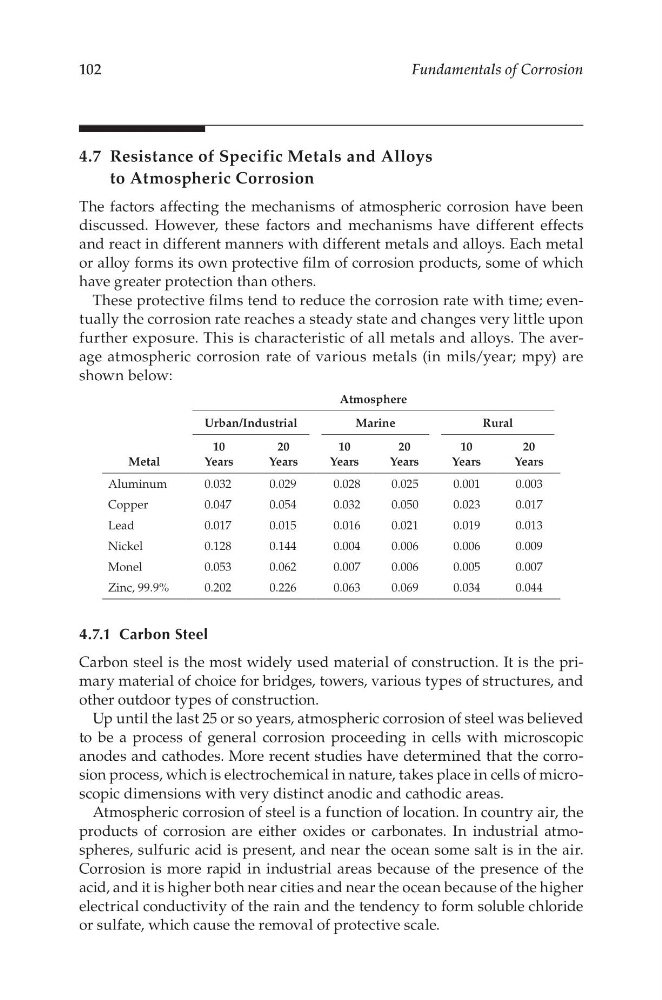
further exposure. This is characteristic of all metals and alloys. The average atmospheric corrosion rate of various metals (in mils/year; mpy) are
shown below:
Metal
Atmosphere
Urban/Industrial
Marine
Rural
10
Years
20
Years
10
Years
20
Years
10
Years
20
Years
Aluminum
0.032
0.029
0.028
0.025
0.001
0.003
Copper
0.047
0.054
0.032
0.050
0.023
0.017
Lead
0.017
0.015
0.016
0.021
0.019
0.013
Nickel
0.128
0.144
0.004
0.006
0.006
0.009
Monel
0.053
0.062
0.007
0.006
0.005
0.007
Zinc, 99.9%
0.202
0.226
0.063
0.069
0.034
0.044
4.7.1 Carbon Steel
Carbon steel is the most widely used material of construction. It is the primary material of choice for bridges, towers, various types of structures, and
other outdoor types of construction.
Up until the last 25 or so years, atmospheric corrosion of steel was believed
to be a process of general corrosion proceeding in cells with microscopic
anodes and cathodes. More recent studies have determined that the corrosion process, which is electrochemical in nature, takes place in cells of microscopic dimensions with very distinct anodic and cathodic areas.
Atmospheric corrosion of steel is a function of location. In country air, the
products of corrosion are either oxides or carbonates. In industrial atmospheres, sulfuric acid is present, and near the ocean some salt is in the air.
Corrosion is more rapid in industrial areas because of the presence of the
acid, and it is higher both near cities and near the ocean because of the higher
electrical conductivity of the rain and the tendency to form soluble chloride
or sulfate, which cause the removal of protective scale.
Fundamentals of Corrosion
4.7 Resistance of Specific Metals and Alloys
to Atmospheric Corrosion
The factors affecting the mechanisms of atmospheric corrosion have been
discussed. However, these factors and mechanisms have different effects
and react in different manners with different metals and alloys. Each metal
or alloy forms its own protective film of corrosion products, some of which
have greater protection than others.
These protective films tend to reduce the corrosion rate with time; eventually the corrosion rate reaches a steady state and changes very little upon
further exposure. This is characteristic of all metals and alloys. The average atmospheric corrosion rate of various metals (in mils/year; mpy) are
shown below:
Metal
Atmosphere
Urban/Industrial
Marine
Rural
10
Years
20
Years
10
Years
20
Years
10
Years
20
Years
Aluminum
0.032
0.029
0.028
0.025
0.001
0.003
Copper
0.047
0.054
0.032
0.050
0.023
0.017
Lead
0.017
0.015
0.016
0.021
0.019
0.013
Nickel
0.128
0.144
0.004
0.006
0.006
0.009
Monel
0.053
0.062
0.007
0.006
0.005
0.007
Zinc, 99.9%
0.202
0.226
0.063
0.069
0.034
0.044
4.7.1 Carbon Steel
Carbon steel is the most widely used material of construction. It is the primary material of choice for bridges, towers, various types of structures, and
other outdoor types of construction.
Up until the last 25 or so years, atmospheric corrosion of steel was believed
to be a process of general corrosion proceeding in cells with microscopic
anodes and cathodes. More recent studies have determined that the corrosion process, which is electrochemical in nature, takes place in cells of microscopic dimensions with very distinct anodic and cathodic areas.
Atmospheric corrosion of steel is a function of location. In country air, the
products of corrosion are either oxides or carbonates. In industrial atmospheres, sulfuric acid is present, and near the ocean some salt is in the air.
Corrosion is more rapid in industrial areas because of the presence of the
acid, and it is higher both near cities and near the ocean because of the higher
electrical conductivity of the rain and the tendency to form soluble chloride
or sulfate, which cause the removal of protective scale.