

Atmospheric Corrosion
103
When steel is exposed in a clean, dry atmosphere, the surface is covered
with a 20- to 50-Å-thick oxide film consisting of an oxide layer of Fe 2 O 3 . This
film practically prevents further corrosion. If small amounts of water vapor
are present, FeOOH may also form.
In noncontaminated atmospheres, the initiation of corrosion on a clean
metal surface is a very slow process, even if the atmosphere is saturated with
water vapor. Under these conditions, initiation of corrosion may occur at
surface inclusions of MnS, which dissolve when the surface becomes wet.
However, the presence of solid particles on the surface is a more important factor for the start of corrosion. Airborne dust that has settled on the
steel surface may prompt corrosion by absorbing SO 2 and water vapor from
the atmosphere. Of greater significance are particles of hygroscopic salts,
such as sulfates or chlorides, that form a corrosive electrolyte on the surface. Cathodes in microcells may also be formed by carbonaceous particles
settling on the steel surface. Cathodes may also be formed by residues of
mill scale on the surface, initiating corrosion when the surface becomes wet.
Rusting is rapidly initiated in SO 2 polluted atmospheres at high humidity,
even in the absence of any particles on the surface.
Because carbon steel is not capable of developing its own protective coating in corrosive atmospheres, unalloyed steel used in outdoor applications
is usually protected with a coating of antirust paint, or zinc or aluminum.
For the paint coating to be effective, surface preparation prior to painting is
extremely important.
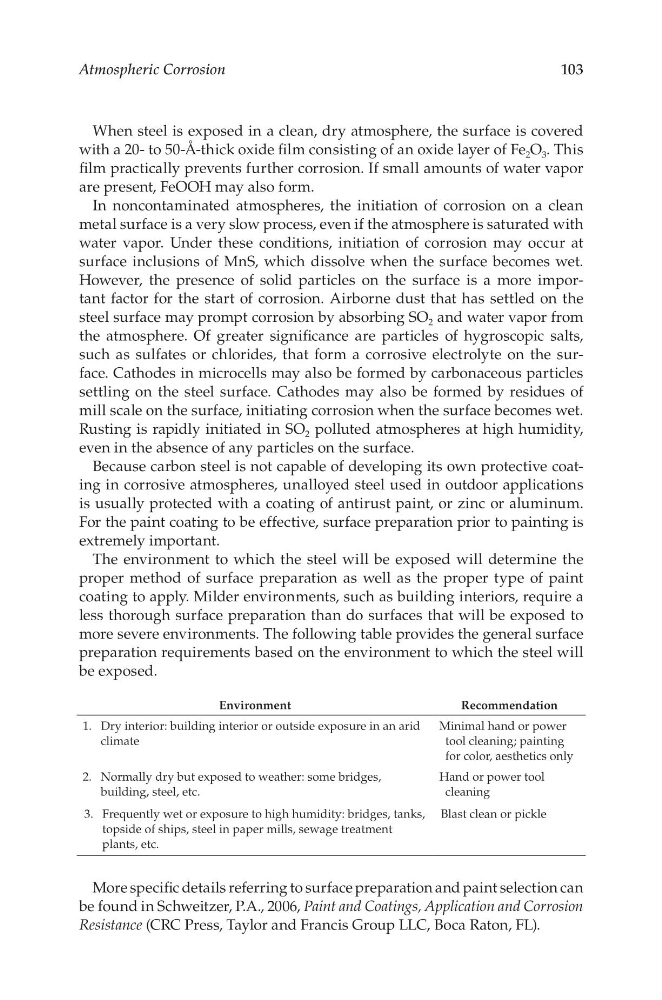
The environment to which the steel will be exposed will determine the
proper method of surface preparation as well as the proper type of paint
coating to apply. Milder environments, such as building interiors, require a
less thorough surface preparation than do surfaces that will be exposed to
more severe environments. The following table provides the general surface
preparation requirements based on the environment to which the steel will
be exposed.
Environment
Recommendation
1. Dry interior: building interior or outside exposure in an arid
climate
Minimal hand or power
tool cleaning; painting
for color, aesthetics only
2. Normally dry but exposed to weather: some bridges,
building, steel, etc.
Hand or power tool
cleaning
3. Frequently wet or exposure to high humidity: bridges, tanks,
topside of ships, steel in paper mills, sewage treatment
plants, etc.
Blast clean or pickle
More specific details referring to surface preparation and paint selection can
be found in Schweitzer, P.A., 2006, Paint and Coatings, Application and Corrosion
Resistance (CRC Press, Taylor and Francis Group LLC, Boca Raton, FL).
103
When steel is exposed in a clean, dry atmosphere, the surface is covered
with a 20- to 50-Å-thick oxide film consisting of an oxide layer of Fe 2 O 3 . This
film practically prevents further corrosion. If small amounts of water vapor
are present, FeOOH may also form.
In noncontaminated atmospheres, the initiation of corrosion on a clean
metal surface is a very slow process, even if the atmosphere is saturated with
water vapor. Under these conditions, initiation of corrosion may occur at
surface inclusions of MnS, which dissolve when the surface becomes wet.
However, the presence of solid particles on the surface is a more important factor for the start of corrosion. Airborne dust that has settled on the
steel surface may prompt corrosion by absorbing SO 2 and water vapor from
the atmosphere. Of greater significance are particles of hygroscopic salts,
such as sulfates or chlorides, that form a corrosive electrolyte on the surface. Cathodes in microcells may also be formed by carbonaceous particles
settling on the steel surface. Cathodes may also be formed by residues of
mill scale on the surface, initiating corrosion when the surface becomes wet.
Rusting is rapidly initiated in SO 2 polluted atmospheres at high humidity,
even in the absence of any particles on the surface.
Because carbon steel is not capable of developing its own protective coating in corrosive atmospheres, unalloyed steel used in outdoor applications
is usually protected with a coating of antirust paint, or zinc or aluminum.
For the paint coating to be effective, surface preparation prior to painting is
extremely important.
The environment to which the steel will be exposed will determine the
proper method of surface preparation as well as the proper type of paint
coating to apply. Milder environments, such as building interiors, require a
less thorough surface preparation than do surfaces that will be exposed to
more severe environments. The following table provides the general surface
preparation requirements based on the environment to which the steel will
be exposed.
Environment
Recommendation
1. Dry interior: building interior or outside exposure in an arid
climate
Minimal hand or power
tool cleaning; painting
for color, aesthetics only
2. Normally dry but exposed to weather: some bridges,
building, steel, etc.
Hand or power tool
cleaning
3. Frequently wet or exposure to high humidity: bridges, tanks,
topside of ships, steel in paper mills, sewage treatment
plants, etc.
Blast clean or pickle
More specific details referring to surface preparation and paint selection can
be found in Schweitzer, P.A., 2006, Paint and Coatings, Application and Corrosion
Resistance (CRC Press, Taylor and Francis Group LLC, Boca Raton, FL).