

Atmospheric Corrosion
101
4.5.4 Carbon Dioxide (CO 2 )
Carbon dioxide (CO 2 ) occurs naturally in the atmosphere in concentrations
of 0.03 to 0.05% by volume. This concentration varies with the time of day
and the season of the year. The above percentages correspond to a concentration of the order 10 –5 mol/L when at equilibrium in the water film, if the pH
value is 6 or lower.
4.5.5 Oxygen (O 2 )
Oxygen is a natural constituent of air and is readily absorbed from the air
into a water film on the metal surface, which is considered saturated, thereby
promoting any oxidation reaction.
4.5.6 indoor atmospheric Compounds
Formaldehyde (HCHO) and formic acid (HCOOH) are important indoor
corrosion stimulants that can originate from tobacco smoke, combustion of
biomass, adhesives, and plastics. In general, the concentration of these stimulants is lower indoors than outdoors, except for ammonia and the organic
species, which usually have a higher concentration indoors than outdoors.
This higher level·is the result of anthropogenic activity.
4.6 Summary
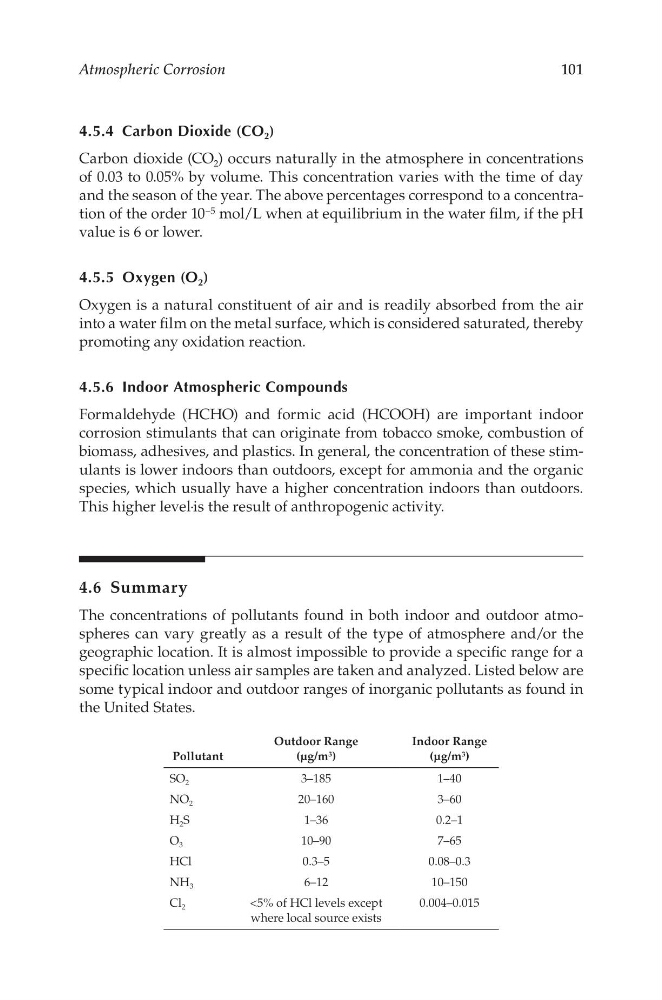
The concentrations of pollutants found in both indoor and outdoor atmospheres can vary greatly as a result of the type of atmosphere and/or the
geographic location. It is almost impossible to provide a specific range for a
specific location unless air samples are taken and analyzed. Listed below are
some typical indoor and outdoor ranges of inorganic pollutants as found in
the United States.
Pollutant
Outdoor Range
(µg/m 3 )
Indoor Range
(µg/m 3 )
SO 2
3–185
1–40
NO 2
20–160
3–60
H 2 S
1–36
0.2–1
O 3
10–90
7–65
HCl
0.3–5
0.08–0.3
NH 3
6–12
10–150
Cl 2
<5% of HCl levels except
where local source exists
0.004–0.015
101
4.5.4 Carbon Dioxide (CO 2 )
Carbon dioxide (CO 2 ) occurs naturally in the atmosphere in concentrations
of 0.03 to 0.05% by volume. This concentration varies with the time of day
and the season of the year. The above percentages correspond to a concentration of the order 10 –5 mol/L when at equilibrium in the water film, if the pH
value is 6 or lower.
4.5.5 Oxygen (O 2 )
Oxygen is a natural constituent of air and is readily absorbed from the air
into a water film on the metal surface, which is considered saturated, thereby
promoting any oxidation reaction.
4.5.6 indoor atmospheric Compounds
Formaldehyde (HCHO) and formic acid (HCOOH) are important indoor
corrosion stimulants that can originate from tobacco smoke, combustion of
biomass, adhesives, and plastics. In general, the concentration of these stimulants is lower indoors than outdoors, except for ammonia and the organic
species, which usually have a higher concentration indoors than outdoors.
This higher level·is the result of anthropogenic activity.
4.6 Summary
The concentrations of pollutants found in both indoor and outdoor atmospheres can vary greatly as a result of the type of atmosphere and/or the
geographic location. It is almost impossible to provide a specific range for a
specific location unless air samples are taken and analyzed. Listed below are
some typical indoor and outdoor ranges of inorganic pollutants as found in
the United States.
Pollutant
Outdoor Range
(µg/m 3 )
Indoor Range
(µg/m 3 )
SO 2
3–185
1–40
NO 2
20–160
3–60
H 2 S
1–36
0.2–1
O 3
10–90
7–65
HCl
0.3–5
0.08–0.3
NH 3
6–12
10–150
Cl 2
<5% of HCl levels except
where local source exists
0.004–0.015