

100
Fundamentals of Corrosion
NO hv NO + O
<420nm
O O
O
2 + →
+ →
(
)
λ
2
3
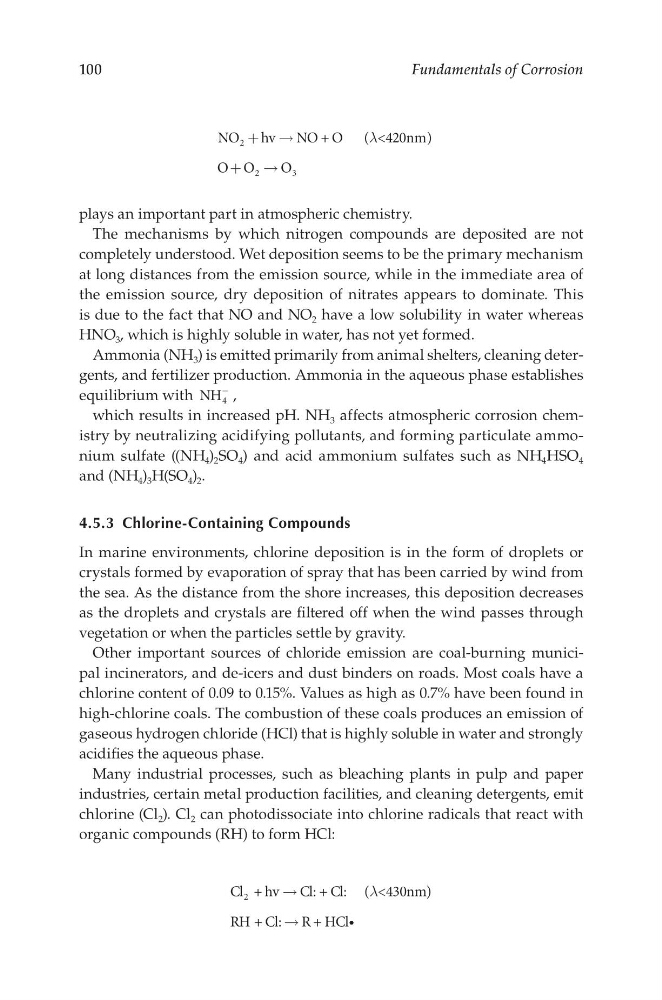
plays an important part in atmospheric chemistry.
The mechanisms by which nitrogen compounds are deposited are not
completely understood. Wet deposition seems to be the primary mechanism
at long distances from the emission source, while in the immediate area of
the emission source, dry deposition of nitrates appears to dominate. This
is due to the fact that NO and NO 2 have a low solubility in water whereas
HNO 3 , which is highly soluble in water, has not yet formed.
Ammonia (NH 3 ) is emitted primarily from animal shelters, cleaning detergents, and fertilizer production. Ammonia in the aqueous phase establishes
equilibrium with NH 4
− ,
which results in increased pH. NH 3 affects atmospheric corrosion chemistry by neutralizing acidifying pollutants, and forming particulate ammonium sulfate ((NH 4 ) 2 SO 4 ) and acid ammonium sulfates such as NH 4 HSO 4
and (NH 4 ) 3 H(SO 4 ) 2 .
4.5.3 Chlorine-Containing Compounds
In marine environments, chlorine deposition is in the form of droplets or
crystals formed by evaporation of spray that has been carried by wind from
the sea. As the distance from the shore increases, this deposition decreases
as the droplets and crystals are filtered off when the wind passes through
vegetation or when the particles settle by gravity.
Other important sources of chloride emission are coal-burning municipal incinerators, and de-icers and dust binders on roads. Most coals have a
chlorine content of 0.09 to 0.15%. Values as high as 0.7% have been found in
high-chlorine coals. The combustion of these coals produces an emission of
gaseous hydrogen chloride (HCl) that is highly soluble in water and strongly
acidifies the aqueous phase.
Many industrial processes, such as bleaching plants in pulp and paper
industries, certain metal production facilities, and cleaning detergents, emit
chlorine (Cl 2 ). Cl 2 can photodissociate into chlorine radicals that react with
organic compounds (RH) to form HCl:
Cl + hv Cl: + Cl: ( <430nm)
+ Cl: R + HCl
2
→
→
λ
RH
i i
Fundamentals of Corrosion
NO hv NO + O
<420nm
O O
O
2 + →
+ →
(
)
λ
2
3
plays an important part in atmospheric chemistry.
The mechanisms by which nitrogen compounds are deposited are not
completely understood. Wet deposition seems to be the primary mechanism
at long distances from the emission source, while in the immediate area of
the emission source, dry deposition of nitrates appears to dominate. This
is due to the fact that NO and NO 2 have a low solubility in water whereas
HNO 3 , which is highly soluble in water, has not yet formed.
Ammonia (NH 3 ) is emitted primarily from animal shelters, cleaning detergents, and fertilizer production. Ammonia in the aqueous phase establishes
equilibrium with NH 4
− ,
which results in increased pH. NH 3 affects atmospheric corrosion chemistry by neutralizing acidifying pollutants, and forming particulate ammonium sulfate ((NH 4 ) 2 SO 4 ) and acid ammonium sulfates such as NH 4 HSO 4
and (NH 4 ) 3 H(SO 4 ) 2 .
4.5.3 Chlorine-Containing Compounds
In marine environments, chlorine deposition is in the form of droplets or
crystals formed by evaporation of spray that has been carried by wind from
the sea. As the distance from the shore increases, this deposition decreases
as the droplets and crystals are filtered off when the wind passes through
vegetation or when the particles settle by gravity.
Other important sources of chloride emission are coal-burning municipal incinerators, and de-icers and dust binders on roads. Most coals have a
chlorine content of 0.09 to 0.15%. Values as high as 0.7% have been found in
high-chlorine coals. The combustion of these coals produces an emission of
gaseous hydrogen chloride (HCl) that is highly soluble in water and strongly
acidifies the aqueous phase.
Many industrial processes, such as bleaching plants in pulp and paper
industries, certain metal production facilities, and cleaning detergents, emit
chlorine (Cl 2 ). Cl 2 can photodissociate into chlorine radicals that react with
organic compounds (RH) to form HCl:
Cl + hv Cl: + Cl: ( <430nm)
+ Cl: R + HCl
2
→
→
λ
RH
i i