

282 Basic Engineering Mathematics
y 1 5 5
y 2 5 4
308
Figure 30.12
y 1 ϭ 5
y 2 ϭ 4
0
y R
a
b
30Њ
150Њ
Figure 30.13
from which
y R =
√
75.641 = 8.697
Using the sine rule,
8.697
sin 150 ◦ =
4
sin φ
from which
sin φ =
4 sin 150 ◦
8.697
= 0.22996
and
φ = sin
−1 0.22996
= 13.29
◦ or 0.232 rad
Hence, y R = y 1 + y 2 = 5 sinωt + 4 sin(ωt − π/6)
= 8.697 sin(ωt − 0.232)
Problem 7. Given y 1 = 2 sin ωt and
y 2 = 3 sin(ωt + π/4), obtain an expression, by
calculation, for the resultant, y R = y 1 + y 2
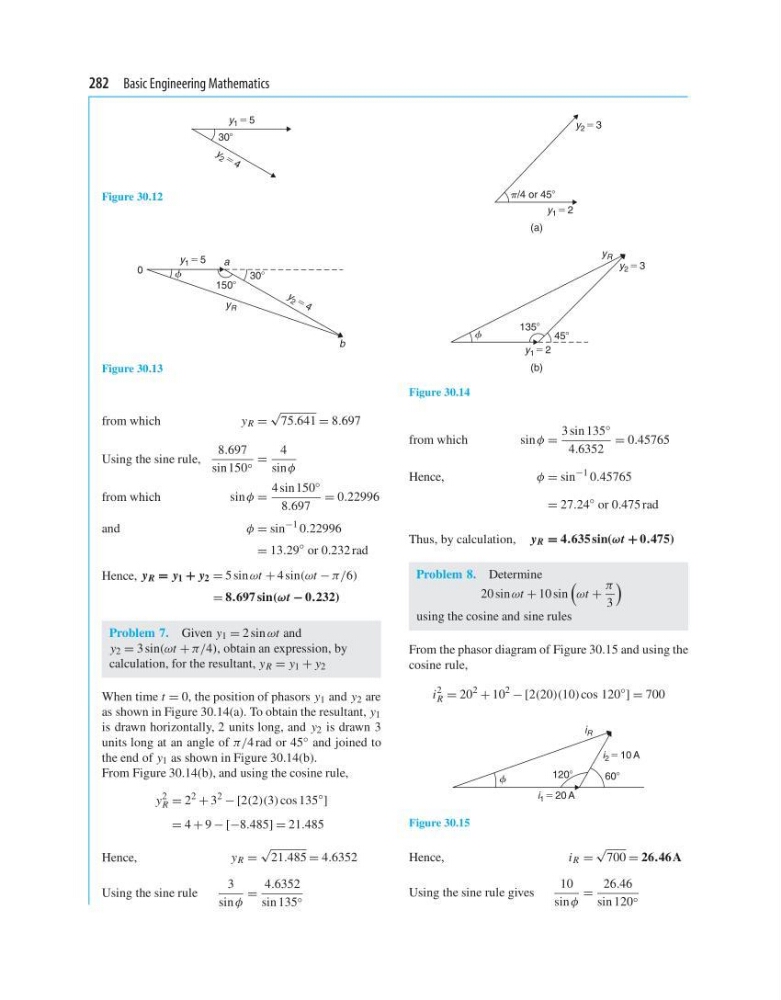
When time t = 0, the position of phasors y 1 and y 2 are
as shown in Figure 30.14(a). To obtain the resultant, y 1
is drawn horizontally, 2 units long, and y 2 is drawn 3
units long at an angle of π/4 rad or 45 ◦ and joined to
the end of y 1 as shown in Figure 30.14(b).
From Figure 30.14(b), and using the cosine rule,
y
2
R = 2
2
+ 3
2
− [2(2)(3) cos 135
◦ ]
= 4 + 9 − [−8.485] = 21.485
Hence,
y R =
√
21.485 = 4.6352
Using the sine rule
3
sin φ
=
4.6352
sin 135 ◦
y 2 5 3
y 1 5 2
/4 or 458
(a)
y 1 5 2
y 2 5 3
1358
458
y R
(b)
Figure 30.14
from which
sin φ =
3 sin 135 ◦
4.6352
= 0.45765
Hence,
φ = sin
−1 0.45765
= 27.24
◦ or 0.475 rad
Thus, by calculation, y R = 4.635 sin(ωt + 0.475)
Problem 8. Determine
20 sin ωt + 10 sin
ωt +
π
3
using the cosine and sine rules
From the phasor diagram of Figure 30.15 and using the
cosine rule,
i
2
R = 20
2
+ 10
2
− [2(20)(10) cos 120
◦ ] = 700
i 2 5 10 A
i 1 5 20 A
i R
608
1208
Figure 30.15
Hence,
i R =
√
700 = 26.46 A
Using the sine rule gives
10
sin φ
=
26.46
sin 120 ◦
y 1 5 5
y 2 5 4
308
Figure 30.12
y 1 ϭ 5
y 2 ϭ 4
0
y R
a
b
30Њ
150Њ
Figure 30.13
from which
y R =
√
75.641 = 8.697
Using the sine rule,
8.697
sin 150 ◦ =
4
sin φ
from which
sin φ =
4 sin 150 ◦
8.697
= 0.22996
and
φ = sin
−1 0.22996
= 13.29
◦ or 0.232 rad
Hence, y R = y 1 + y 2 = 5 sinωt + 4 sin(ωt − π/6)
= 8.697 sin(ωt − 0.232)
Problem 7. Given y 1 = 2 sin ωt and
y 2 = 3 sin(ωt + π/4), obtain an expression, by
calculation, for the resultant, y R = y 1 + y 2
When time t = 0, the position of phasors y 1 and y 2 are
as shown in Figure 30.14(a). To obtain the resultant, y 1
is drawn horizontally, 2 units long, and y 2 is drawn 3
units long at an angle of π/4 rad or 45 ◦ and joined to
the end of y 1 as shown in Figure 30.14(b).
From Figure 30.14(b), and using the cosine rule,
y
2
R = 2
2
+ 3
2
− [2(2)(3) cos 135
◦ ]
= 4 + 9 − [−8.485] = 21.485
Hence,
y R =
√
21.485 = 4.6352
Using the sine rule
3
sin φ
=
4.6352
sin 135 ◦
y 2 5 3
y 1 5 2
/4 or 458
(a)
y 1 5 2
y 2 5 3
1358
458
y R
(b)
Figure 30.14
from which
sin φ =
3 sin 135 ◦
4.6352
= 0.45765
Hence,
φ = sin
−1 0.45765
= 27.24
◦ or 0.475 rad
Thus, by calculation, y R = 4.635 sin(ωt + 0.475)
Problem 8. Determine
20 sin ωt + 10 sin
ωt +
π
3
using the cosine and sine rules
From the phasor diagram of Figure 30.15 and using the
cosine rule,
i
2
R = 20
2
+ 10
2
− [2(20)(10) cos 120
◦ ] = 700
i 2 5 10 A
i 1 5 20 A
i R
608
1208
Figure 30.15
Hence,
i R =
√
700 = 26.46 A
Using the sine rule gives
10
sin φ
=
26.46
sin 120 ◦