

Methods of adding alternating waveforms 283
from which
sinφ =
10 sin 120 ◦
26.46
= 0.327296
and
φ = sin
−1 0.327296 = 19.10
◦
= 19.10 ×
π
180
= 0.333 rad
Hence, by cosine and sine rules,
i R = i 1 + i 2 = 26.46sin(ωt + 0.333)A
Now try the following Practice Exercise
Practice Exercise 120 Resultant phasors by
the sine and cosine rules (answers on
page 352)
1. Determine, using the cosine and sine rules, a
sinusoidal expression for
y = 2 sin A + 4 cos A.
2. Given v 1 = 10 sin ωt volts and
v 2 = 14 sin(ωt + π/3) volts, use the cosine
and sine rules to determine sinusoidal expressions for (a) v 1 + v 2 (b) v 1 − v 2
In problems 3 to 5, express the given expressions
in the form A sin(ωt ± α) by using the cosine and
sine rules.
3. 12 sin ωt + 5 cos ωt
4. 7 sin ωt + 5 sin
ωt +
π
4
5. 6 sin ωt + 3 sin
ωt −
π
6
30.5 Determining resultant phasors
by horizontal and vertical
components
If a right-angled triangle is constructed as shown in
Figure 30.16, 0a is called the horizontal component of
F and ab is called the vertical component of F.
0
H
a
V
b
F
Figure 30.16
From trigonometry (see Chapter 21 and remember SOH
CAH TOA),
cos θ =
0a
0b
, from which 0a = 0b cos θ = F cos θ
i.e. the horizontal component of F, H = F cos θ,
and
sin θ =
ab
0b
, from which ab = 0b sin θ = F sin θ
i.e. the vertical component of F, V = F sin θ .
Determining resultant phasors by horizontal and vertical
components is demonstrated in the following worked
problems.
Problem 9. Two alternating voltages are given by
v 1 = 15 sin ωt volts and v 2 = 25 sin(ωt − π/6)
volts. Determine a sinusoidal expression for the
resultant v R = v 1 + v 2 by finding horizontal and
vertical components
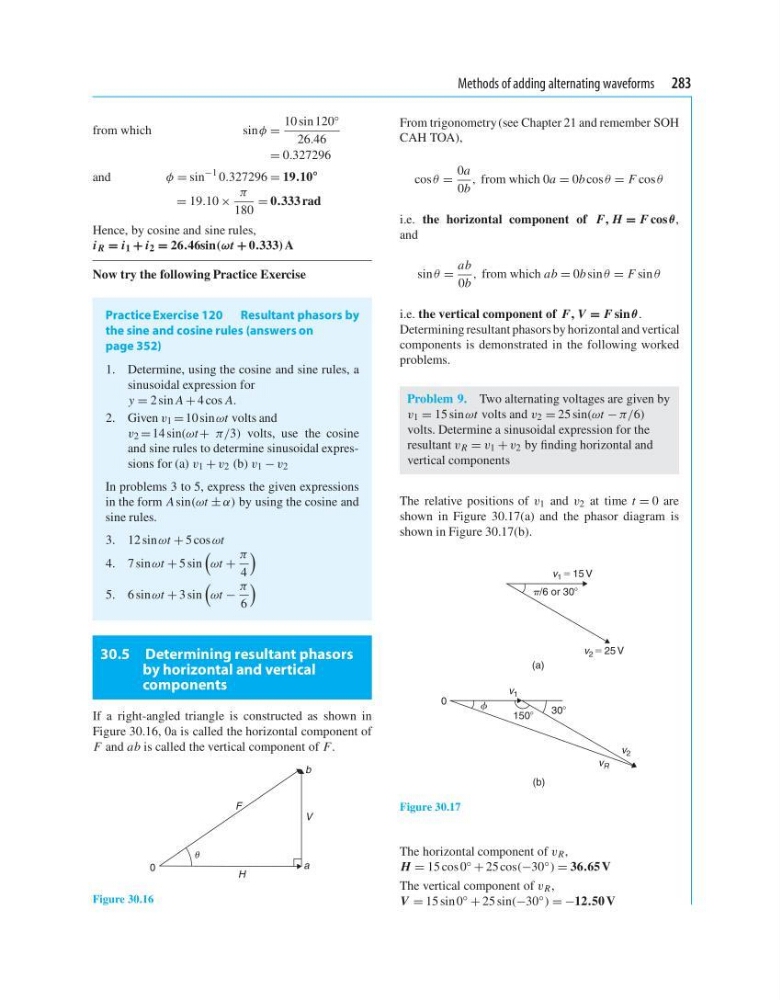
The relative positions of v 1 and v 2 at time t = 0 are
shown in Figure 30.17(a) and the phasor diagram is
shown in Figure 30.17(b).
v 1 5 15 V
(a)
v 2 5 25 V
/6 or 308
(b)
0
v R
v 2
v 1
308
1508
Figure 30.17
The horizontal component of v R ,
H = 15 cos 0 ◦ + 25 cos(−30 ◦ ) = 36.65 V
The vertical component of v R ,
V = 15 sin 0 ◦ + 25 sin(−30 ◦ ) = −12.50 V
from which
sinφ =
10 sin 120 ◦
26.46
= 0.327296
and
φ = sin
−1 0.327296 = 19.10
◦
= 19.10 ×
π
180
= 0.333 rad
Hence, by cosine and sine rules,
i R = i 1 + i 2 = 26.46sin(ωt + 0.333)A
Now try the following Practice Exercise
Practice Exercise 120 Resultant phasors by
the sine and cosine rules (answers on
page 352)
1. Determine, using the cosine and sine rules, a
sinusoidal expression for
y = 2 sin A + 4 cos A.
2. Given v 1 = 10 sin ωt volts and
v 2 = 14 sin(ωt + π/3) volts, use the cosine
and sine rules to determine sinusoidal expressions for (a) v 1 + v 2 (b) v 1 − v 2
In problems 3 to 5, express the given expressions
in the form A sin(ωt ± α) by using the cosine and
sine rules.
3. 12 sin ωt + 5 cos ωt
4. 7 sin ωt + 5 sin
ωt +
π
4
5. 6 sin ωt + 3 sin
ωt −
π
6
30.5 Determining resultant phasors
by horizontal and vertical
components
If a right-angled triangle is constructed as shown in
Figure 30.16, 0a is called the horizontal component of
F and ab is called the vertical component of F.
0
H
a
V
b
F
Figure 30.16
From trigonometry (see Chapter 21 and remember SOH
CAH TOA),
cos θ =
0a
0b
, from which 0a = 0b cos θ = F cos θ
i.e. the horizontal component of F, H = F cos θ,
and
sin θ =
ab
0b
, from which ab = 0b sin θ = F sin θ
i.e. the vertical component of F, V = F sin θ .
Determining resultant phasors by horizontal and vertical
components is demonstrated in the following worked
problems.
Problem 9. Two alternating voltages are given by
v 1 = 15 sin ωt volts and v 2 = 25 sin(ωt − π/6)
volts. Determine a sinusoidal expression for the
resultant v R = v 1 + v 2 by finding horizontal and
vertical components
The relative positions of v 1 and v 2 at time t = 0 are
shown in Figure 30.17(a) and the phasor diagram is
shown in Figure 30.17(b).
v 1 5 15 V
(a)
v 2 5 25 V
/6 or 308
(b)
0
v R
v 2
v 1
308
1508
Figure 30.17
The horizontal component of v R ,
H = 15 cos 0 ◦ + 25 cos(−30 ◦ ) = 36.65 V
The vertical component of v R ,
V = 15 sin 0 ◦ + 25 sin(−30 ◦ ) = −12.50 V