

Methods of adding alternating waveforms 281
60Њ
60Њ
y 1 ϭ 4
Ϫy 2 ϭ 3
y R
y 2
Figure 30.8
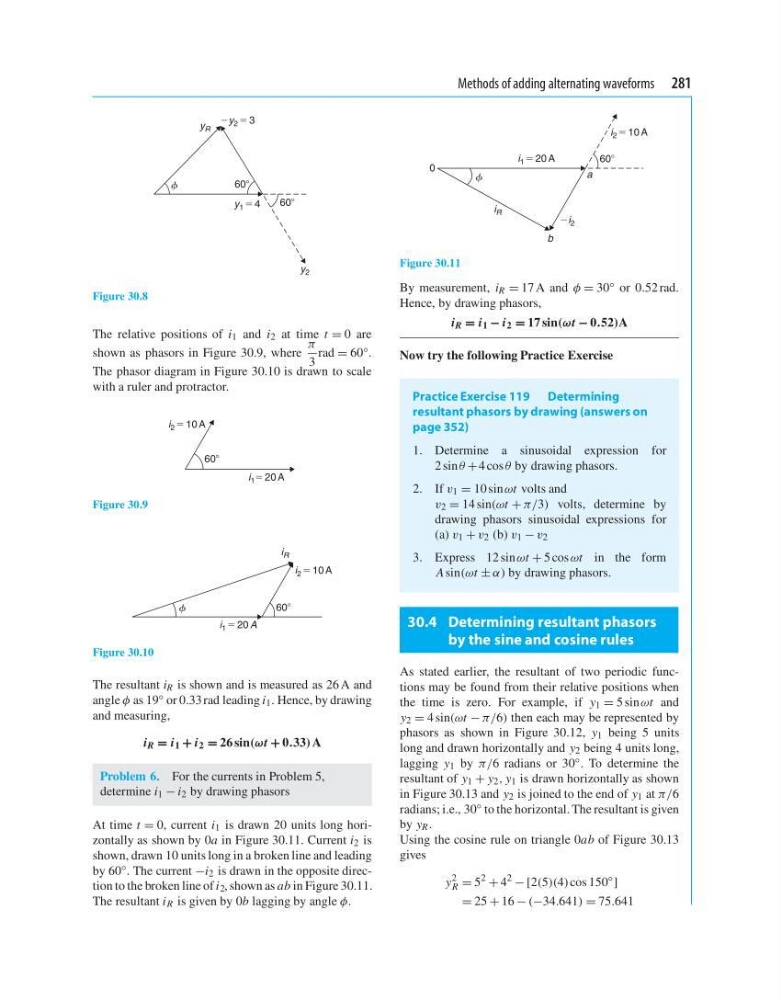
The relative positions of i 1 and i 2 at time t = 0 are
shown as phasors in Figure 30.9, where
π
3
rad = 60 ◦ .
The phasor diagram in Figure 30.10 is drawn to scale
with a ruler and protractor.
i 1 5 20 A
i 2 5 10 A
608
Figure 30.9
i 2 5 10 A
i 1 5 20 A
i R
608
Figure 30.10
The resultant i R is shown and is measured as 26 A and
angle φ as 19 ◦ or 0.33 rad leading i 1 . Hence, by drawing
and measuring,
i R = i 1 + i 2 = 26 sin(ωt + 0.33) A
Problem 6. For the currents in Problem 5,
determine i 1 − i 2 by drawing phasors
At time t = 0, current i 1 is drawn 20 units long horizontally as shown by 0a in Figure 30.11. Current i 2 is
shown, drawn 10 units long in a broken line and leading
by 60 ◦ . The current −i 2 is drawn in the opposite direction to the broken line of i 2 , shown as ab in Figure 30.11.
The resultant i R is given by 0b lagging by angle φ.
i 1 5 20 A
i 2 5 10 A
i R
a
b
0
2i 2
608
Figure 30.11
By measurement, i R = 17 A and φ = 30 ◦ or 0.52 rad.
Hence, by drawing phasors,
i R = i 1 − i 2 = 17 sin(ωt − 0.52)A
Now try the following Practice Exercise
Practice Exercise 119 Determining
resultant phasors by drawing (answers on
page 352)
1. Determine a sinusoidal expression for
2 sinθ + 4 cos θ by drawing phasors.
2. If v 1 = 10 sin ωt volts and
v 2 = 14 sin(ωt + π/3) volts, determine by
drawing phasors sinusoidal expressions for
(a) v 1 + v 2 (b) v 1 − v 2
3. Express 12 sin ωt + 5 cos ωt in the form
A sin(ωt ± α) by drawing phasors.
30.4 Determining resultant phasors
by the sine and cosine rules
As stated earlier, the resultant of two periodic functions may be found from their relative positions when
the time is zero. For example, if y 1 = 5 sinωt and
y 2 = 4 sin(ωt − π/6) then each may be represented by
phasors as shown in Figure 30.12, y 1 being 5 units
long and drawn horizontally and y 2 being 4 units long,
lagging y 1 by π/6 radians or 30 ◦ . To determine the
resultant of y 1 + y 2 , y 1 is drawn horizontally as shown
in Figure 30.13 and y 2 is joined to the end of y 1 at π/6
radians; i.e., 30 ◦ to the horizontal. The resultant is given
by y R .
Using the cosine rule on triangle 0ab of Figure 30.13
gives
y
2
R = 5
2
+ 4
2
− [2(5)(4) cos 150
◦ ]
= 25 + 16 − (−34.641) = 75.641
60Њ
60Њ
y 1 ϭ 4
Ϫy 2 ϭ 3
y R
y 2
Figure 30.8
The relative positions of i 1 and i 2 at time t = 0 are
shown as phasors in Figure 30.9, where
π
3
rad = 60 ◦ .
The phasor diagram in Figure 30.10 is drawn to scale
with a ruler and protractor.
i 1 5 20 A
i 2 5 10 A
608
Figure 30.9
i 2 5 10 A
i 1 5 20 A
i R
608
Figure 30.10
The resultant i R is shown and is measured as 26 A and
angle φ as 19 ◦ or 0.33 rad leading i 1 . Hence, by drawing
and measuring,
i R = i 1 + i 2 = 26 sin(ωt + 0.33) A
Problem 6. For the currents in Problem 5,
determine i 1 − i 2 by drawing phasors
At time t = 0, current i 1 is drawn 20 units long horizontally as shown by 0a in Figure 30.11. Current i 2 is
shown, drawn 10 units long in a broken line and leading
by 60 ◦ . The current −i 2 is drawn in the opposite direction to the broken line of i 2 , shown as ab in Figure 30.11.
The resultant i R is given by 0b lagging by angle φ.
i 1 5 20 A
i 2 5 10 A
i R
a
b
0
2i 2
608
Figure 30.11
By measurement, i R = 17 A and φ = 30 ◦ or 0.52 rad.
Hence, by drawing phasors,
i R = i 1 − i 2 = 17 sin(ωt − 0.52)A
Now try the following Practice Exercise
Practice Exercise 119 Determining
resultant phasors by drawing (answers on
page 352)
1. Determine a sinusoidal expression for
2 sinθ + 4 cos θ by drawing phasors.
2. If v 1 = 10 sin ωt volts and
v 2 = 14 sin(ωt + π/3) volts, determine by
drawing phasors sinusoidal expressions for
(a) v 1 + v 2 (b) v 1 − v 2
3. Express 12 sin ωt + 5 cos ωt in the form
A sin(ωt ± α) by drawing phasors.
30.4 Determining resultant phasors
by the sine and cosine rules
As stated earlier, the resultant of two periodic functions may be found from their relative positions when
the time is zero. For example, if y 1 = 5 sinωt and
y 2 = 4 sin(ωt − π/6) then each may be represented by
phasors as shown in Figure 30.12, y 1 being 5 units
long and drawn horizontally and y 2 being 4 units long,
lagging y 1 by π/6 radians or 30 ◦ . To determine the
resultant of y 1 + y 2 , y 1 is drawn horizontally as shown
in Figure 30.13 and y 2 is joined to the end of y 1 at π/6
radians; i.e., 30 ◦ to the horizontal. The resultant is given
by y R .
Using the cosine rule on triangle 0ab of Figure 30.13
gives
y
2
R = 5
2
+ 4
2
− [2(5)(4) cos 150
◦ ]
= 25 + 16 − (−34.641) = 75.641