

280 Basic Engineering Mathematics
2 angle t
19Њ
19Њ
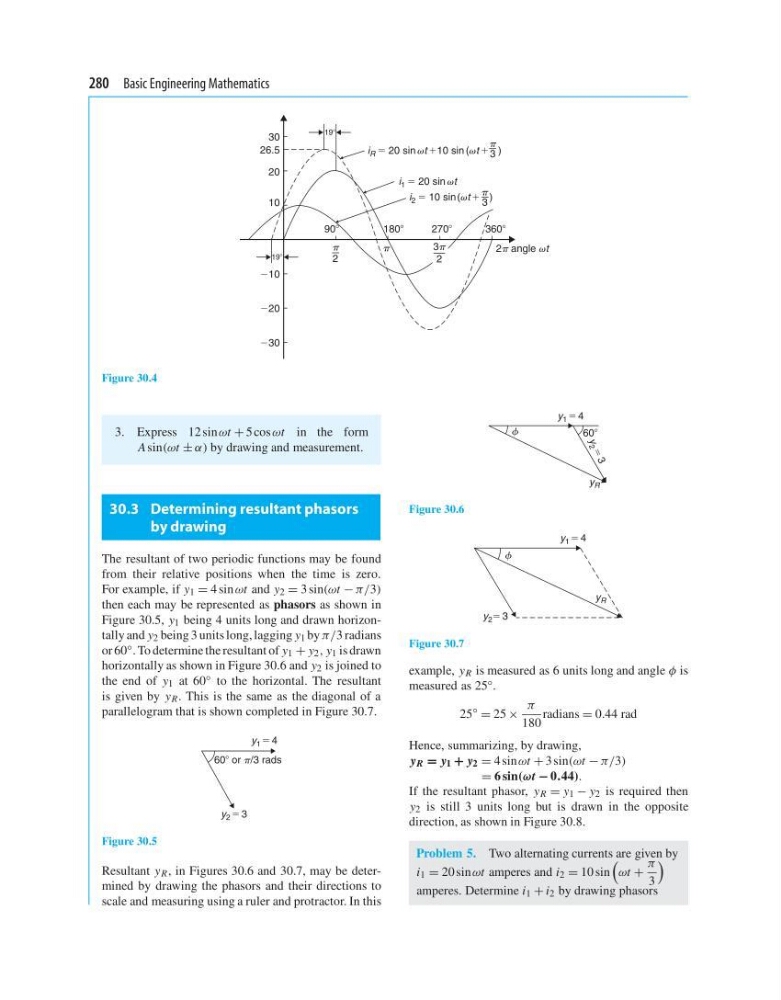
i 1 ϭ 20 sin t
i R ϭ 20 sin t ϩ10 sin (t ϩ )
90Њ
180Њ
270Њ
360Њ
Ϫ30
Ϫ20
Ϫ10
10
20
26.5
30
3
2
2
3
i 2 ϭ 10 sin (t ϩ )
3
Figure 30.4
3. Express 12 sin ωt + 5 cos ωt in the form
A sin(ωt ± α) by drawing and measurement.
30.3 Determining resultant phasors
by drawing
The resultant of two periodic functions may be found
from their relative positions when the time is zero.
For example, if y 1 = 4 sinωt and y 2 = 3 sin(ωt − π/3)
then each may be represented as phasors as shown in
Figure 30.5, y 1 being 4 units long and drawn horizontally and y 2 being 3 units long, lagging y 1 by π/3 radians
or 60 ◦ . To determine the resultant of y 1 + y 2 , y 1 is drawn
horizontally as shown in Figure 30.6 and y 2 is joined to
the end of y 1 at 60 ◦ to the horizontal. The resultant
is given by y R . This is the same as the diagonal of a
parallelogram that is shown completed in Figure 30.7.
608 or /3 rads
y 1 5 4
y 2 5 3
Figure 30.5
Resultant y R , in Figures 30.6 and 30.7, may be determined by drawing the phasors and their directions to
scale and measuring using a ruler and protractor. In this
y 1 5 4
y 2 5 3
608
y R
Figure 30.6
y 1 ϭ 4
y 2 ϭ 3
y R
Figure 30.7
example, y R is measured as 6 units long and angle φ is
measured as 25 ◦ .
25
◦
= 25 ×
π
180
radians = 0.44 rad
Hence, summarizing, by drawing,
y R = y 1 + y 2 = 4 sinωt + 3 sin(ωt − π/3)
= 6 sin(ωt − 0.44).
If the resultant phasor, y R = y 1 − y 2 is required then
y 2 is still 3 units long but is drawn in the opposite
direction, as shown in Figure 30.8.
Problem 5. Two alternating currents are given by
i 1 = 20 sin ωt amperes and i 2 = 10 sin
ωt +
π
3
amperes. Determine i 1 + i 2 by drawing phasors
2 angle t
19Њ
19Њ
i 1 ϭ 20 sin t
i R ϭ 20 sin t ϩ10 sin (t ϩ )
90Њ
180Њ
270Њ
360Њ
Ϫ30
Ϫ20
Ϫ10
10
20
26.5
30
3
2
2
3
i 2 ϭ 10 sin (t ϩ )
3
Figure 30.4
3. Express 12 sin ωt + 5 cos ωt in the form
A sin(ωt ± α) by drawing and measurement.
30.3 Determining resultant phasors
by drawing
The resultant of two periodic functions may be found
from their relative positions when the time is zero.
For example, if y 1 = 4 sinωt and y 2 = 3 sin(ωt − π/3)
then each may be represented as phasors as shown in
Figure 30.5, y 1 being 4 units long and drawn horizontally and y 2 being 3 units long, lagging y 1 by π/3 radians
or 60 ◦ . To determine the resultant of y 1 + y 2 , y 1 is drawn
horizontally as shown in Figure 30.6 and y 2 is joined to
the end of y 1 at 60 ◦ to the horizontal. The resultant
is given by y R . This is the same as the diagonal of a
parallelogram that is shown completed in Figure 30.7.
608 or /3 rads
y 1 5 4
y 2 5 3
Figure 30.5
Resultant y R , in Figures 30.6 and 30.7, may be determined by drawing the phasors and their directions to
scale and measuring using a ruler and protractor. In this
y 1 5 4
y 2 5 3
608
y R
Figure 30.6
y 1 ϭ 4
y 2 ϭ 3
y R
Figure 30.7
example, y R is measured as 6 units long and angle φ is
measured as 25 ◦ .
25
◦
= 25 ×
π
180
radians = 0.44 rad
Hence, summarizing, by drawing,
y R = y 1 + y 2 = 4 sinωt + 3 sin(ωt − π/3)
= 6 sin(ωt − 0.44).
If the resultant phasor, y R = y 1 − y 2 is required then
y 2 is still 3 units long but is drawn in the opposite
direction, as shown in Figure 30.8.
Problem 5. Two alternating currents are given by
i 1 = 20 sin ωt amperes and i 2 = 10 sin
ωt +
π
3
amperes. Determine i 1 + i 2 by drawing phasors