

Volumes of common solids 249
Total surface area of pyramid
= 2(26.80) + 2(39.83) + (3.60)(5.40)
= 53.60 + 79.66 + 19.44
= 152.7 cm
2
Problem 18. Calculate the volume and total
surface area of a hemisphere of diameter 5.0 cm
Volume of hemisphere =
1
2
(volume of sphere)
=
2
3
πr
3
=
2
3
π
5.0
2
3
= 32.7 cm
3
Total surface area
= curved surface area + area of circle
=
1
2
(surface area of sphere) + πr
2
=
1
2
(4πr
2
) + πr
2
= 2πr
2
+ πr
2
= 3πr
2
= 3π
5.0
2
2
= 58.9 cm
2
Problem 19. A rectangular piece of metal having
dimensions 4 cm by 3 cm by 12 cm is melted down
and recast into a pyramid having a rectangular base
measuring 2.5 cm by 5 cm. Calculate the
perpendicular height of the pyramid
Volume of rectangular prism of metal = 4 × 3 × 12
= 144 cm
3
Volume of pyramid
=
1
3
(area of base)(perpendicular height)
Assuming no waste of metal,
144 =
1
3
(2.5 × 5)(height)
i.e. perpendicular height of pyramid =
144 × 3
2.5 × 5
= 34.56 cm
Problem 20. A rivet consists of a cylindrical
head, of diameter 1 cm and depth 2 mm, and a shaft
of diameter 2 mm and length 1.5 cm. Determine the
volume of metal in 2000 such rivets
Radius of cylindrical head =
1
2
cm = 0.5 cm and
height of cylindrical head = 2 mm = 0.2 cm.
Hence, volume of cylindrical head
= πr
2 h = π(0.5)
2
(0.2) = 0.1571 cm
3
Volume of cylindrical shaft
= πr
2 h = π
0.2
2
2
(1.5) = 0.0471 cm
3
Total volume of 1 rivet= 0.1571 + 0.0471
= 0.2042 cm
3
Volume of metal in 2000 such rivets
= 2000 × 0.2042 = 408.4 cm
3
Problem 21. A solid metal cylinder of radius
6 cm and height 15 cm is melted down and recast
into a shape comprising a hemisphere surmounted
by a cone. Assuming that 8% of the metal is wasted
in the process, determine the height of the conical
portion if its diameter is to be 12 cm
Volume of cylinder = πr
2 h = π × 6
2
× 15
= 540π cm
3
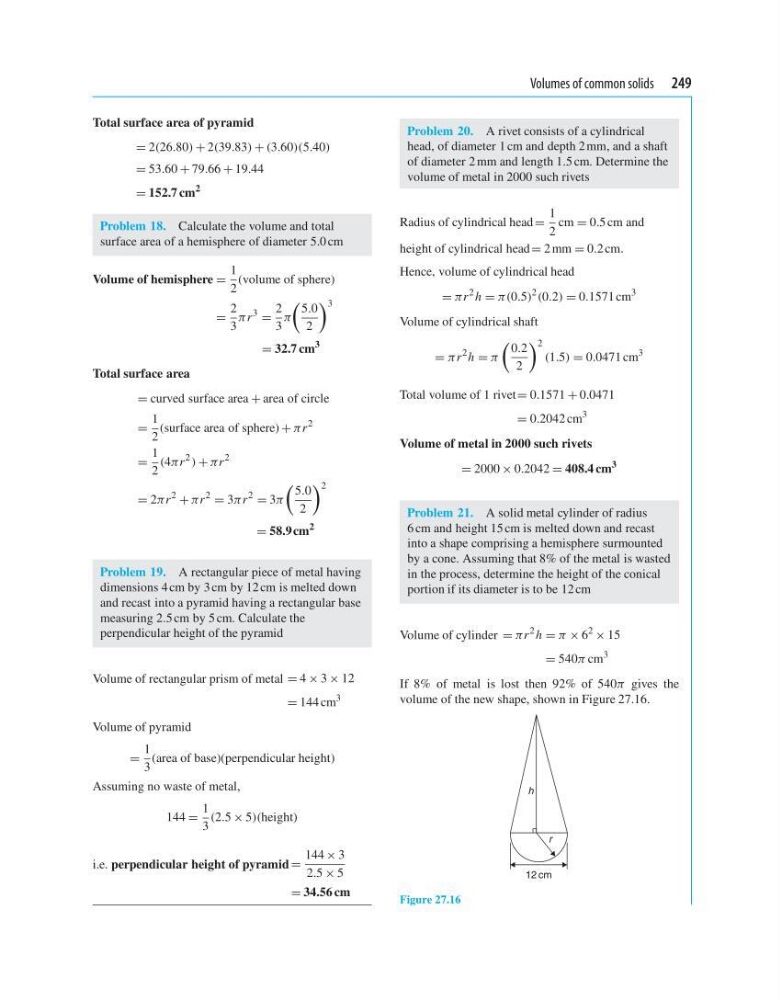
If 8% of metal is lost then 92% of 540π gives the
volume of the new shape, shown in Figure 27.16.
h
r
12 cm
Figure 27.16
Total surface area of pyramid
= 2(26.80) + 2(39.83) + (3.60)(5.40)
= 53.60 + 79.66 + 19.44
= 152.7 cm
2
Problem 18. Calculate the volume and total
surface area of a hemisphere of diameter 5.0 cm
Volume of hemisphere =
1
2
(volume of sphere)
=
2
3
πr
3
=
2
3
π
5.0
2
3
= 32.7 cm
3
Total surface area
= curved surface area + area of circle
=
1
2
(surface area of sphere) + πr
2
=
1
2
(4πr
2
) + πr
2
= 2πr
2
+ πr
2
= 3πr
2
= 3π
5.0
2
2
= 58.9 cm
2
Problem 19. A rectangular piece of metal having
dimensions 4 cm by 3 cm by 12 cm is melted down
and recast into a pyramid having a rectangular base
measuring 2.5 cm by 5 cm. Calculate the
perpendicular height of the pyramid
Volume of rectangular prism of metal = 4 × 3 × 12
= 144 cm
3
Volume of pyramid
=
1
3
(area of base)(perpendicular height)
Assuming no waste of metal,
144 =
1
3
(2.5 × 5)(height)
i.e. perpendicular height of pyramid =
144 × 3
2.5 × 5
= 34.56 cm
Problem 20. A rivet consists of a cylindrical
head, of diameter 1 cm and depth 2 mm, and a shaft
of diameter 2 mm and length 1.5 cm. Determine the
volume of metal in 2000 such rivets
Radius of cylindrical head =
1
2
cm = 0.5 cm and
height of cylindrical head = 2 mm = 0.2 cm.
Hence, volume of cylindrical head
= πr
2 h = π(0.5)
2
(0.2) = 0.1571 cm
3
Volume of cylindrical shaft
= πr
2 h = π
0.2
2
2
(1.5) = 0.0471 cm
3
Total volume of 1 rivet= 0.1571 + 0.0471
= 0.2042 cm
3
Volume of metal in 2000 such rivets
= 2000 × 0.2042 = 408.4 cm
3
Problem 21. A solid metal cylinder of radius
6 cm and height 15 cm is melted down and recast
into a shape comprising a hemisphere surmounted
by a cone. Assuming that 8% of the metal is wasted
in the process, determine the height of the conical
portion if its diameter is to be 12 cm
Volume of cylinder = πr
2 h = π × 6
2
× 15
= 540π cm
3
If 8% of metal is lost then 92% of 540π gives the
volume of the new shape, shown in Figure 27.16.
h
r
12 cm
Figure 27.16