

250 Basic Engineering Mathematics
Hence, the volume of (hemisphere + cone)
= 0.92 × 540π cm
3
i.e.
1
2
4
3
πr
3
+
1
3
πr
2 h = 0.92 × 540π
Dividing throughout by π gives
2
3
r
3
+
1
3
r
2 h = 0.92 × 540
Since the diameter of the new shape is to be 12 cm, radius
r = 6 cm,
hence
2
3
(6)
3
+
1
3
(6)
2 h = 0.92 × 540
144 + 12h = 496.8
i.e. height of conical portion,
h =
496.8 − 144
12
= 29.4 cm
Problem 22. A block of copper having a mass of
50 kg is drawn out to make 500 m of wire of
uniform cross-section. Given that the density of
copper is 8.91 g/cm 3 , calculate (a) the volume of
copper, (b) the cross-sectional area of the wire and
(c) the diameter of the cross-section of the wire
(a) A density of 8.91 g/cm 3 means that 8.91 g of copper has a volume of 1 cm 3 , or 1 g of copper has a
volume of (1 ÷ 8.91) cm 3 .
Density =
mass
volume
from which
volume =
mass
density
Hence, 50 kg, i.e. 50 000 g, has a
volume =
mass
density
=
50000
8.91
cm
3
= 5612 cm
3
(b) Volume of wire = area of circular cross-section
× length of wire.
Hence, 5612 cm
3
= area × (500 × 100 cm)
from which, area =
5612
500 × 100
cm
2
= 0.1122 cm
2
(c) Area of circle = πr 2 or
πd 2
4
hence, 0.1122 =
πd 2
4
from which, d =
4 × 0.1122
π
= 0.3780 cm
i.e. diameter of cross-section is 3.780 mm.
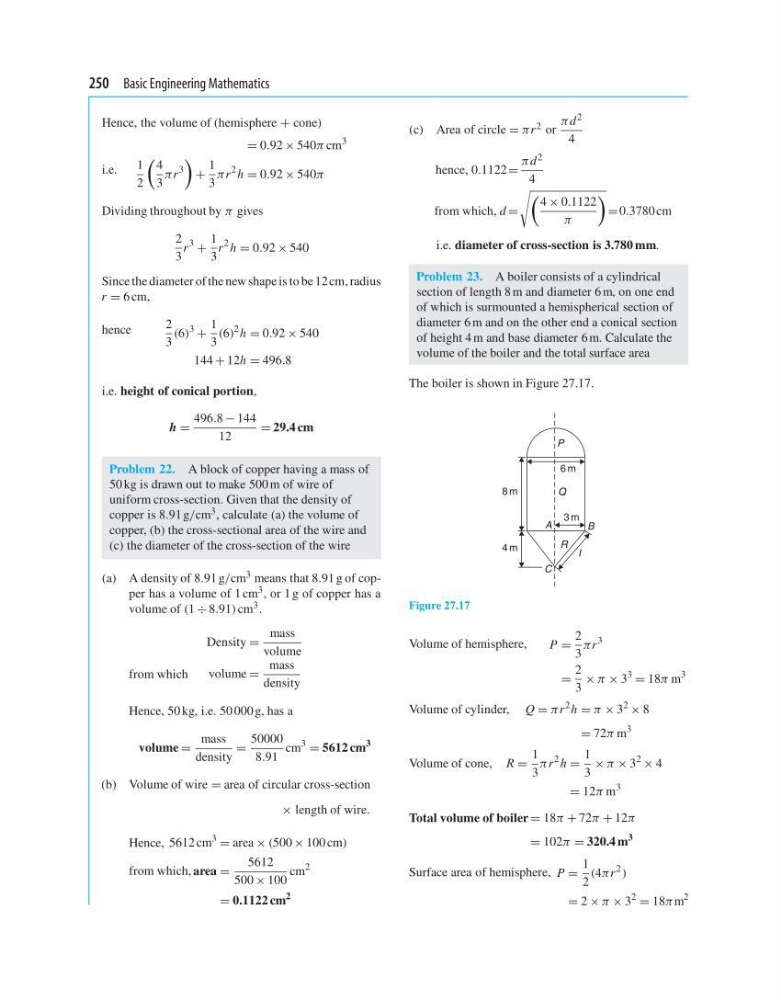
Problem 23. A boiler consists of a cylindrical
section of length 8 m and diameter 6 m, on one end
of which is surmounted a hemispherical section of
diameter 6 m and on the other end a conical section
of height 4 m and base diameter 6 m. Calculate the
volume of the boiler and the total surface area
The boiler is shown in Figure 27.17.
8 m
4 m
C
I
B
R
A
Q
P
3 m
6 m
Figure 27.17
Volume of hemisphere,
P =
2
3
πr
3
=
2
3
× π × 3
3
= 18π m
3
Volume of cylinder, Q = πr
2 h = π × 3
2
× 8
= 72π m
3
Volume of cone, R =
1
3
πr
2 h =
1
3
× π × 3
2
× 4
= 12π m
3
Total volume of boiler = 18π + 72π + 12π
= 102π = 320.4 m
3
Surface area of hemisphere, P =
1
2
(4πr
2
)
= 2 × π × 3
2
= 18πm
2
Hence, the volume of (hemisphere + cone)
= 0.92 × 540π cm
3
i.e.
1
2
4
3
πr
3
+
1
3
πr
2 h = 0.92 × 540π
Dividing throughout by π gives
2
3
r
3
+
1
3
r
2 h = 0.92 × 540
Since the diameter of the new shape is to be 12 cm, radius
r = 6 cm,
hence
2
3
(6)
3
+
1
3
(6)
2 h = 0.92 × 540
144 + 12h = 496.8
i.e. height of conical portion,
h =
496.8 − 144
12
= 29.4 cm
Problem 22. A block of copper having a mass of
50 kg is drawn out to make 500 m of wire of
uniform cross-section. Given that the density of
copper is 8.91 g/cm 3 , calculate (a) the volume of
copper, (b) the cross-sectional area of the wire and
(c) the diameter of the cross-section of the wire
(a) A density of 8.91 g/cm 3 means that 8.91 g of copper has a volume of 1 cm 3 , or 1 g of copper has a
volume of (1 ÷ 8.91) cm 3 .
Density =
mass
volume
from which
volume =
mass
density
Hence, 50 kg, i.e. 50 000 g, has a
volume =
mass
density
=
50000
8.91
cm
3
= 5612 cm
3
(b) Volume of wire = area of circular cross-section
× length of wire.
Hence, 5612 cm
3
= area × (500 × 100 cm)
from which, area =
5612
500 × 100
cm
2
= 0.1122 cm
2
(c) Area of circle = πr 2 or
πd 2
4
hence, 0.1122 =
πd 2
4
from which, d =
4 × 0.1122
π
= 0.3780 cm
i.e. diameter of cross-section is 3.780 mm.
Problem 23. A boiler consists of a cylindrical
section of length 8 m and diameter 6 m, on one end
of which is surmounted a hemispherical section of
diameter 6 m and on the other end a conical section
of height 4 m and base diameter 6 m. Calculate the
volume of the boiler and the total surface area
The boiler is shown in Figure 27.17.
8 m
4 m
C
I
B
R
A
Q
P
3 m
6 m
Figure 27.17
Volume of hemisphere,
P =
2
3
πr
3
=
2
3
× π × 3
3
= 18π m
3
Volume of cylinder, Q = πr
2 h = π × 3
2
× 8
= 72π m
3
Volume of cone, R =
1
3
πr
2 h =
1
3
× π × 3
2
× 4
= 12π m
3
Total volume of boiler = 18π + 72π + 12π
= 102π = 320.4 m
3
Surface area of hemisphere, P =
1
2
(4πr
2
)
= 2 × π × 3
2
= 18πm
2