

248 Basic Engineering Mathematics
3 m
r
r 5 8 c m
12 cm
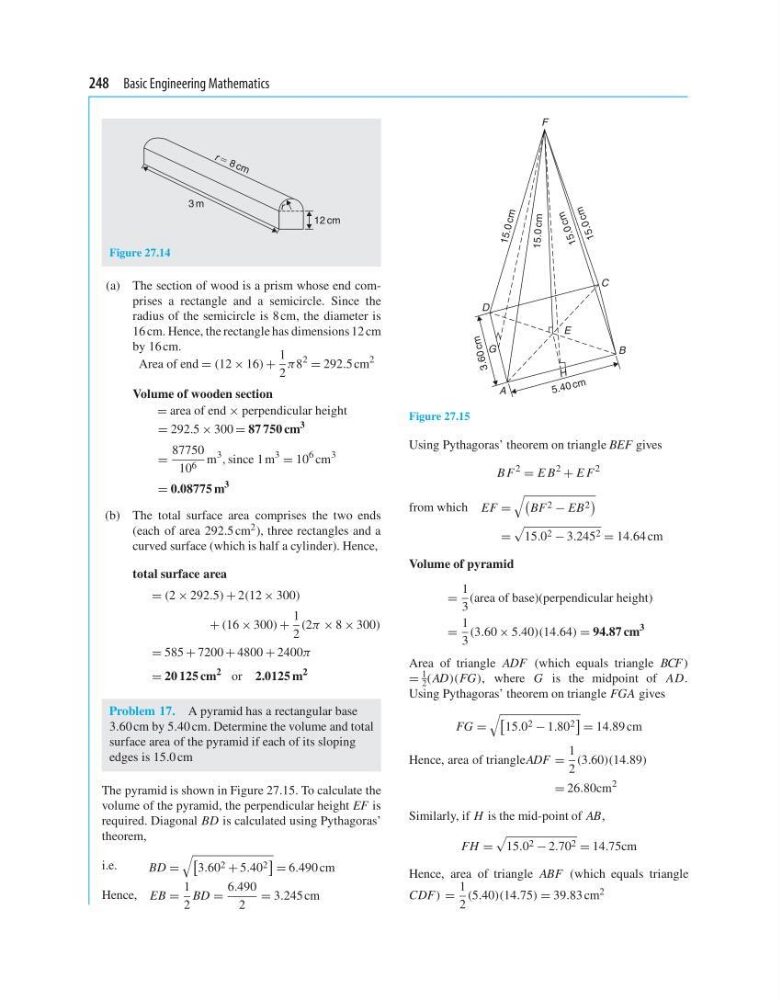
Figure 27.14
(a) The section of wood is a prism whose end comprises a rectangle and a semicircle. Since the
radius of the semicircle is 8 cm, the diameter is
16 cm. Hence, the rectangle has dimensions 12 cm
by 16 cm.
Area of end = (12 × 16) +
1
2
π8
2
= 292.5 cm
2
Volume of wooden section
= area of end × perpendicular height
= 292.5 × 300 = 87 750 cm
3
=
87750
10 6 m
3
, since 1 m
3
= 10
6 cm
3
= 0.08775 m
3
(b) The total surface area comprises the two ends
(each of area 292.5 cm 2 ), three rectangles and a
curved surface (which is half a cylinder). Hence,
total surface area
= (2 × 292.5) + 2(12 × 300)
+ (16 × 300) +
1
2
(2π × 8 × 300)
= 585 + 7200 + 4800 + 2400π
= 20 125 cm
2 or 2.0125 m
2
Problem 17. A pyramid has a rectangular base
3.60 cm by 5.40 cm. Determine the volume and total
surface area of the pyramid if each of its sloping
edges is 15.0 cm
The pyramid is shown in Figure 27.15. To calculate the
volume of the pyramid, the perpendicular height EF is
required. Diagonal BD is calculated using Pythagoras’
theorem,
i.e.
BD =
3.60 2 + 5.40 2
= 6.490 cm
Hence, EB =
1
2
BD =
6.490
2
= 3.245 cm
C
F
D
G
A
E
H
B
1
5
.0
c
m
1
5
.0
c
m
15.0 cm
1 5 .0 cm
5 .4 0 cm
3
.6
0
cm
Figure 27.15
Using Pythagoras’ theorem on triangle BEF gives
B F
2
= E B
2
+ E F
2
from which EF =
BF 2 − EB 2
=
15.0 2 − 3.245 2 = 14.64 cm
Volume of pyramid
=
1
3
(area of base)(perpendicular height)
=
1
3
(3.60 × 5.40)(14.64) = 94.87 cm
3
Area of triangle ADF (which equals triangle BCF)
=
1
2 (AD)(FG), where G is the midpoint of AD.
Using Pythagoras’ theorem on triangle FGA gives
FG =
15.0 2 − 1.80 2
= 14.89 cm
Hence, area of triangleADF =
1
2
(3.60)(14.89)
= 26.80cm
2
Similarly, if H is the mid-point of AB,
FH =
15.0 2 − 2.70 2 = 14.75cm
Hence, area of triangle ABF (which equals triangle
CDF) =
1
2
(5.40)(14.75) = 39.83 cm 2
3 m
r
r 5 8 c m
12 cm
Figure 27.14
(a) The section of wood is a prism whose end comprises a rectangle and a semicircle. Since the
radius of the semicircle is 8 cm, the diameter is
16 cm. Hence, the rectangle has dimensions 12 cm
by 16 cm.
Area of end = (12 × 16) +
1
2
π8
2
= 292.5 cm
2
Volume of wooden section
= area of end × perpendicular height
= 292.5 × 300 = 87 750 cm
3
=
87750
10 6 m
3
, since 1 m
3
= 10
6 cm
3
= 0.08775 m
3
(b) The total surface area comprises the two ends
(each of area 292.5 cm 2 ), three rectangles and a
curved surface (which is half a cylinder). Hence,
total surface area
= (2 × 292.5) + 2(12 × 300)
+ (16 × 300) +
1
2
(2π × 8 × 300)
= 585 + 7200 + 4800 + 2400π
= 20 125 cm
2 or 2.0125 m
2
Problem 17. A pyramid has a rectangular base
3.60 cm by 5.40 cm. Determine the volume and total
surface area of the pyramid if each of its sloping
edges is 15.0 cm
The pyramid is shown in Figure 27.15. To calculate the
volume of the pyramid, the perpendicular height EF is
required. Diagonal BD is calculated using Pythagoras’
theorem,
i.e.
BD =
3.60 2 + 5.40 2
= 6.490 cm
Hence, EB =
1
2
BD =
6.490
2
= 3.245 cm
C
F
D
G
A
E
H
B
1
5
.0
c
m
1
5
.0
c
m
15.0 cm
1 5 .0 cm
5 .4 0 cm
3
.6
0
cm
Figure 27.15
Using Pythagoras’ theorem on triangle BEF gives
B F
2
= E B
2
+ E F
2
from which EF =
BF 2 − EB 2
=
15.0 2 − 3.245 2 = 14.64 cm
Volume of pyramid
=
1
3
(area of base)(perpendicular height)
=
1
3
(3.60 × 5.40)(14.64) = 94.87 cm
3
Area of triangle ADF (which equals triangle BCF)
=
1
2 (AD)(FG), where G is the midpoint of AD.
Using Pythagoras’ theorem on triangle FGA gives
FG =
15.0 2 − 1.80 2
= 14.89 cm
Hence, area of triangleADF =
1
2
(3.60)(14.89)
= 26.80cm
2
Similarly, if H is the mid-point of AB,
FH =
15.0 2 − 2.70 2 = 14.75cm
Hence, area of triangle ABF (which equals triangle
CDF) =
1
2
(5.40)(14.75) = 39.83 cm 2