

Volumes of common solids 247
3. A sphere has a diameter of 6 cm. Determine
its volume and surface area.
4. If the volume of a sphere is 566 cm 3 , find its
radius.
5. A pyramid having a square base has a perpendicular height of 25 cm and a volume of
75 cm 3 . Determine, in centimetres, the length
of each side of the base.
6. A cone has a base diameter of 16 mm and a
perpendicular height of 40 mm. Find its volume correct to the nearest cubic millimetre.
7. Determine (a) the volume and (b) the surface
area of a sphere of radius 40 mm.
8. The volume of a sphere is 325 cm 3 . Determine its diameter.
9. Given the radius of the earth is 6380 km,
calculate, in engineering notation
(a) its surface area in km 2 .
(b) its volume in km 3 .
10. An ingot whose volume is 1.5 m 3 is to be
made into ball bearings whose radii are
8.0 cm. How many bearings will be produced
from the ingot, assuming 5% wastage?
27.3 Summary of volumes and surface
areas of common solids
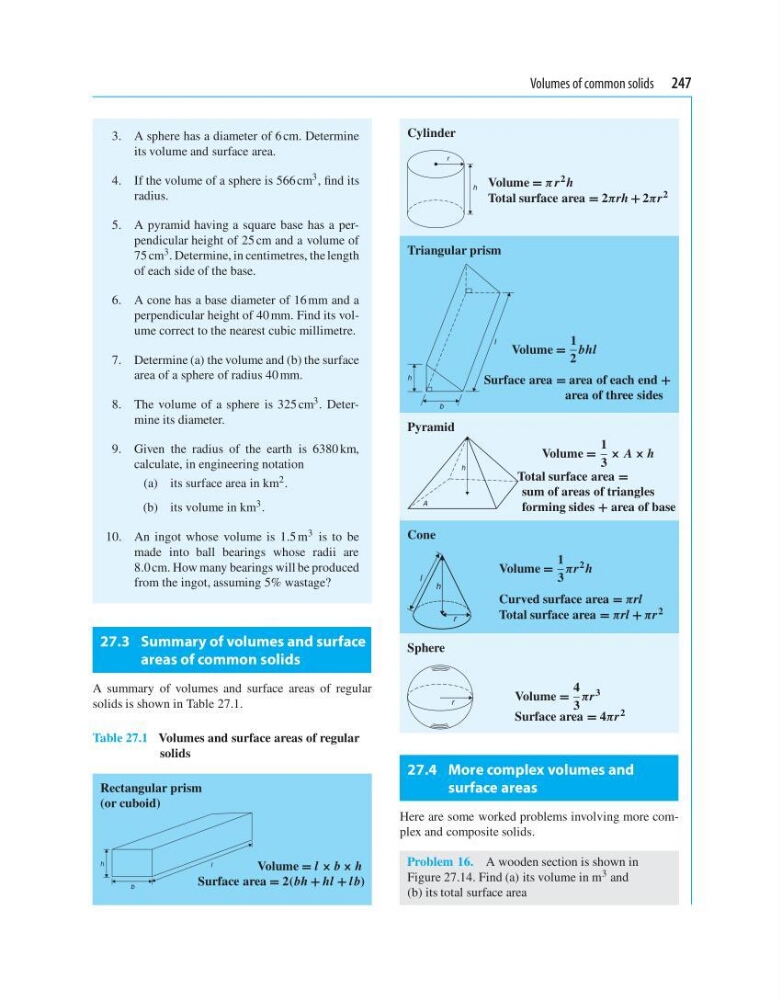
A summary of volumes and surface areas of regular
solids is shown in Table 27.1.
Table 27.1 Volumes and surface areas of regular
solids
Rectangular prism
(or cuboid)
h
b
l
Volume = l × b × h
Surface area = 2(bh + hl + lb)
Cylinder
h
r
Volume = πr 2 h
Total surface area = 2πrh + 2πr 2
Triangular prism
I
b
h
Volume =
1
2
bhl
Surface area = area of each end +
area of three sides
Pyramid
h
A
Volume =
1
3
× A × h
Total surface area =
sum of areas of triangles
forming sides + area of base
Cone
h
r
l
Volume =
1
3
πr 2 h
Curved surface area = πrl
Total surface area = πrl + πr 2
Sphere
r
Volume =
4
3
πr 3
Surface area = 4πr 2
27.4 More complex volumes and
surface areas
Here are some worked problems involving more complex and composite solids.
Problem 16. A wooden section is shown in
Figure 27.14. Find (a) its volume in m 3 and
(b) its total surface area
3. A sphere has a diameter of 6 cm. Determine
its volume and surface area.
4. If the volume of a sphere is 566 cm 3 , find its
radius.
5. A pyramid having a square base has a perpendicular height of 25 cm and a volume of
75 cm 3 . Determine, in centimetres, the length
of each side of the base.
6. A cone has a base diameter of 16 mm and a
perpendicular height of 40 mm. Find its volume correct to the nearest cubic millimetre.
7. Determine (a) the volume and (b) the surface
area of a sphere of radius 40 mm.
8. The volume of a sphere is 325 cm 3 . Determine its diameter.
9. Given the radius of the earth is 6380 km,
calculate, in engineering notation
(a) its surface area in km 2 .
(b) its volume in km 3 .
10. An ingot whose volume is 1.5 m 3 is to be
made into ball bearings whose radii are
8.0 cm. How many bearings will be produced
from the ingot, assuming 5% wastage?
27.3 Summary of volumes and surface
areas of common solids
A summary of volumes and surface areas of regular
solids is shown in Table 27.1.
Table 27.1 Volumes and surface areas of regular
solids
Rectangular prism
(or cuboid)
h
b
l
Volume = l × b × h
Surface area = 2(bh + hl + lb)
Cylinder
h
r
Volume = πr 2 h
Total surface area = 2πrh + 2πr 2
Triangular prism
I
b
h
Volume =
1
2
bhl
Surface area = area of each end +
area of three sides
Pyramid
h
A
Volume =
1
3
× A × h
Total surface area =
sum of areas of triangles
forming sides + area of base
Cone
h
r
l
Volume =
1
3
πr 2 h
Curved surface area = πrl
Total surface area = πrl + πr 2
Sphere
r
Volume =
4
3
πr 3
Surface area = 4πr 2
27.4 More complex volumes and
surface areas
Here are some worked problems involving more complex and composite solids.
Problem 16. A wooden section is shown in
Figure 27.14. Find (a) its volume in m 3 and
(b) its total surface area