

246 Basic Engineering Mathematics
Alternatively, from the question, r = 30 mm = 3 cm and
h = 80 mm = 8 cm. Hence,
volume =
1
3
πr
2 h =
1
3
× π × 3
2
× 8 = 75.40 cm
3
Problem 13. Determine the volume and total
surface area of a cone of radius 5 cm and
perpendicular height 12 cm
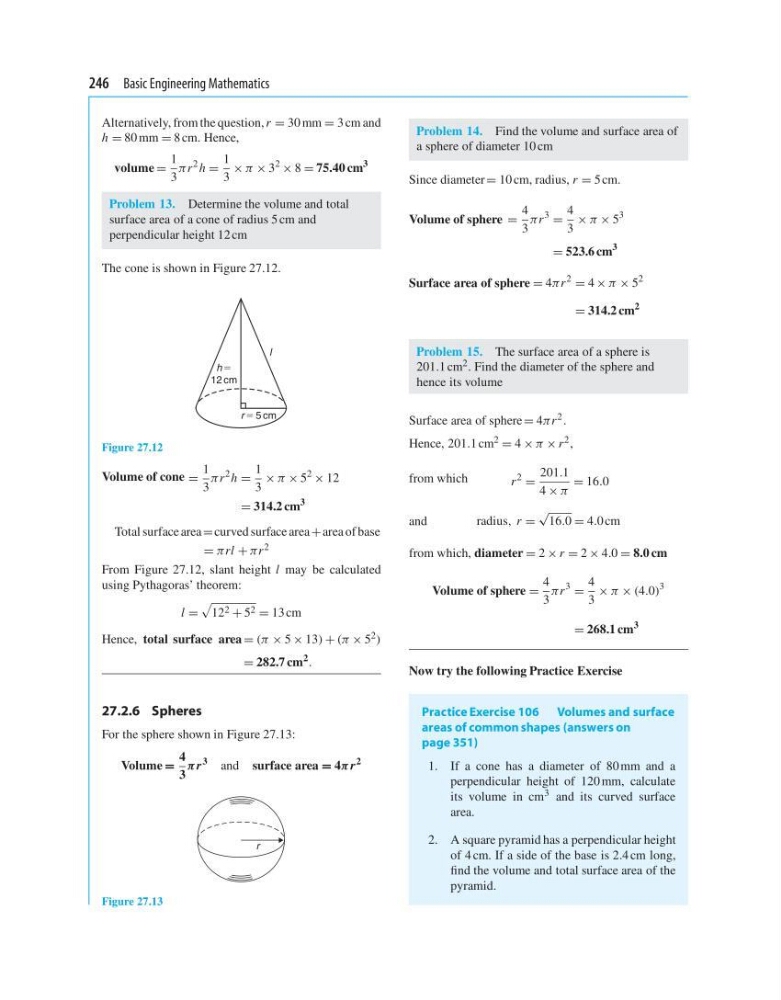
The cone is shown in Figure 27.12.
h ϭ
12 cm
r ϭ 5 cm
l
Figure 27.12
Volume of cone =
1
3
πr
2 h =
1
3
× π × 5
2
× 12
= 314.2 cm
3
Total surface area = curved surface area + area of base
= πrl + πr 2
From Figure 27.12, slant height l may be calculated
using Pythagoras’ theorem:
l =
12 2 + 5 2 = 13 cm
Hence, total surface area = (π × 5 × 13) + (π × 5 2 )
= 282.7 cm
2 .
27.2.6 Spheres
For the sphere shown in Figure 27.13:
Volume =
4
3
πr
3 and surface area = 4πr
2
r
Figure 27.13
Problem 14. Find the volume and surface area of
a sphere of diameter 10 cm
Since diameter = 10 cm, radius, r = 5 cm.
Volume of sphere =
4
3
πr
3
=
4
3
× π × 5
3
= 523.6 cm
3
Surface area of sphere = 4πr
2
= 4 × π × 5
2
= 314.2 cm
2
Problem 15. The surface area of a sphere is
201.1 cm 2 . Find the diameter of the sphere and
hence its volume
Surface area of sphere = 4πr 2 .
Hence, 201.1 cm 2 = 4 × π × r 2 ,
from which
r
2
=
201.1
4 × π
= 16.0
and
radius, r =
√
16.0 = 4.0 cm
from which, diameter = 2 × r = 2 × 4.0 = 8.0 cm
Volume of sphere =
4
3
πr
3
=
4
3
× π × (4.0)
3
= 268.1 cm
3
Now try the following Practice Exercise
Practice Exercise 106 Volumes and surface
areas of common shapes (answers on
page 351)
1. If a cone has a diameter of 80 mm and a
perpendicular height of 120 mm, calculate
its volume in cm 3 and its curved surface
area.
2. A square pyramid has a perpendicular height
of 4 cm. If a side of the base is 2.4 cm long,
find the volume and total surface area of the
pyramid.
Alternatively, from the question, r = 30 mm = 3 cm and
h = 80 mm = 8 cm. Hence,
volume =
1
3
πr
2 h =
1
3
× π × 3
2
× 8 = 75.40 cm
3
Problem 13. Determine the volume and total
surface area of a cone of radius 5 cm and
perpendicular height 12 cm
The cone is shown in Figure 27.12.
h ϭ
12 cm
r ϭ 5 cm
l
Figure 27.12
Volume of cone =
1
3
πr
2 h =
1
3
× π × 5
2
× 12
= 314.2 cm
3
Total surface area = curved surface area + area of base
= πrl + πr 2
From Figure 27.12, slant height l may be calculated
using Pythagoras’ theorem:
l =
12 2 + 5 2 = 13 cm
Hence, total surface area = (π × 5 × 13) + (π × 5 2 )
= 282.7 cm
2 .
27.2.6 Spheres
For the sphere shown in Figure 27.13:
Volume =
4
3
πr
3 and surface area = 4πr
2
r
Figure 27.13
Problem 14. Find the volume and surface area of
a sphere of diameter 10 cm
Since diameter = 10 cm, radius, r = 5 cm.
Volume of sphere =
4
3
πr
3
=
4
3
× π × 5
3
= 523.6 cm
3
Surface area of sphere = 4πr
2
= 4 × π × 5
2
= 314.2 cm
2
Problem 15. The surface area of a sphere is
201.1 cm 2 . Find the diameter of the sphere and
hence its volume
Surface area of sphere = 4πr 2 .
Hence, 201.1 cm 2 = 4 × π × r 2 ,
from which
r
2
=
201.1
4 × π
= 16.0
and
radius, r =
√
16.0 = 4.0 cm
from which, diameter = 2 × r = 2 × 4.0 = 8.0 cm
Volume of sphere =
4
3
πr
3
=
4
3
× π × (4.0)
3
= 268.1 cm
3
Now try the following Practice Exercise
Practice Exercise 106 Volumes and surface
areas of common shapes (answers on
page 351)
1. If a cone has a diameter of 80 mm and a
perpendicular height of 120 mm, calculate
its volume in cm 3 and its curved surface
area.
2. A square pyramid has a perpendicular height
of 4 cm. If a side of the base is 2.4 cm long,
find the volume and total surface area of the
pyramid.