

Volumes of common solids 245
5 cm
5 cm
D
C
E
A
B
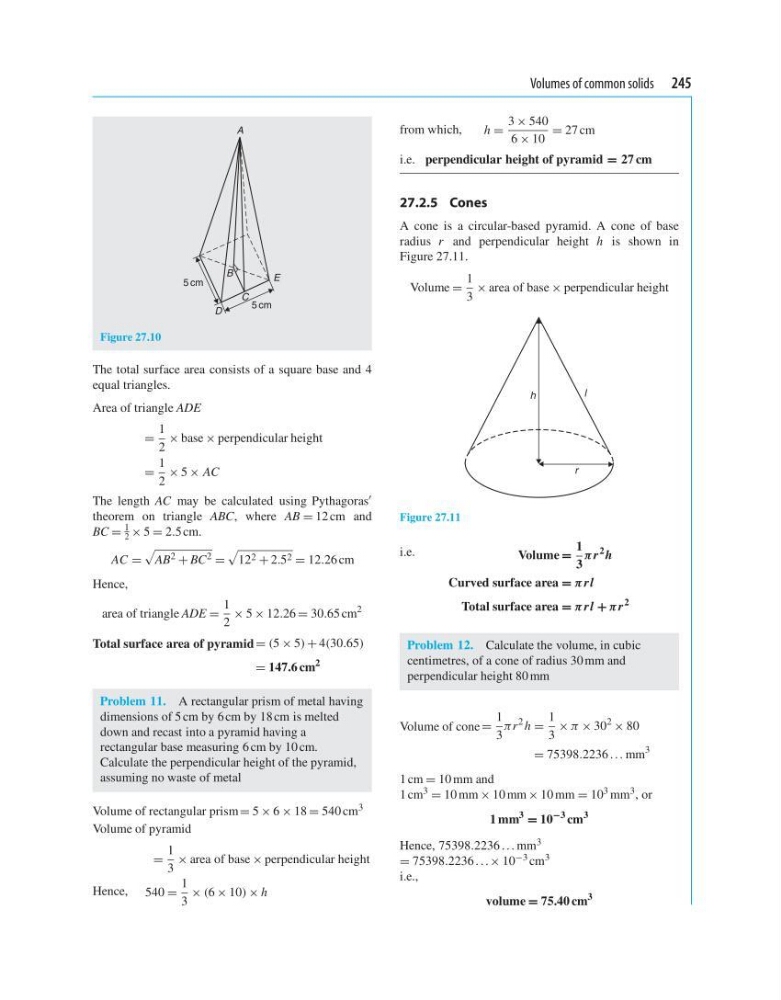
Figure 27.10
The total surface area consists of a square base and 4
equal triangles.
Area of triangle ADE
=
1
2
× base × perpendicular height
=
1
2
× 5 × AC
The length AC may be calculated using Pythagoras
theorem on triangle ABC, where AB = 12 cm and
BC =
1
2 × 5 = 2.5 cm.
AC =
AB 2 + BC 2 =
12 2 + 2.5 2 = 12.26 cm
Hence,
area of triangle ADE =
1
2
× 5 × 12.26 = 30.65 cm
2
Total surface area of pyramid = (5 × 5) + 4(30.65)
= 147.6 cm
2
Problem 11. A rectangular prism of metal having
dimensions of 5 cm by 6 cm by 18 cm is melted
down and recast into a pyramid having a
rectangular base measuring 6 cm by 10 cm.
Calculate the perpendicular height of the pyramid,
assuming no waste of metal
Volume of rectangular prism = 5 × 6 × 18 = 540 cm 3
Volume of pyramid
=
1
3
× area of base × perpendicular height
Hence, 540 =
1
3
× (6 × 10) × h
from which,
h =
3 × 540
6 × 10
= 27 cm
i.e. perpendicular height of pyramid = 27 cm
27.2.5 Cones
A cone is a circular-based pyramid. A cone of base
radius r and perpendicular height h is shown in
Figure 27.11.
Volume =
1
3
× area of base × perpendicular height
h
r
l
Figure 27.11
i.e.
Volume =
1
3
πr
2 h
Curved surface area = πrl
Total surface area = πrl + πr
2
Problem 12. Calculate the volume, in cubic
centimetres, of a cone of radius 30 mm and
perpendicular height 80 mm
Volume of cone =
1
3
πr
2 h =
1
3
× π × 30
2
× 80
= 75398.2236 ... mm
3
1 cm = 10 mm and
1 cm 3 = 10 mm × 10 mm × 10 mm = 10 3 mm 3 , or
1 mm
3
= 10
−3 cm
3
Hence, 75398.2236 ... mm 3
= 75398.2236 ...× 10 −3 cm 3
i.e.,
volume = 75.40 cm
3
5 cm
5 cm
D
C
E
A
B
Figure 27.10
The total surface area consists of a square base and 4
equal triangles.
Area of triangle ADE
=
1
2
× base × perpendicular height
=
1
2
× 5 × AC
The length AC may be calculated using Pythagoras
theorem on triangle ABC, where AB = 12 cm and
BC =
1
2 × 5 = 2.5 cm.
AC =
AB 2 + BC 2 =
12 2 + 2.5 2 = 12.26 cm
Hence,
area of triangle ADE =
1
2
× 5 × 12.26 = 30.65 cm
2
Total surface area of pyramid = (5 × 5) + 4(30.65)
= 147.6 cm
2
Problem 11. A rectangular prism of metal having
dimensions of 5 cm by 6 cm by 18 cm is melted
down and recast into a pyramid having a
rectangular base measuring 6 cm by 10 cm.
Calculate the perpendicular height of the pyramid,
assuming no waste of metal
Volume of rectangular prism = 5 × 6 × 18 = 540 cm 3
Volume of pyramid
=
1
3
× area of base × perpendicular height
Hence, 540 =
1
3
× (6 × 10) × h
from which,
h =
3 × 540
6 × 10
= 27 cm
i.e. perpendicular height of pyramid = 27 cm
27.2.5 Cones
A cone is a circular-based pyramid. A cone of base
radius r and perpendicular height h is shown in
Figure 27.11.
Volume =
1
3
× area of base × perpendicular height
h
r
l
Figure 27.11
i.e.
Volume =
1
3
πr
2 h
Curved surface area = πrl
Total surface area = πrl + πr
2
Problem 12. Calculate the volume, in cubic
centimetres, of a cone of radius 30 mm and
perpendicular height 80 mm
Volume of cone =
1
3
πr
2 h =
1
3
× π × 30
2
× 80
= 75398.2236 ... mm
3
1 cm = 10 mm and
1 cm 3 = 10 mm × 10 mm × 10 mm = 10 3 mm 3 , or
1 mm
3
= 10
−3 cm
3
Hence, 75398.2236 ... mm 3
= 75398.2236 ...× 10 −3 cm 3
i.e.,
volume = 75.40 cm
3